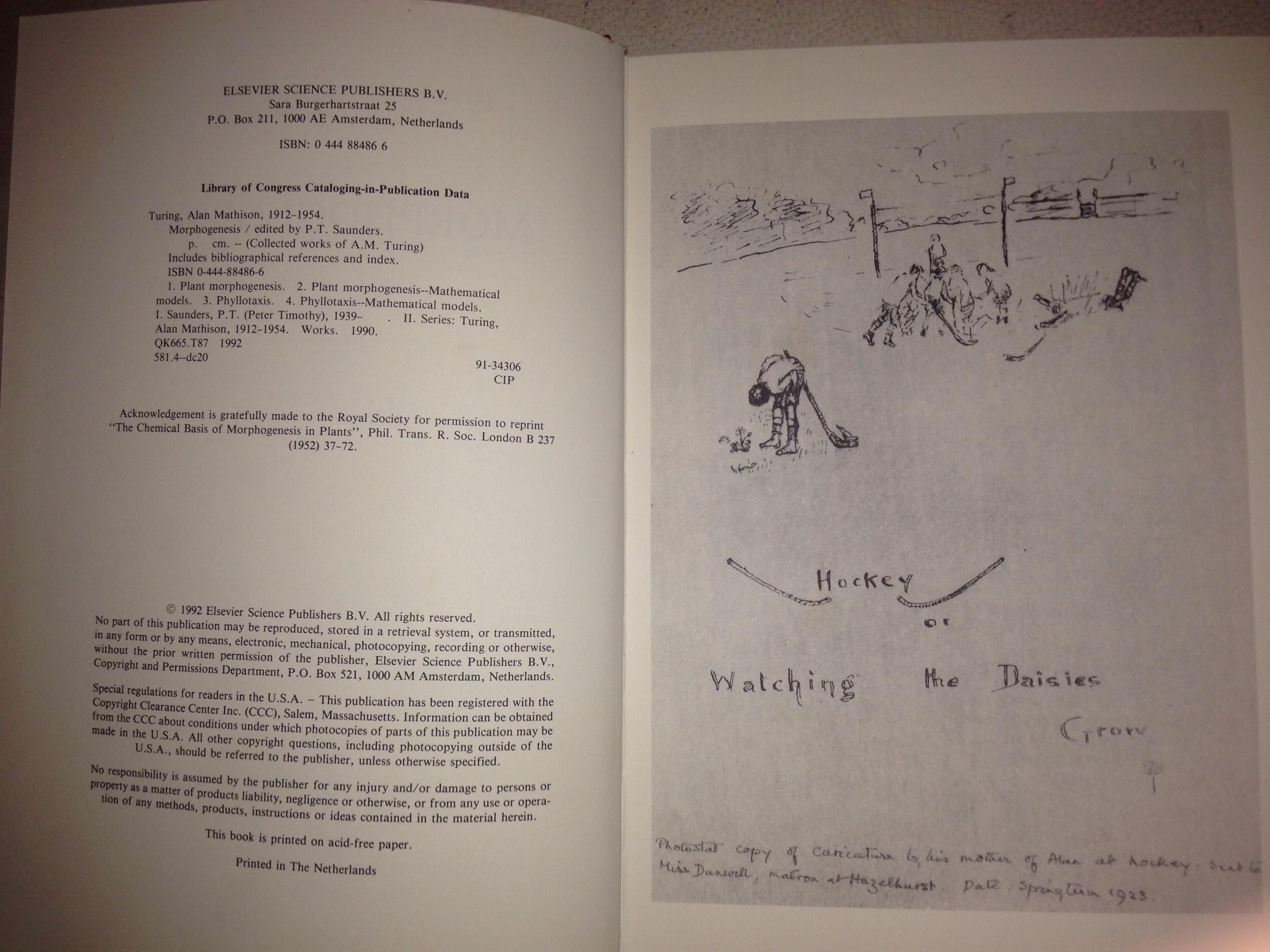
| I typed in the preface to my copy of Morphogenesis (which describes what we now call cellular automata and reaction-diffusion systems), and I also scanned the drawing by Alan Turing's mother inside the front cover, showing her son watching the daisies grow in the Springtime of 1923. Hockey or Watching the Daisies Grow: https://donhopkins.com/home/AlanTuringHockeyOrWatchingTheDai... Collected Works of A.M. Turing: Morphogenesis: P.T. Saunders, Editor: https://donhopkins.com/home/archive/Turing/Morphogenesis.txt >Preface >It is not in dispute that A.M. Turing was one of the leading figures in
twentieth-century science. The fact would have been known to the general
public sooner but for the Official Secrets Act, which prevented discussion
of his wartime work. At all events it is now widely known that he was, to
the extent that any single person can claim to have been so, the inventor of
the "computer". Indeed, with the aid of Andrew Hodges's excellent biography,
A.M. Turing: the Enigma, even non-mathematicians like myself have some idea
of how his idea of a "universal machine": arose - as a sort of byproduct of
a paper answering Hilbert's "Entscheidungsproblem". However, his work in
pure mathematics and mathematical logic extended considerably further; and
the work of his last years, on morphogenesis in plants, is, so one
understands, also of the greatest originality and of permanent importance. [...] >Preface to This Volume >It may seem surprising that this collection of Alan Turing's work includes a
whole volume devoted to biology, a subject in which he published only one
paper. Biology was, however, far more important to Turing than is generally
recognized. He has been interested in the subject right from his school
days, and he has read, and been much impressed by, the book that has had
such a strong influence on many theoretical biologists over the years,
D'Arcy Thompson's (1917) classic "On Growth and Form". He was also, like so
many who work in biology, attracted by the sheer beauty of organisms. He
wrote his (1952) paper not as a mathematical exercise, but because he saw
the origin of biological form as one of the fundamental problems in science.
And at the time of his death he was still working in biology, applying the
theory he had derived to particular examples. >I found reading the archive material a fascinating experience. For while at
first glance Turing's work on biology appears quite different from his other
writings, it actually exhibits the features typical of all his work: his
ability to identify a crucial problem in a field, his comparative lack of
interest in what others were doing, his selection of an appropriate
mathematical approach, and the great skill and evident ease with which he
handled a wide range of mathematical techniques. [...] >Introduction >Turing's work in biology illustrated just as clearly as his other work his
ability to identify a fundamental problem and to approach it in a highly
original way, drawing remarkably little from what others had done. He chose
to work on the problem of form at a time when the majority of biologists
were primarily interested in other questions. There are very few references
in these papers, and most of them are for confirmation of details rather
than for ideas which he was following up. In biology, as in almost
everything else he did within science -- or out of it -- Turing was not
content to accept a framework set up by others. >Even the fact that the mathematics in these papers is different from what he
used in his other work is significant. For while it is not uncommon for a
newcomer to make an important contribution to a subject, this is usually
because he brings to it techniques and ideas which he has been using in his
previous field but which are not known in the new one. Now much of Turing's
career up to this point had been concerned with computers, from the
hypothetical Turing machine to the real life Colossus, and this might have
been expected to have led him to see the development of an organism from egg
to adult as being programmed in the genes and to set out to study the
structure of the programs. This would also have been in the spirit of the
times, because the combining of Darwinian natural selection and Mendelian
genetics into the synthetic theory of evolution had only been completed
about ten years earlier, and it was in the very next year that Crick and
Watson discovered the structure of DNA. Alternatively, Turing's experience
in computing might have suggested to him something like what are now called
cellular automata, models in which the fate of a cell is determined by the
states of its neighbours through some simple algorithm, in a way that is
very reminiscent of the Turing machine. >For Turing, however, the fundamental problem of biology had always been to
account for pattern and form, and the dramatic progress that was being made
at that time in genetics did not alter his view. And because he believed
that the solution was to be found in physics and chemistry it was to these
subjects and the sort of mathematics that could be applied to them that he
turned. In my view, he was right, but even someone who disagrees must be
impressed by the way in which he went directly to what he saw as the most
important problem and set out to attack it with the tools that he judged
appropriate to the task, rather than those which were easiest to hand or
which others were already using. What is more, he understood the full
significance of the problem in a way that many biologists did not and still
do not. We can see this in the joint manuscript with Wardlaw which is
included in this volume, but it is clear just from the comment he made to
Robin Gandy (Hodges 1983, p. 431) that his new ideas were "intended to
defeat the argument from design". >This single remark sums up one of the most crucial issues in contemporary
biology. The argument from design was originally put forward as a scientific
proof of the existence of God. The best known statement of it is William
Paley's (1802) famous metaphor of a watchmaker. If we see a stone on some
waste ground we do not wonder about it. If, on the other hand, we were to
find a watch, with all its many parts combining so beautifully to achieve
its purpose of keeping accurate time, we would be bound to infer that it had
been designed and constructed by an intelligent being. Similarly, so the
argument runs, when we look at an organism, and above all at a human being,
how can we not believe that there must be an intelligent Creator? >Turing was not, of course, trying to refute Paley; that has been done almost
a century earlier by Charles Darwin. But the argument from design had
survived, and was, and indeed remains, still a potent force in biology. For
the essence of Darwin's theory is that organisms are created by natural
selection out of random variations. Almost any small variation can occur;
whether it persists and so features in evolution depends on whether it is
selected. Consequently we explain how a certain feature has evolved by
saying what advantage it gives to the organism, i.e. what purpose it serves,
just as if we were explaining why the Creator has designed the organism in
that way. Natural selection thus takes over the role of the Creator, and
becomes "The Blind Watchmaker" (Dawkins 1986). >Not all biologists, however, have accepted this view. One of the strongest
dissenters was D'Arcy Thompson (1917), who insisted that biological form is
to be explained chiefly in the same way as inorganic form, i.e., as the
result of physical and chemical processes. The primary task of the biologist
is to discover the set of forms that are likely to appear. Only then is it
worth asking which of them will be selected. Turing, who had been very much
influenced by D'Arcy Thompson, set out to put the program into practice.
Instead of asking why a certain arrangement of leaves is especially
advantageous to a plant, he tried to show that it was a natural consequence
of the process by which the leaves are produced. He did not in fact achieve
his immediate aim, and indeed more than thirty-five years later the problem
of phyllotaxis has still not been solved. On the other hand, the
reaction-diffusion model has been applied to many other problems of pattern
and form and Turing structures (as they are now called) have been observed
experimentally (Castets at al. 1990), so Turing's idea had been vindicated. [...] Turing, Alan Mathison, 1912-1954. Morphogenesis / edited by P. T. Saunders. p. cm. -- (Collected works of A. M. Turing, Volume 3). Includes bibliographical references and index. ISBN 0 444 88486 6. 1. Plant morphogenesis. 2. Plant morphogenesis -- Mathematical models. 3. Phyllotaxis. 4. Phyllotaxis -- Mathematical models. (C) 1992 Elsevier Science Publishers B. V. All Rights Reserved. https://books.google.nl/books?id=GX7NCgAAQBAJ&pg=PR8&lpg=PR8 Watching the daisies grow: Turing and Biology: https://web.archive.org/web/20180901055917/http://tokillamac... >There’s a sketch drawn by Turing’s mother while he was still a child, showing a hockey game at school. The boys in the background are playing hockey, and Turing in the foreground is not playing, instead he’s leaning over to inspect a daisy growing in the field. The title of the sketch is “Hockey or watching the daisies grow”. >Turing continued this interest in biology into his adult life. In 1952 Turing wrote what became his most cited paper “The Chemical Basis of Morphogenesis”. This work looked at the question of how structure in nature comes about. How do we start from single cells and end up with complex patterns and shapes? For example, the black and white patterning on a cow, the patterns on a sea shell, the dappling on a fish. >He came up with the idea of having two interacting chemicals, which he called “morphogens”. These would diffuse through a space, and inhibit or promote each other as they met. He modelled this system with two equations, showing how the amount of chemicals would vary over time across the space. He demonstrated that his model could provide convincingly life-like patterns, and suggested that this might be how nature does it. Not only that but he programmed his computer to help him to calculate the results of the equations for certain cases. [...] Turing pattern: https://en.wikipedia.org/wiki/Turing_pattern >The Turing pattern is a concept introduced by English mathematician Alan Turing in a 1952 paper titled "The Chemical Basis of Morphogenesis" which describes how patterns in nature, such as stripes and spots, can arise naturally and autonomously from a homogeneous, uniform state. In his classic paper, Turing examined the behaviour of a system in which two diffusible substances interact with each other, and found that such a system is able to generate a spatially periodic pattern even from a random or almost uniform initial condition. Turing hypothesized that the resulting wavelike patterns are the chemical basis of morphogenesis. >Turing patterning is often found in combination with other patterns: vertebrate limb development is one of the many phenotypes exhibiting Turing patterning overlapped with a complementary pattern (in this case a French flag model). Reaction–diffusion system: https://en.wikipedia.org/wiki/Reaction%E2%80%93diffusion_sys... >Reaction–diffusion systems are mathematical models which correspond to several physical phenomena. The most common is the change in space and time of the concentration of one or more chemical substances: local chemical reactions in which the substances are transformed into each other, and diffusion which causes the substances to spread out over a surface in space. >Reaction–diffusion systems are naturally applied in chemistry. However, the system can also describe dynamical processes of non-chemical nature. Examples are found in biology, geology and physics (neutron diffusion theory) and ecology. Mathematically, reaction–diffusion systems take the form of semi-linear parabolic partial differential equations. They can be represented in the general form: >[Impressive Gratuitous Partial Differential Equation [1] goes here] >where q(x, t) represents the unknown vector function, D is a diagonal matrix of diffusion coefficients, and R accounts for all local reactions. The solutions of reaction–diffusion equations display a wide range of behaviours, including the formation of travelling waves and wave-like phenomena as well as other self-organized patterns like stripes, hexagons or more intricate structure like dissipative solitons. Such patterns have been dubbed "Turing patterns". Each function, for which a reaction diffusion differential equation holds, represents in fact a concentration variable. Another important historic but underrated paper: [1] Ray Tracing JELL-O Brand Gelatin; Paul S. Heckbert, Dessert Foods Division, Pixar; Communications of the ACM, Feb 1, 1988: https://www.thefreelibrary.com/Ray+tracing+JELL-O+brand+gela... >JELL-O DYNAMICS: "Previous researchers have observed that, under certain conditions, Jell-O wiggles. We have been able to simulate these unique and complex Jell-O dynamics using spatial deformations and other hairy mathematics. From previous research with rendering systems, we have learned that a good dose of Gratuitous Partial Differential Equations is needed to meet the paper quota for Impressive Formulas." >[Lots of impressive sounding detailed hairy mathematical technobabble redacted. To eloquently summarize:] >The "begetted" eightness as the system-limit number of the nuclear uniqueness of self-regenerative symmetrical growth may well account for the fundamental octave of unique interpermutative integer effects identified as plus one, plus two, plus three, plus four, as the interpermuted effects of the integers one, two, three, and four, respectively; and as minus four, minus three, minus two, minus one, characterizing the integers five, six, seven, and eight, respectively. >In other words, to a first approximation: >J = 0 [...] |