Hacker News new | ask | show | jobs
by kkfx 1568 days ago
Having a east-west roof and a large south area my panels are on ground, facing south, I'm connected to the grid and have no plan not to, but my point is that in mere kWh/month in most month I can say I produce more than I consume, witch is numerically true and practically false since I produce few hours a day much more than my needs and I still have to cover the rest.

My point is at national level: how can a nation imaging energy independence with f.v. and eolic. IMVHO that's simply an illusion. Some say "coupled to the nuclear", but since the network need to be always powered and nuclear better produce at a steady constant peace f.v. et al can just be local small-scale backups.

Something else? Well, maybe a country like Norway can with wind+hydro satisfy it's needs, but most countries can't, or essentially: I see nothing that can really work on scale beside a hypothetical global superconductive grid, or nuclear fusion etc witch actually are more dream with something behind then tangible things. Personally I can even recharge an e.v. since I do normally not need much car usage except for holidays/weekends etc, but if I need medical assistance I do not want to accept "we have drained battery, sorry" or at the hospital "we can't make surgery due to lack of energy today" and similarly when shopping for cheese I expect to find it, not to need more tentatives to buy it until I fond etc. Such "lux" witch are actually normal life in the western world I can see how can exists with the Green New Deal, simply.

I know oil&gas are finite resources, I know pollution is bad, but still fail to se a real solution that can scale behind mass genocides, middle-age revivals etc...

1 comments

This gets really complicated if you want to understand solar at scale going forward.

First European countries don’t operate reliable and independent electric grids, it’s always been more cost effective to average our demand across huge areas. At the same time, at an organizational and technical level it’s useful to split the grid into multiple different chunks that all connect with each other to various degrees. Even the US shares it’s electric grid with Canada while connecting to the Mexican grid. https://en.wikipedia.org/wiki/Eastern_Interconnection A country may hit say 99% reliably on it’s own but 99.9X% when part of a larger grid.

Next reaching 99.9+% reliability requires significant redundancy no matter the scale. Normally you subsidize some percentage of generation so it’s there when you need it rather than trying to depend on second by second spot prices to handle extreme outlier events.

In that context solar is really vastly more reliable with a little extra capacity and a great deal of geographic separation between generation. Many US examples have 30+% capacity factors which is ~90% of their theoretical maximums ~(1/pi), but importing power east/west time shifts generation. Similarly aiming panels east or west trades off total generation to get more power either earlier or later.

All of the above doesn’t help at 2AM, but it still means your personal experience with solar doesn’t map very well to grid scale generation. California for example already sees 5% of all solar power being wasted, but because power is more valuable in the morning and evening than in the middle of the day that excess isn’t a big deal.

Sure, if you can use 100% of PV output then solar costs ~2c/kWh in a good location, but that number is largely irrelevant as you notice. The question is how much excess capacity do you add. If you can only use 50% of the output your paying 4c/kWh which is roughly the cost of just the natural gas needed to operate a natural gas power plant averaged over multiple years. Put another way if you own a natural gas power plant you currently save money installing PV simply to offset the cost of natural gas though that’s likely to change as PV gets more ubiquitous.

The question then becomes if you can meet say 60% of total monthly demand with solar but doing so means you have a lot of excess capacity should you then install batteries to cover some of the rest with batteries? Looking at how prices spike at some times of the day the answer seems to be yes, it’s only a niche but it’s still viable today. Which then brings the question of do you eventually build solar simply to charge batteries? We aren’t there yet, but with the way battery prices have been dropping that’s going to happen. (And when it does most other forms of generation get serious competition.)

Of course solar + batteries doesn’t operate in a vacuum. Hydroelectric generation is ~7% of total electricity generation in most areas, but while it basically provides a fixed amount of Wh per month it has a great deal of flexibility when within the month to generate power. This combined with weather forecasting caps how much battery power you want to set aside for unusual days as it’s cheaper to store energy in existing dams and tap that when needed. Hydro in in many ways the inverse of PV.

Similarly wind is it’s own thing and complements solar + batteries quite well.

Now Nuclear seems like a good fit on the surface but costs go up as capacity factor drops. In this model it’s really competing with Hydro and at vastly higher prices because most of the time it’s output is worth very little. Japan might subsidize nuclear because it’s grid is operating individually and so has more expensive and less reliable solar power. Similarly, it might be heavily subsidized for political reasons in some counties, but in general it’s unlikely to make up a large fraction of total generation long term.

Hum, perhaps I was a bit unclear: I think anyone, at any actual realistic scale, can't live with p.v. and eolic. The Sun shine around the globe, of course, so IF we have an hypothetical global superconductive network we can get "constant enough" p.v. and with the same network distribute eolic power around the world, but the if condition is not met: we do not have air-temperature superconductivity at scale nor such a giant global network.

Deploy p.v. at grid scale, not counting the cost, probably means covering the need of many countries in the world during a certain amount of hours/day, that's ok, I'm not really sure how much can scale even in theory but probably it can, however we have 24/7/365 activities that must never stop from hospitals to military passing through countless of enterprises, services etc and we can't power them from lithium storage... So regardless of the economical meaning we can't live on renewable IMVHO...

That's the biggest point: we still have nuclear, it's not really renewable so far, we do not have fusion, but some say we still can run much more nuclear than today before running out of uranium. There is the radioactive wastes issue, still unsolved, but apparently it's manageable and except in case of accidents there is essentially no pollution. Here came my point: nuclear work best at a constant peace witch means that to have energy in the night we still have energy in the day, at that's point why investing in p.v. etc? Just to diversify seems a bit expensive done at a grid scale...

A possible explanation is: yes, we can develop enough nuclear to supply energy for critical usage, but not much more, so we still need other sources, in that case p.v. and eolic might be an interesting option, that's seems convinced IF we can recycle batteries at minimum at 95% or so, witch means we can run a society on trains (electric) and e.v. limiting oil usage to things we do not know how to do otherwise. But again this might came, but so far is not there, so far pushing e.v. seems to be suicidal: we buy vehicles that last 5-8 years, have essentially zero resale value and we do not even know if we will recycle them or not nor if we can built enough batteries for anyone...

So New Urban Agenda? Most people stuck in modern concentration camps named prisons pardon, smart cities, to consume less and just few, rich enough to afford that new old lifestyle, outside benefiting from the hard work of those who live to work in prisons^Wcities? How can possibly a society like that can stay alive? Even if the élite-people separation works and people remain calm and productive, there is no much freedom to develop intelligence, to evolve, we have had élite-people separated society in the past, works for the élite for a certain period of time, but does not really scale. A certain degree of separation is a thing, the Great Reset level of separation is simply unsustainable in the medium run, not counting the long one.

IMHVO the real problem is that modern tech demand an extremely big quantity of people just to exists, and that's means and extremely big quantity of resources. The sole way to make it more efficient (less resource intensive) is erase the economic competition and doing so in the "new deal" way means creating a dictatorship that can't work, like Chinese one that works just because it exists in a context, not alone in the world.

Ignoring the rest of your comment you don’t need a superconducting network to move power around the globe. China just built a 3,300km 1,100KV DC line to move 12GW east or west with less than 10% losses. You can play with the geometry but no city on the earth is more than ~7,000km from sunlight, which would mean at most ~20% losses ignoring the ocean.

However, that’s incredibly wasteful vs building local battery storage. Especially by the time we need it, globally only 3% of electricity is from solar it’s going to be 20+ years before storage is an issue and batteries are already being built for large scale grid storage.

You can play with adoption curves but approximately 3.5 million more EV’s where built in 2021 than 2020. That took an incredible investment in battery factories and the trend is only going in one direction.

So far, from EV "data" (between " because I've read of them, not having them nor being able to really know how trustable they are) modern LiIon (i.e. LiFePo batteries) last 5 year of intense usage, 8 if the usage is less intense. And so far we are unable to recycle lithium batteries (while we almost entirely recycle classic plomb ones), productive capacity from raw materials yet unknown so we actually do not even know if we can build batteries for all on scale and for how many years since lithium itself is not so rare, but not so abundant.

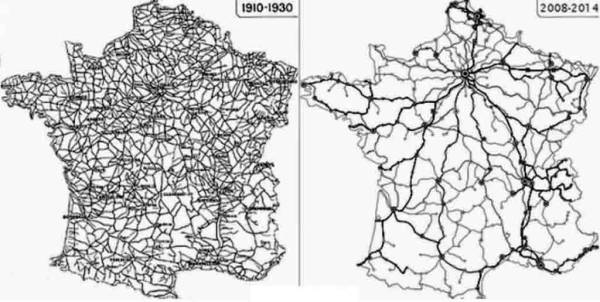
Beside that my home can run on battery, my car probably can for most of it's usage (i.e. not counting long range trips) but trucks can't, yes we can build a classic EU 18m+ truck on batteries, only it halve it's load capacity and almost double the route time. We can push railroads of course, in the past in EU there were far more railroads than now (just http://carfree.fr/img/2015/06/sncf.jpg as an example) but that demand energy, in quantity.

IMVHO choosing nuclear for "industry and critical appliance" is mandatory, but in that case there is little interest for large renewable deploy, I do not see any other option: you can't run a solar panel factory on solar just as an example: it demand too much energy. You can't run an aluminum foundry on solar, you can't produce/recycle much glass on solar etc.

About EV adoption: yes they grow, following the high price of oil and the growth of domestic p.v. personally if I decide to buy an EV in most cases I can power it for free, unfortunately such EV is absurdly expensive and have exactly zero resale value so compared to classic ICE vehicle is an extremely overpriced crap... Of course if the trend will continue, since I need a car I'll have no other logical choices but that's far from being really convenient nor environmental friendly nor sustainable.

EV’s have high resale values. 2017 Model 3 long range with 55k miles is selling for 40k. https://www.carfax.com/vehicle/5YJ3E1EA3HF001873

We don’t have a lot of data on really old EV’s but 10 year old model S’s are retaining around 40% of their initial prices which is really good for such expensive cars.

Some of that’s the limited stock of used cars right now, but it’s really inexpensive cars that are seeing the largest bump more expensive cars are closer to normal prices.

As to battery degradation, that varies wildly with chemistry your cellphone doesn’t use the same battery technology as an EV.