|
|
|
|
|
|
by stouset
1619 days ago
|
|
|
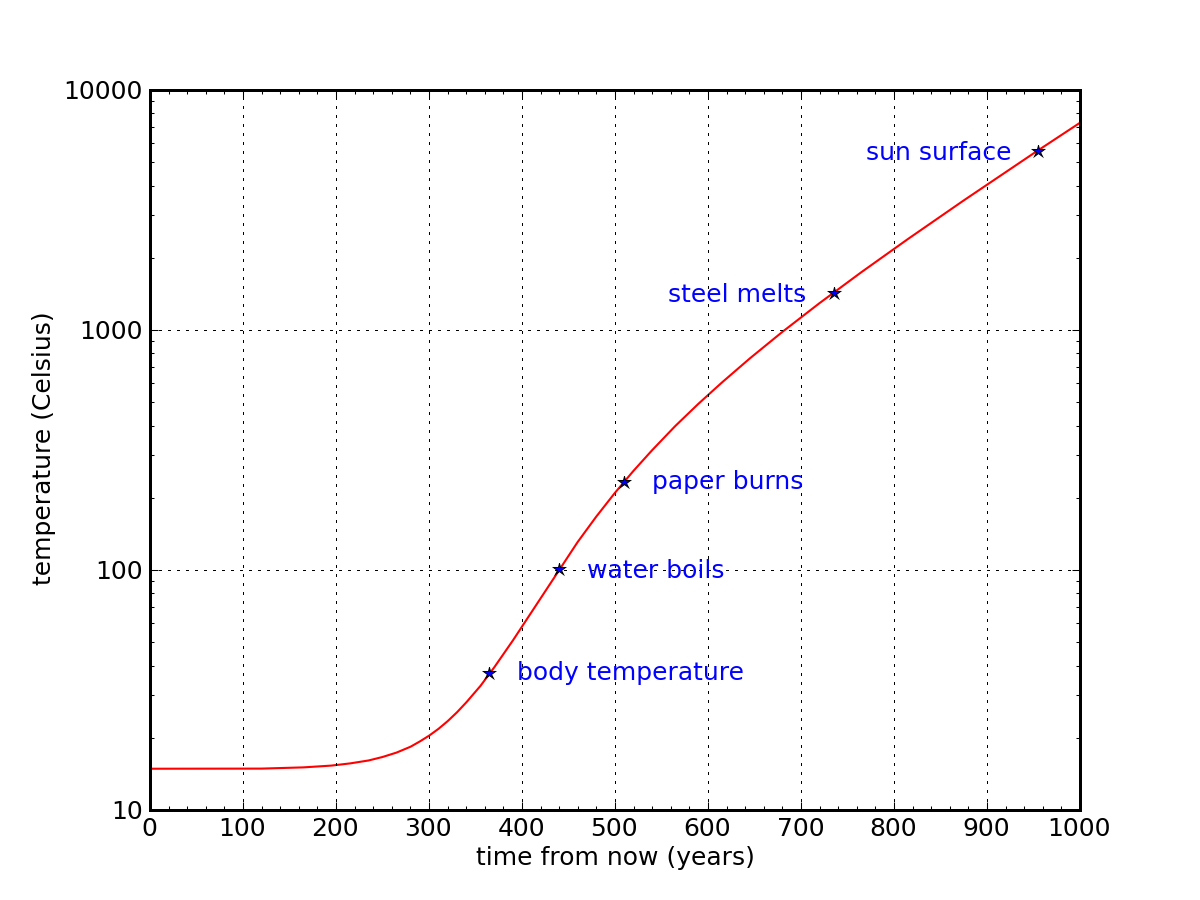
Feel free to do the math yourself. You’ll forgive me for trusting in the calculations of UCSD professor of physics Tom Murphy, who’s written about this extensively. Edit: Also, your numbers are quite simply incorrect. The 70% of sunlight that doesn’t bounce back into space is about 35,000TW, far from the hundreds of trillions of terawatts you claim. At 2.3% energy growth for the next 275 years, we’ll be adding 7,000TW to this number. That is easily enough to noticeably increase Earth’s equilibrium temperature, and far less than this will be necessary to do so given greenhouse gases which reduce our ability to radiate heat into space. https://dothemath.ucsd.edu/2011/07/galactic-scale-energy/ |
|
|
The Earth receives 340 W / m^2 on average (not accounting for albedo) [1]. The surface area of the Earth is 510 trillion m^2. Humans release 160,000 TWh / year (18.5 TW) [2]. That means the input power from the sun is 9350x what humans release into the atmosphere. If wind and solar play a larger role in the energy mix then the picture looks even better. I can't see how humans could increase power consumption by multiple orders of magnitude without solving so many other (more difficult) problems. Even if we did, playing games with albedo and/or orbital sunshades are on the table with the comparatively meager means we have today. Any future society using that much power surely could address these issues with ease.
Also, expecting constant growth for the next 275 years isn't really a good projection of current trends. We're already seeing negative 2nd derivatives in energy production and population. There is nowhere left to expand in to. The world has become very small very fast.
1. https://earthobservatory.nasa.gov/features/EnergyBalance/pag...
2. https://www.e-education.psu.edu/egee102/node/1925