|
|
|
|
|
|
by bsedlm
1590 days ago
|
|
|
from what I've seen, there's a lot of "obscurity" to this; there are many seemingly arbitrary choices all over the place. In the end most encryption algorithms boil down to doing 'random' (arbitrary, hard to justify why) things to data and then undoing them exactly in order to decrypt. the math is all incredibly abstract but not all that complex, the high level of abstraction does make it quite difficult to grasp. What's worse is that I fear there are incentives (mostly political/security interests) to keep the field small and to keep many people far away from this very practical use for all these beautiful, elegant, simple (but extremely abstract) mathematics (refering to the entire cryptography field). |
|
|

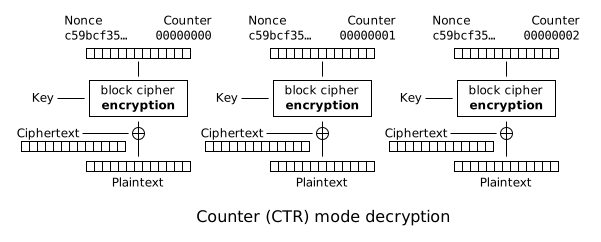
I mean, everything you want to learn about crypto is available online, in libraries, in textbooks. Including differential cryptoanalysis, the theory behind these mathematical forms (Galois Field makes things _EASIER_, not harder actually. That's why CRC-checks and Reed-Solomon codes were based off of Galois Fields, and AES being based on GF(2^8) is to take advantage of those same properties).
--------
What has happened is that the "old generation" of programmers is dying out / retiring. And they aren't passing on their knowledge to the new generation. The "old generation" of programmers were high-math, abstract algebra and more, while "new generation" programmers just never bothered to learn this stuff.