Hacker News new | ask | show | jobs
by ahallock 1617 days ago
The taxes aren't just. The state blows trillions on wars, foreign aid, etc so I think there's a spending problem. Maybe if they could reign their spending, we could let people keep more of their money. Instead people take out loans and go into debt to keep up. And then we tell them to be austere (no smart phone for you, skip the coffee, etc) while the state spends with wild abandon.
3 comments

The primary cost center for the US Government - and a rapidly expanding one - are entitlements, not wars and certainly not the tiny foreign aid budget (and of course the US should not repeat the mistakes of Iraq / Afghanistan).

Entitlement costs already dwarf defense spending, and it's going to get a lot more dramatic over the next 20 years.

Entitlement costs aka the people getting money.

> Instead people take out loans and go into debt to keep up

Well that certainly depends on who you're talking about. US households at the median and above are in decent debt shape, including debt interest expenses in relation to household disposable income. The payday loan context trap for the working poor is still every bit as bad as it has ever been.

The biggest household financial threat right now are real consumer prices - including rent/housing, education, energy - rising considerably faster than wages.

edit: I was mistaken, see below for corrections

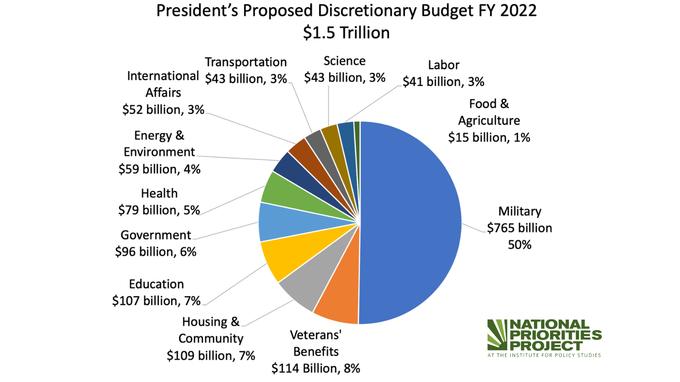
~~https://media.nationalpriorities.org/uploads/presidents_fy_2...

the military budget is 50% of the US budget for FY22

That's misleading, that's showing 50% of discretionary spending. Defense is not even 20% of total spending.

https://datalab.usaspending.gov/americas-finance-guide/spend...

50% of the discretionary budget. Entitlements (Social Security, Medicare, etc.) are 65% of the budget. The full budget is about $6 trillion.
This is a huge tangent and has nothing to do with the discussion at hand.
I think it's completely relevant, and it should always be pointed out that humans are suffering because of our tax dollars.
Correction: VOTERS are suffering because of their own voting choices.
Correction: VOTERS are suffering because their choices are no longer meaningful.

(Two party system is broken and neither does a good job of serving the interests of their voters. "Vote harder" isn't practically effective and displaces blame to the victims. Ineffective, selfish and corrupt leaders have captured the majority of political positions, and until we get rid of them change is impossible.)

I am anti-military and vote to reflect that position. Last I checked, my tax dollars are still going towards the 700B+ military budget. How is this a consequence of my own voting choices?
Foreign aid is an absolutely minuscule amount of the US budget and should be increased. I'm disappointed you're uttering concern over foreign aid in the same sentence as wars ("defense" budget).
It's also not charity. It's 1) used as diplomacy, and 2) earmarked to purchase from US companies.
So I should pay money to foreign countries and foreign wars under threat of violence, if I don’t pay I will have my assets seized or even go to prison? We’re 30 trillion dollars in debt and still think this is a good idea?
The money paid to foreign countries is economic diplomacy, and is inexpensive compared to actual military diplomacy. A good part of the reason you are able to earn what you do is because of the US' might in both economic and military influence.

I agree that the military budget is problematic, but it's short sighted to spend too much time worrying about foreign aid. It's a very cheap way to wield influence.

In 1970 countries agreed to give at least 0.7% of GNI [0] and the US has been giving severely less than that for decades: only 0.17%

[0] - https://www.oecd.org/development/stats/the07odagnitarget-ahi...

[1] - https://w3.unece.org/SDG/en/Indicator?id=72

> In 1970 countries agreed to give at least 0.7% of GNI [0] and the US has been giving severely less than that for decades

The US and nearly everybody else. The biggest exceptions most recently? Sweden, Luxembourg, Norway. Gee, I just can't figure out why the US doesn't match Norway (or other tiny hyper affluent European nations) on such a matter. The only real exceptional outcomes in that list are Britain and Germany, and France to a lesser degree - outside of that the entire world is largely failing badly at that supposed test.

Meanwhile during that time the US supplied nearly half the world's food aid, while only representing 4%-5% of its population. A tradition of food aid going back more than a century now.

For example:

"The U.S. contributed $3.4 billion to WFP [UN World Food Program] in 2019, which was 42% of all contributions last year." - from the UN WFP homepage. And that's just to one entity.

Globally at present the US is supplying around 40% of the world's food aid all by itself (the number used to be slightly higher in the past and I think the US should do more, however that's still astounding coming from one nation).

You know what the US should do? It should pull its military entirely out of Europe and Asia, and let Russia and China run wild (they'd promptly conquer and pillage like it was the 1930s all over again). North Korea would be in South Korea before the final US troops were out of Asia; South Korea would cease to exist as we know it today within a decade. Then we should cut that related defense spending, and redirect that former defense expenditure to meeting that 0.7% GNI target (and helping the people ravaged by the inevitable large wars, which is how we used to approach the problem circa the WW1 & WW2 eras).

Food aid is basically the US subsidizing its own food producers and dumping free food in countries, thus undermining the already-poor farmers. It's not as charitable as you make it sound, and it has a lot of negative outcomes. If the US was interested in helping the people there, it would use different approaches.