Hacker News new | ask | show | jobs
by throwaway34241 1671 days ago
> So the price of this "equity" movement is going to be (and always was) mass de-industrialization and transforming the economy to third world status

I also disagree with these sort of decisions but this seems a bit hyperbolic. Certain institutions will probably admit fewer students who are able to excel in those fields, and if the change is large enough it will affect the quality of those degree programs (although in probably any admissions process talented students will be better able to game it).

But the likely eventual outcome to that seems like it would be other institutions attracting the most talented students and professors. It's hard for me to imagine every single university getting on board with this, although I could imagine STEM being increasingly concentrated at universities with that focus like Caltech instead of general liberal-arts schools.

It also might be kind of interesting if the brightest students tried to excel more in things that aren't directly competitive (kind of like Thiel fellows), although I don't think that's the purpose behind these sorts of changes.

1 comments

"It's hard for me to imagine every single university getting on board with this"

Think for a bit how many things that were hard to imagine 10 years ago are now common place in the corporate world. Social conformity pressure is a real b*tch. The best we can hope is that the occasional larger-than-life professor will be left alone to teach his craft the way he sees fit. Pray that your kids have a chance to meet one of them and the wisdom to subject themselves to the gauntlet.

The corporate world isn't a bad analogy. But corporates are still by and large very profitable, some companies operate as they always have (although that isn't newsworthy, and it isn't a marketing point), and on this specific topic (testing) leetcode type questions are still ubiquitous.

If social trends seriously impaired companies' competitiveness I might expect to see the companies that are more on board underperform. But when I think of recent corporate failures (maybe Google failing to compete with FB on chat / VR / Google plus etc), garden variety mismanagement still seems like it has more impact.

So I also disagree with the policy, but worrying about "transforming the economy to third world status" like the OP seems like it is going overboard. If suboptimal policy choices or social trends destroyed society it would have been destroyed a long time ago many times over (and San Francisco wouldn't be a startup hub).

Post-stalinist Soviet Union, while not manically murderous, eventually imploded under the weight of a myriad suboptimal policy choices. Alas, it took 40 years to do so. There is a lot of inertia, I don't think anyone is arguing that UC (or Google) will collapse next year, but that the weight of poor policy choices compounds over time.

Re "mass de-industrialization", there is a historical reference, specifically the complete bankruptcy of ex Soviet block industry in the '90s, being sold for pennies to Western investors to bulldoze it and build something else in its place. I don't have a crystal ball, but I do wonder how US/China rivalry will play out in the 2040s and beyond.

I think it's useful to explore historical perspectives, but there are many others. If I look at my parents' generation in the US, people were being forced against their will to fight overseas in a war that didn't achieve anything (and involved mass poisoning the crops of substance farmers). You had double-digit inflation, rationing gas by license plate, and, at points, literal price controls.

Before the baby boomers we had global war, before that the great depression and growing literal communism, before that prohibition and the mob. And of course prohibition was prompted by social problems around alcohol.

So I don't think "problems compound" is always true. For a long time, teen pregnancy and alcohol use were on the rise, but that trend didn't continue indefinitely, and both have relatively recently had dramatic declines.

If you look closely enough at any time period there are often multiple serious political, economic, and/or social problems, so much so that it seems to be the norm rather than the exception.

> Post-stalinist Soviet Union, while not manically murderous, eventually imploded under the weight of a myriad suboptimal policy choices

Even this I'm not so sure. Here is a graph of their GDP [1]. My understanding is it was a political collapse first (a failed coup), and the economic collapse followed. An example that I've read China has been very mindful of (apparently Xi talks about Russia much more in his books than he does the US).

> I do wonder how US/China rivalry will play out in the 2040s and beyond.

Me too, at that point they'll probably be a much larger economy than the US. Will that have a destabilizing effect (especially with a potential military conflict over Taiwan)? Or will (the US) having a shared rival be somewhat unifying? The UK did OK despite declining in (relative) importance, but I could imagine the US struggling with its domestic problems even without any great power rivalry...

[1] https://en.wikipedia.org/wiki/File:Soviet_Union_GDP_per_capi...

Life in the '80s in the Soviet Union space was marred by widespread food shortages. Here is a fairly accurate video of how the usual grocery shop looked like: https://www.youtube.com/watch?v=t8LtQhIQ2AE When the sporadic food supply truck would show up, people would line up for hours, many only to leave empty handed when the load would inevitably run out.

In 1989 Boris Yeltsin visited Texan grocery store and was positively shocked by the choice and availability. https://www.chron.com/neighborhood/bayarea/news/article/When...

This is the very tangible result of suboptimal choices.

But I agree, life in the '90s, post collapse, was even worse. I read it as a warning that embarking on a suboptimal choice course may be hard to steer back until reality forces a very harsh collapse.

> This is the very tangible result of suboptimal choices.

I agree - I've always liked that story about the grocery store.

I don't think bad policies are something that can be straightforwardly extrapolated into a course to the Soviet Union though. The US has had price controls in the past but backed off. Even large welfare states like Sweden eventually hit a point where they stopped or turned back the expansion of the public sector (reducing marginal rates, eliminating wealth taxes, spending as % of GDP leveling off, etc).

The Soviet Union even collapsed while it was heading in a more positive direction from where they were at (reducing state political and economic control).

So there doesn't seem to me to be a straightforward connection between incremental policy changes and collapse.

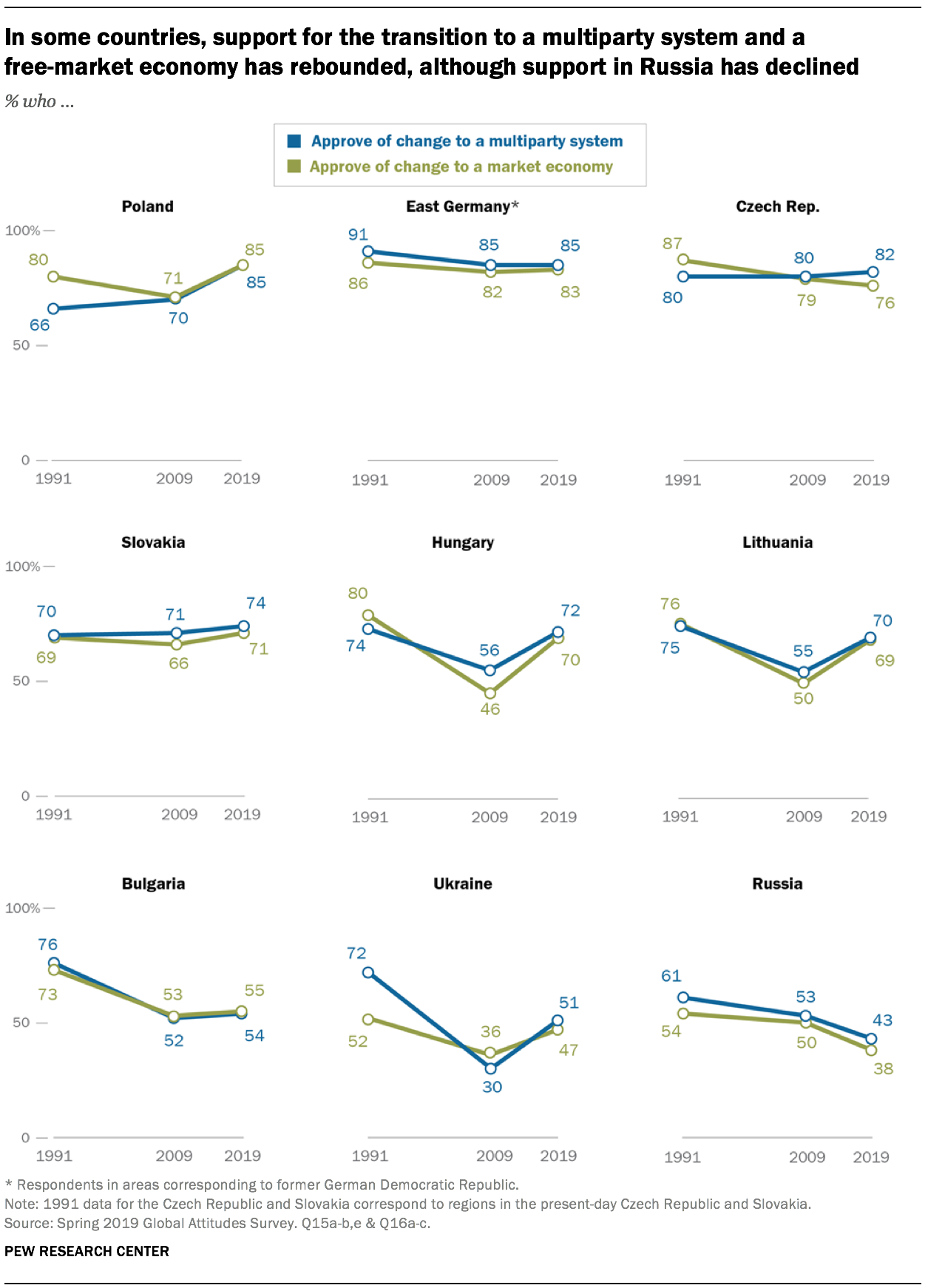
I don't see a clear connection between collapse and subsequent "steering back" either. Support for the market economy and multiparty democracy in Russia are both at record lows [1]. Venezuela has undergone an economic collapse but is still very dysfunctional. Neither seems on track to catch up with western countries any time soon.

It's interesting to contrast this with China, which had similar issues to the Soviet Union (of having an inefficient state-run economy) and had heavy debate about how to go about reforming it [2]. At least for their economic prospects the incremental path they chose seems to be working out better.

[1] https://www.pewresearch.org/global/wp-content/uploads/sites/...

[2] https://www.amazon.com/Escaped-Therapy-Routledge-Studies-Chi...