Hacker News new | ask | show | jobs
by jhgb 1686 days ago
I'm wondering if a similar effect couldn't be done using a continuous surface and just silvering it. I saw something similar done with refraction but can't remember the URL now. 3D printers definitely have higher resolution than mirrors of this size.
3 comments

If you're willing to spend a lot of money on silver then probably yes. After all the height differences are substantial and silver isn't cheap. 3D printers resolution sucks in comparison to the mirrors, I'm not sure what you mean by that.
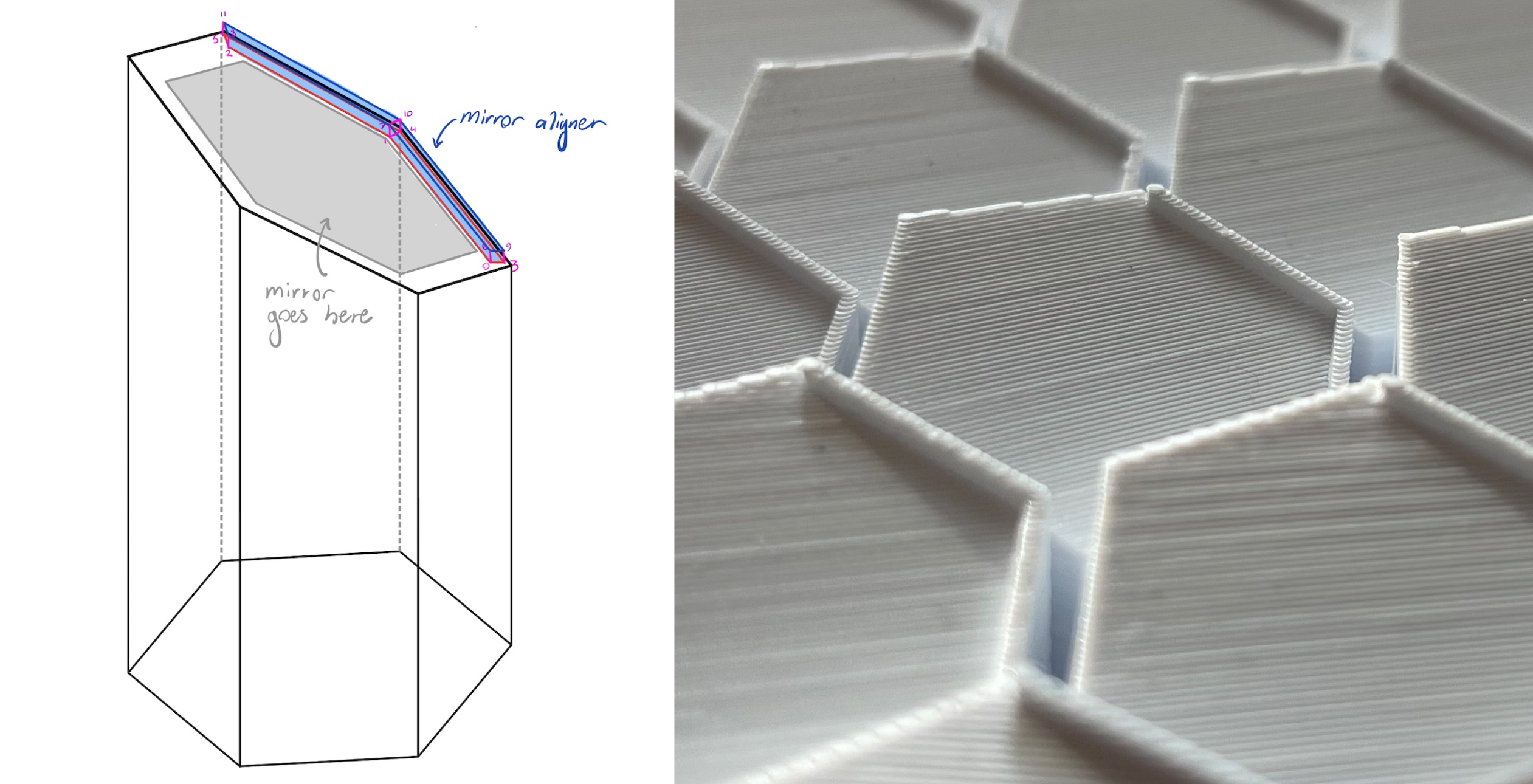
Not quite sure you need that much silver. You need some filler between the silver layer and the crude plastic surface to get the silvering smooth, but that filler doesn't necessarily need to be silver. As for the resolution, I'm judging it from this picture: https://raw.githubusercontent.com/bencbartlett/3D-printed-mi... - there seems to be almost two orders of magnitude of a difference between the size of a flat mirror and the size of the "printing step".
Aluminizing it would be way cheaper than silver.

For that matter, you could probably glue down pieces of aluminized mylar rather than using mirrors, since you all you need is a spot of light, not a full-blown mirror image. Aluminized mylar is pretty cheap!

Bare aluminum would oxidize in a very short time to something dull. It would still reflect light but not quite as good.

Aluminized Mylar would definitely work, but that's not bare aluminum but aluminum with a shiny layer over it to keep it clean.

Very useful stuff, I built huge solar concentrators with it. 1000 suns on an area the size of a poststamp. You can do some pretty crazy stuff with that kind of energy density.

You might need a micron of thickness of aluminum or silver. This piece looks like it's about 300 mm x 300 mm, which would work out to 90 mm³ of silver (or aluminum), which at 10.5 g/cc would work out to 950 mg of silver. Silver currently costs US$25.25 per troy ounce, so this would be 0.12¢ (US$0.0012) of silver, or somewhat less of aluminum.

Both silver and aluminum will tarnish if exposed to the air, silver more slowly but much more completely.

The process for silvering things is a lot easier to do at small scales than the process for aluminizing them. Aluminizing things normally requires a fairly good vacuum, and, moreover, a vacuum chamber large enough to fit whatever you're aluminizing. Perhaps someone will come up with some kind of convenient wet process for doing it but I'm not hoding my breath.

By contrast, you can silver glass with Tollens' test, using distilled water, silver nitrate, concentrated aqueous ammonia, hydroxide of potassium or sodium, and a reducing sugar (almost any sugar that isn't sucrose, for which you can substitute numerous other chemicals, such as formaldehyde, formate, isopropanol, or tartrate). This is commonly done as a classroom demonstration in chemistry labs nowadays, and it was done on a large scale almost 150 years ago for telescope mirrors. Nitric acid is beneficial but, unless you have to make the silver nitrate, not essential.

This is why it's much more common for amateur telescope makers to silver their mirrors rather than aluminizing them.

I've silvered a lot of copper plates for photography (Daguerrotypes).
Well, as usual, you probably know more than I do about what I'm writing about. Am I overlooking something significant? I don't even know if you can use the Tollens test to silver copper.
There are single solution spray-on electroless plating "paint" for modelmaking. They can make any smooth and black surface into a mirror so I think it's just a matter of surface preparations.
Can they actually produce a mirror you could mistake for a glass mirror?

I assume if your mirror is "only" as good as as the shiny side of some aluminium foil, you can't project things with any detail.

Isn't the mirror surface effectively at the aperture in this system...
You could use reflective mylar tape over the surface. And if you wanted something with very high resolution I'd try vacuum forming wide mylar film onto the 3D printed surface.
I don't think so; the angling of the mirrors is done with small steps, which the mirrors smooth out.

If you apply a very thin film, it will just follow the steps.

That's why I'm mentioning the filler. It definitely can't be "very thin". But all that matters is if the resulting shape is predictable.