Hacker News new | ask | show | jobs
by trutannus 1685 days ago
It's not random detonation that is the problem, the issue is containment failures, or anything that causes one. A collision, or stress fracture for example will allow oxygen into the tank. In an atmosphere with enough oxygen in it like ours, that's always a risk.
2 comments

Oxygen leaking in is not an explosion risk. As noted, it takes 25% O / 75% H before it can ignite. Above 75% H it cannot.

With positive airflow around possible leaks, sufficient H2 to sustain a flame can be prevented. In a collision, gas released goes up and out of trouble.

As noted, the lower explosive limit for hydrogen in air is 4%. Significantly lower with pure oxygen. https://www.safeopedia.com/definition/2205/explosive-flammab...

The problem is that hydrogen is a very small molecule and readily escapes containment. It can even travel along grain boundaries through solid metal.

Exactly, the lower limit, when hydrogen has escaped into the air, not when air has leaked into the contained hydrogen. The article makes clear that above 75% H2, ignition is impossible (but only if you read it).

"Traveling along grain boundaries" can only leak trace amounts. With, as I said, positive airflow, trace leaks can be constantly diluted below the concentration where ignition is possible.

> In a collision, gas released goes up and out of trouble

Except for the cases when there's an open flame nearby or sufficient heat, as is the case in a non-insignificant number of collisions. What if a hydrogen engine collides with a standard petrol engine? Or if the gas becomes exposed to hot surfaces during the oxygen mixing? The gas expansion is also a major cause of explosion. You essentially pull oxygen into the fuel, and rapid fuel-air mixing is a known cause of detonation.

What leads you to think that anything would "pull oxygen into the fuel"? H2 under pressure moves outward, and in a containment breach tends to, instead, increase the H2 fraction above the 75% that can sustain a flame until most of the gas has escaped and leapt skyward. H2 explosions are a concern in enclosed, unventilated spaces.
> H2 explosions are a concern in enclosed, unventilated spaces

Well, ignoring one of the largest hydrogen explosions in History which occurred in the open air under the exact circumstances you say are impossible: https://en.wikipedia.org/wiki/Hindenburg_disaster. You mention earlier that this is not the hydrogen, and instead just the fabric. That's been debunked repeatedly: https://www.airships.net/hindenburg/disaster/myths/#hydrogen...

You also mention nobody died in the fire as a result of the hydrogen, which is also debunked: https://www.airships.net/hindenburg/disaster/myths/#hydrogen

"This is probably the most absurd myth about the Hindenburg disaster, yet it is frequently promoted by hydrogen fuel advocates."

In addition, hydrogen tanks are not just sitting there in a vacuum. In order for the hydrogen to "leap skyward", you have to have it, again like I said earlier, not come in contact with anything that will induce combustion. Also, you need a perfectly open environment. Your point about the mixture being above 75% just shows a somewhat naïve understanding of the physical chemistry at play here. All it takes is for an area near the fuel supply to hit the right fuel-air mixture ratio, which leads to combustion, as in common elementary school science experiments (the hydrogen 'pop' demo). This event leads to a pulling in of the air and fuel around it, sustaining the exposition.

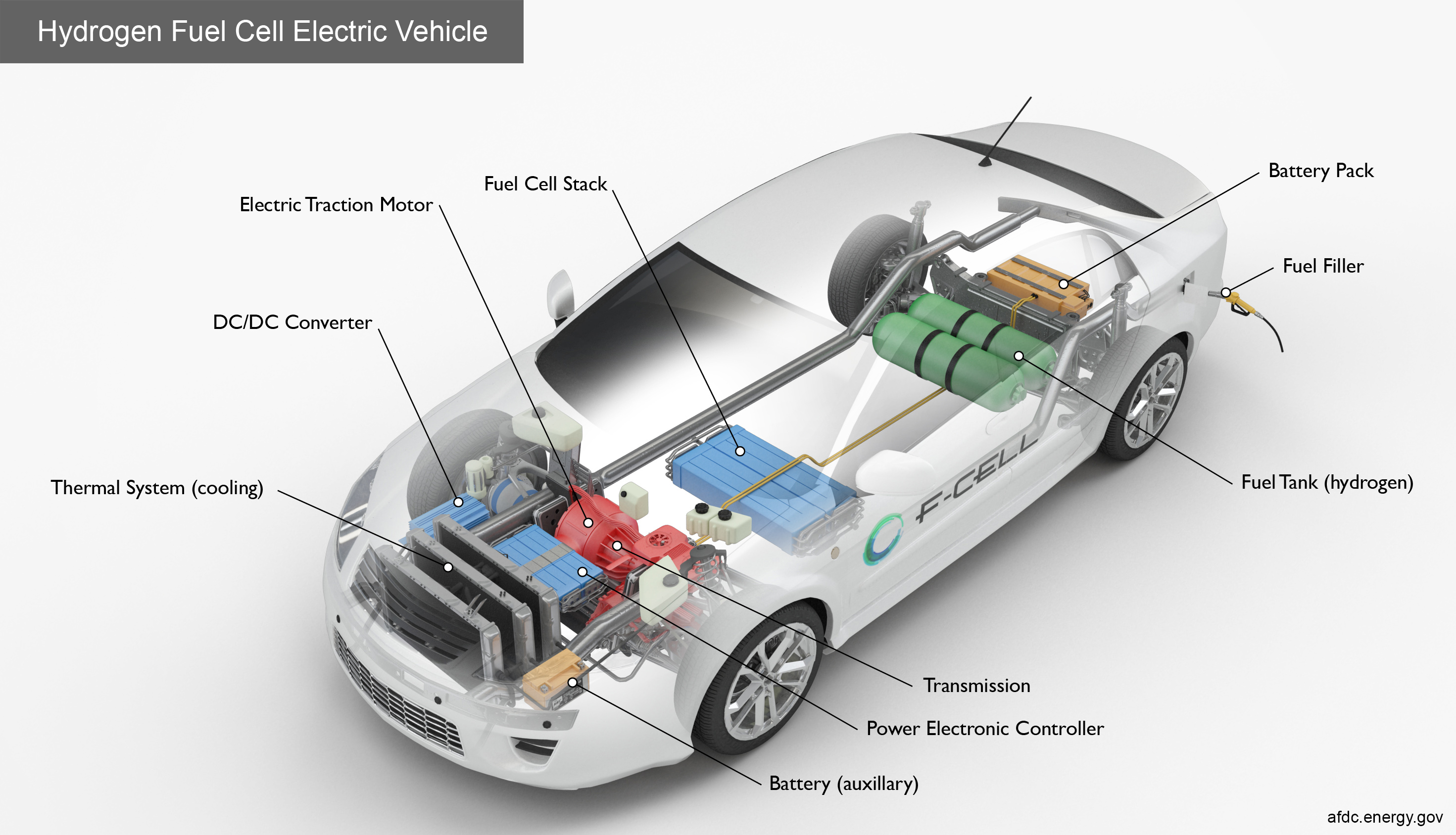
Hydrogen cars have the tanks contained within a sealed environment towards the rear of the car: https://afdc.energy.gov/files/vehicles/hydrogen-high-res.jpg

You are contradicting statements I did not make.

The Hindenberg disaster, in fact, involved no exploding hydrogen. It was a big fire. Fire can be very destructive. There is no need to invent imaginary explosions to explain destruction from fire.

It is a fact that fewer than half who were aboard died. Those who did die obviously could have been burned, and, despite your absurd and repeated accusation, I never claimed otherwise. Nobody who was not aboard died.

Burning hydrogen moves upward the same as non-burning hydrogen. Gas in contact with flame does not magically become non-buoyant.

We are not, in fact, discussing "hydrogen cars", so whatever "sealed environment" you picture in them is wholly irrelevant.

You didn't make the points here, you made them elsewhere.

> Burning hydrogen moves upward the same as non-burning hydrogen. Gas in contact with flame does not magically become non-buoyant.

Correct, it burns. Like it did in the Hindenburg. I have no idea what your point is.

> We are not, in fact, discussing "hydrogen cars", so whatever "sealed environment" you picture in them is wholly irrelevant.

This is a counter-argument for your previous points that leaks are irrelevant. My point is simple: No, they're not. You're trying to side-step this point by saying "well, I'm not talking about that" when you did right here:

> H2 under pressure moves outward, and in a containment breach tends to, instead, increase the H2 fraction above the 75% that can sustain a flame until most of the gas has escaped and leapt skyward.

Which is complete nonsense if you look into what's around a containment system. Which is my point -- containment is never not in a confined environment. You talk about some positive airflow system, sure, that's fine. What if the failure affects that? Well now you have to consider the risks all over again.

> involved no exploding hydrogen

This is a pedantic nitpick. In day to day usage, people say explosion to mean "rapid, uncontrolled fire". That does not negate my point -- that was one of the largest hydrogen fires in history.

You sound like you have tunnel vision on the advantages of hydrogen for industrial uses. There's a reason we don't use it. It's dangerous, and engineering solutions to mitigate the danger are prone to failure. If you want more: https://www.airships.net/hydrogen-airship-accidents/

Had my house once fill up with natural gas for many weeks. Much to the surprise of the gas company it did not explode. Of course everyone has severe long term effects from that.