|
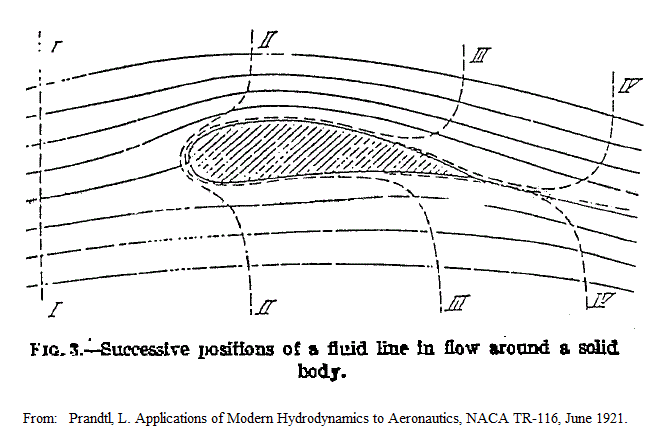
It's not complicated, instead it's HERETICAL. It directly violates Bernoulli/Euler, because with downward accelerated air, the parcels continue moving down, long after the wing has passed by ...meaning that energy has been injected into the atmosphere. Yet Bernoulli equation is entirely based on having zero energy injected. Bernoulli only works if we eliminate all net downward acceleration (so, the parcels MUST be left unmoving after the wing has passed by. As an example of this, look at any 2D airfoil diagram. The air approaches horizontally, and leaves horizontally.) In my opinion, that issue seems to be the source of the entire controversy. --- In real wings, Bernoulli equation cannot be employed, because parcels remain moving downwards, which means that lift is an example of propulsion. Bernoulli does not describe propulsion. Real wings are air-pumps, and they fling air downwards, leaving behind a wake of descending air. The wing is adding net energy to air parcels. Yet in fluid dynamics for beginners, all the low-level explanations reject this notion, and instead eliminate the air-pump (eliminate the energy-injection, eliminate the vortex-creation, eliminate the downward "exhaust-plume" created by all short wings. That way Bernoulli equation can apply.) How do they do this? Just get rid of the wingtips! Make the wingspan be infinite. In other words, we only analyze the flow around airfoils in a 2D world. In a wind-tunnel, a two-dimensional airfoil must have sliding contact with the walls of the tunnel, and the airfoil doesn't pump any net air downwards. It acts as a small slice of an infinitely-wide wing. It creates a pressure distribution which presses against the floor and ceiling of the wind tunnel ...even if the wind tunnel is very very tall. To make Bernoulli equation applicable, we must only analyze airfoils having infinite wingspan. But unfortunately, a 2D airfoil only depicts "ground-effect flight," because an infinitely-wide wing can never fly high enough to escape 100% ground-interaction. (It would have to fly higher than infinite altitude. A wing is in 100% ground-effect whenever the altitude is << wingspan, and if wingspan is infinite, then we're only explaining venturi-effect flight close to the ground surface, where no air is flung downwards on average, and the Newton's-3rd force-pair is between the wing and the ground surface.) In other words, our explanations of lift have the ground surface built into the explanation (which then lets us employ Bernoulli/Euler equations, since zero energy is injected into the air.) The wing pushes indirectly against the ground, and the ground pushes indirectly against the wing. No need for net acceleration of the air. Yet real wings only push upon air, and the ground-surface plays no role. But then we don't bother to mention any of this to our students. And, our 2D flow diagrams completely violate Newton's 3rd, because they don't even depict the ground! Instead, real wings only create propulsion forces, and they fly much like helicopters: flying far from the ground, while leaving behind a momentum-carrying "exhaust plume" of descending air. Indeed, if first we explain a hovering helicopter, then later shove it rapidly sideways, we end up with a complete explanation of lifting force in fixed-wing aircraft. But then we're forbidden from applying Bernoulli, since Bernoulli cannot tolerate propulsion, or air pumps, or descending plumes left behind by airfoils. I'm reminded of the car-keys joke. Someone is searching for their car keys at night, only searching under a bright streetlight, because the light is brighter there. But they dropped their keys far away, in the dark. We've done the same with airfoil explanations: altering them until they no longer can explain flight ...but they do allow us to use much simpler math (employing a Bernoulli-based description.) Unfortunately, if we want an intuitive and satisfying explanation of lifting force, first we must decide to remove Bernoulli entirely. Then sit ourselves down and figure out an alternative approach. This might even be easy! But it remains totally impossible while, right at the start, we insist on using Bernoulli concepts, where helicopters and propulsion and downwash-plumes are utterly forbidden. |
I wonder how this concept came to take hold? If it has no explanatory power, why even offer it?