|
|
|
|
|
|
by hackermom
5460 days ago
|
|
|
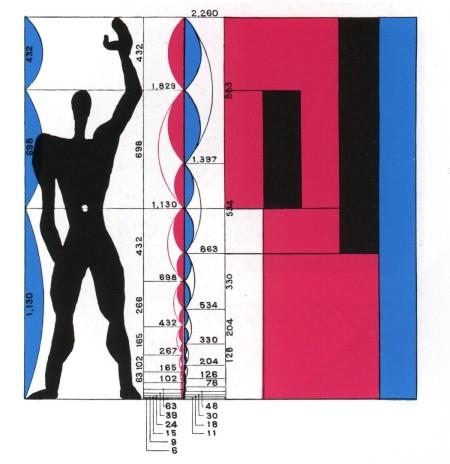
Here's a little something that most people don't know, that I picked up from my architecturally interested father long ago: The French architect Le Corbusier (http://en.wikipedia.org/wiki/Le_Corbusier) made use of Fibonacci sequences to create his famous "Modulor" (http://www.apprendre-en-ligne.net/blog/images/architecture/m... - "A harmonic measure to the human scale, universally applicable to architecture and mechanics.") which represents a few fixed points in Fibonacci sequences that have been in use in architecture, interior decoration, carpentry etc. for more than 50 years, at least here in Europe - I have no idea if these scales are as rigorously followed in the Americas or in Asia. If you look at the picture, and then look at the height of the seat of your kitchen chairs, your kitchen table, your kitchen sink, your cupboards etc., you will find that their tops, bottoms and heights almost always align around numbers in these scales. These measurements create a strange sense of harmony in the way the mind processes geometry picked up from eyesight, which is not perceivable as soon as you move away from these dimensions, in some way quite similar to how the Golden Ratio pleases the eye. Just for fun I measured some of the interior in my home. Desk: 69cm. Kitchen chairs and kitchen table: 43cm and 70cm. Kitchen sink: 88cm. Bottom and top of wall-mounted kitchen cupboards: 138cm, 225cm (height of 87cm). Also interesting to note is that similar scales have been found to be used in ancient times as well - seems we took notice of this particular natural pattern long ago. |
|
|