Can you name those laptop Xeon CPUs that beat the pants off the M1 Max?
[Spoiler because I don't think I'll get a response -- there are none. Even when you get into the "luggable" category of workstation that is ostensibly portable but really needs to be plugged in, there is no competition right now. The upcoming Alder Lake should significantly improve Intel's entrant in this category, and hopefully brings some real competition]
The upcoming Thinkpad X1 Extreme is going to give it some stiff competition. It's wielding the insurmountable RTX 3080, and it's priced very competitively.
But I'm just going to tell it to you now so we don't make the same mistake we have for the past 10 years of computer hardware discussions: specs don't matter. You could tell 90% of the people buying PCs with dGPUs about your 5nm GPU and next-gen power efficiency, but they won't care. They're buying them as gaming devices, general-purpose machines and game development laptops. I'd argue the market for Mac users and PC users has not radically shifted, just the hardware you're using. If we're here to talk smack about hardware superiority, this website would have been insufferable for the past decade, because there was quite literally a complete lack of professional dGPU Macs. Now that the tables have shifted slightly, I don't see why Mac users feel the need to crawl out of the woodwork and declare the game as changed, now that Prometheus gave them the gift of a laptop that doesn't throttle to hell.
People will still buy all sorts of computers. Lots of options will appeal to different people. Intel is finally being forced to actually complete. It's all good. My M1 Mac (not even M1 Pro/Max) is quite easily the best computer I've ever owned, but I have zero need to proselytize and simply do not care what you or anyone else use.
That doesn't change the fact that the above claim about "laptop Xeon chips" beating the pants off the M1 Max is delusional nonsense.
I have to comment on the RTX 3080 bit: I have used many PC laptops over my career, and currently have a Lenova with a fat, barnburner Nvidia dGPU. The GPU is literally never used, because the moment it engages my battery life falls to cartoonish levels (somewhere in the range of 40 minutes), the laptop becomes a space heater, and the fans turn into jet engines. This is the sort of "spec chasing" that the industry is addicted to, providing absurd, completely unreasonable solutions just so someone can boast. One of the things about Apple, quite contrary to your claim, is that they don't do that. When they provide something, it is meaningfully usable and useful 100% of the time.
It's using DDR4 versus DDR5 in the Mac and a fraction of the memory bandwidth so will be interesting to see its performance on heavier tasks. Also looks like it has at least half the battery life if not far less when put under heavy load.
I do love this review though:
"It is a nice laptop but extremely noisy. Even when idle the fans are on all the time."
Memory bandwidth is nothing for most workloads. Besides a scant few Geekbench figures, I have genuinely never encountered a workload that was bottlenecked by my ability to transfer assets to the GPU. Is 100gbps of PCIe bandwidth not enough for your needs?
That's not true if you're actually using the ram though.
I remember memory bandwidth being the bottleneck when running large(ish) datasets for game worlds. It was so much that we put a lot of pressure on google cloud because we worried they wouldn't be able to compete with bare metal (since it's not usually measured, reported and can be non-guaranteed when you have neighbours).
xeon branded workstation laptops aren't using Icelake-SP or similar server chips, they are using Tiger Lake-S or Ice Lake-S or Skylake-S client chips.
They are what would previously have been branded as "Xeon E3" series chips - on the desktop platform they used to share a socket and be drop-in upgrades with consumer desktop chips, because they're basically the same chips with "enterprise" features like ECC turned on.
An example would be Xeon E3-1285 v3 - which is basically the same thing as an i7 4770.
These products are nowhere, nowhere near the M1 Max. They are consumer laptop chips with ECC and vPro turned on.
Yes, your Xeon from 2013 example would be nowhere near the 2021 CPU from Apple. The outdated Xeon Apple had in their old laptops - a year behind everyone else, is also slower. The Xeon W-11955M however makes the M1 look like a kid's toy. In fact, if you remove 2 cores from that Xeon, you'll have my 6-core Xeon. Which also smokes that 10-core M1 in a bong.
I'm also not sure why you're sarcastic about ECC RAM. I have 128GB of RAM in my laptop. If it wasn't ECC, I'd have crashes in my VMs and errors in my calculations. When you go 32GB+ and actually use the RAM, anything that doesn't support ECC cannot be taken seriously for professional use. Like the M1 Max.
The point is that a laptop Xeon from 2021 is also going to be the same as an 1185G7 or something similar - because they’re the same silicon. It’s not like you’re getting more silicon because it’s a Xeon, it’s not a server chip, it’s just a laptop chip with the enterprise features enabled.
So, really no need to test them specifically. Go get an 1185G7 or something and you know what “Mobile Xeon” benches will look like. Anandtech already did those benches.
Just being pedantic, DDR5's implementation of on-die ECC is still not equivalent to the implementation on CPUs. It doesn't account for errors that occur during processing, and there's still a pretty significant chance of corruption in L1-3 caches.
One of my laptops is a Dell Precision 7760. Xeon W-11855M, NVIDIA RTX, 128GB ECC RAM. I don't need too much storage, but you can get it with 14TB if you want. Note mine is a 6-core. There is an 8-core available w/ the Xeon W-11955M, which is faster than mine.
It's only a little thicker than the macbook pro. It's keyboard doesn't break, and the product line has had a 4k screen since 5 years ago. It's 120Hz refresh rate. It has a very large power brick - 240W, it gets hot and loud with a huge fan exhaust. It's thick metal and about 7-9lb - you can run over it with a car. It only gets 9 hours battery w/ regular usage, and about 3 hours of "fan on time." Keep in mind, with the large and loud fan on, it can stay at 5GHz. This is called a pro laptop - a workstation. When I travel, I bring a 65W PSU, and it runs fine on that, just w/o turbo boost.
No, don't point to the lower "geekbench" score for this laptop - that's not a CPU test. GPU performance is a large part of that test, and they run the test on the default GPU. The M1 only has a single GPU. The Precision's default is the low power integrated graphics, not the discreet GPU. If you have a test where they assign the discreet GPU, please feel free to point it out.
As I've discussed before here, I have a shell script that runs in parallel with a bunch of VMs. My coworkers air (yes, I know it's not the max) runs it in 8-10 hours overnight. I run it over lunch. It loads, does calculations on, and creates graphs from several gig of ascii performance data.
What does compare in performance to the M1 air is my Latitude w/ the I7 in it. The M1 "max" is "max for apple" but competes with mid-tier laptops from everyone else. And that's ignoring the fact that it can't run pretty much any of the useful industry tools or games w/o recompiling x86 to arm on the fly.
Yes, I think my Dell cost the company $7-8k, without support. That's why it's called a pro laptop.
I feel like you have the setup necessary to produce an interesting, compelling argument here -- your benchmark seems, at least to some degree, less synthetic than some do, you have an uncommonly fast workstation which a lot of people doing comparison tests wouldn't be able to do...
... but the way you present it undermines your case a bit.
It seems like what you want to say is that if money is no object, weight is no object, heat is no object, battery life is no object, and portability is no object, but the comparison must absolutely be laptop to laptop, then there exists a laptop PC configuration that beats M1. If this is your point, then probably you want to compare an M1 Max to your PC, not your coworker's Macbook Air (which is a fanless laptop...)
I think this is a pretty unusual use case and there aren't too many people who are looking for this exact market segment. I definitely think it's fair to admit that Apple isn't intending to operate in this market segment, for better or worse.
You'd probably also want to drop the part about game support, since anyone who wants to play games can spend 1/4 what your workbench costs and get a shitkicking fast small form factor PC. But also, like, recompilation isn't what you should highlight -- what you should highlight is performance. If the recompilation is fast enough for users not to notice, then it doesn't matter, and if it's not, then the reason why it matters is performance, not recompilation.
Anyway, again, I don't think you're necessarily wrong or whatever here, but you're just presenting your point in a way that I think it's extremely unlikely anyone will care or be convinced.
“A little thicker” is a bit of an understatement. At its thickest point, it’s apparently 71% thicker than the thickest point of the 16-inch MacBook Pro (2021), and 55% thicker at its thinnest point compared to the thickest point of the Mac. That’s a huge difference for portable electronics.
It's also "sale" price of $6,700 with a 2TB HD and just a 6-core CPU. Going with the 8-core xeon bumps price to Bump it up to $6,900 and moving to 8TB of SSD goes up to $9,200 ($8,000 for the 4TB version).
The 2TB M1 macbook 16" is $4,300 and the 8TB, max-specced version is $6,100.
I know Apple has a bad rap for high prices, but that machine's prices make Apple prices look bargain basement. You could almost buy TWO M1 macs for the price of one 4TB Dell.
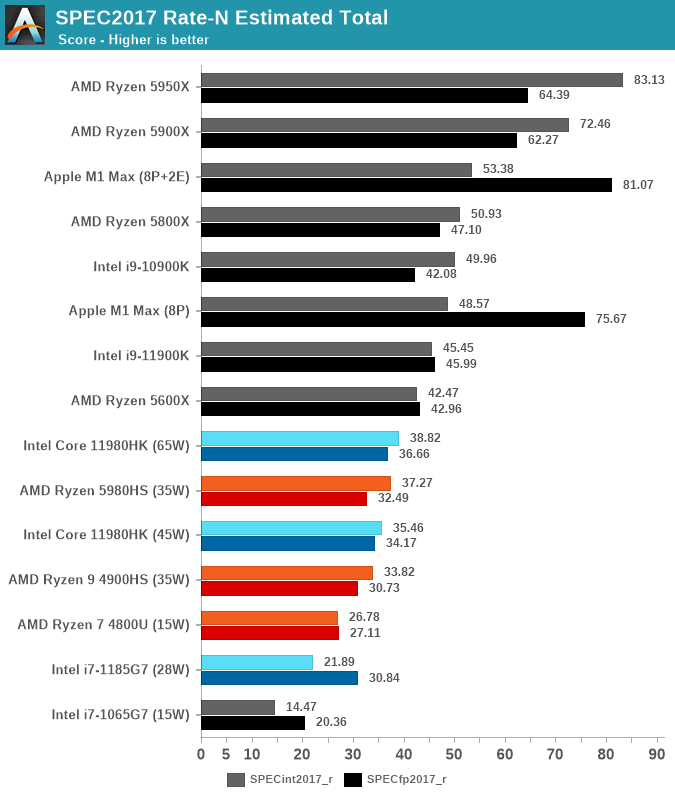
[Spoiler because I don't think I'll get a response -- there are none. Even when you get into the "luggable" category of workstation that is ostensibly portable but really needs to be plugged in, there is no competition right now. The upcoming Alder Lake should significantly improve Intel's entrant in this category, and hopefully brings some real competition]