Hacker News new | ask | show | jobs
by wilburTheDog 1708 days ago
People have been talking about 'peak oil' for years. It was predicted to peak about 15 years ago, at least in the US, but then the government started throwing money at the fracking industry (which as far as I know has never made a profit). This is not news for anyone who has been paying attention. If you haven't started planning how to live your life while our fossil-fuel based economy is collapsing around us, you should start now. Does you think that sounds alarmist? The EIA estimates about 80% of US energy consumption comes from fossil fuels [1]. And there are a large number of things we just can't do with renewables [2], at least not until we figure out how to store energy much more effectively than we can today. There are big changes coming. And I expect a lot of people are going to be caught unprepared.

Edit: If you disagree, please let me know why. I would love to hear why I'm wrong about this.

1. https://www.eia.gov/todayinenergy/detail.php?id=45096 2. https://www.azocleantech.com/article.aspx?ArticleID=1114

6 comments

Fossil fuels are going, and big changes to the economy are coming. That part is certainly correct. Predicting doom, collapse, and chaos doesn’t necessarily follow, and there’s a schadenfreude risk that you might fall into some cognitive traps, like wanting the apocalypse to come so that you can tell everyone you were right, or so you can finally make use of all that tinned food and ammo you hoarded.

You’ll get better expected returns from working to avert disaster than panicking about it.

I think those of us who try to anticipate problems and prepare for them are often easily dismissed and or ridiculed. It's true nobody really needed their cold-war bomb shelters, and the TV shows about people doing bug-out drills to their fortified heavily armed wilderness compounds paint a picture that's hard to relate to. But the two problems I'm concerned about right now are way bigger than me. No matter how hard I try to avert disaster, we are going to continue to see increasing effects of climate change and oil supply depletions. It's hard to predict exactly when, but I expect either or both to be quite significant in my lifetime, and I'm not a child. As such I am trying to arrange my life so that said effects do not constitute a disaster for me. And if I'm completely wrong, and GE develops a clean Mr. Fusion reactor next week, and the Gates foundation figures out an easy way to remove 2-3 trillion tons of CO2 from the atmosphere, well then I'll enjoy my gardens and my hobbies and never think of it again. But just because I'm preparing for problems in the future doesn't mean I want them to happen. Don't worry about that.
It's interesting how a comment can be so differently interpreted depending on what you extrapolate from the term 'collapse'. It might conjur up preppers spouting about TEOTWAWKI, WROL, and SHTF as they lock down in their bunkers waiting for the bombs to drop. On that basis I understand your response.

But there is also much discussion on peak oil and climate change that apply 'collapse' differently, as shorthand for a simplifying of the economy and civilisation as a result of no longer having the cheap abundant energy needed to sustain the level of complexity which it has grown into during the age of fossil fuel extraction.

If (and it's a big if) you anticipate the fossil fuel boom ending without the advent of an equal or greater replacement energy source, collapse by the latter definition is a useful term to discuss what that might look like. It's certainly true that we have extensive supply chains, dense living, abstraction from the fundamentals of survival, and many aspects of our current way of living exclusively dependent on fossil fuel and petrochemicals. So it follow that without equivalent or better energy source to sustain those things there must come about, either by choice or circumstance, a simplification (or collapse) of many aspects of present-day civilisation.

If anyone is interested in a good video explaining "Peak Oil" [0], "Shale Oil" (aka Fracking) [1] as it relates to what this article is talking about, I recommend checking out the links below. I don't endorse everything Peak Prosperity posts but their "Crash Course" is really well done in my opinion (both those videos are on the Crash Course playlist).

[0] https://www.youtube.com/watch?v=0uKihKkx0eY&list=PLRgTUN1zz_...

[1] https://www.youtube.com/watch?v=xliyZMPJvjk&list=PLRgTUN1zz_...

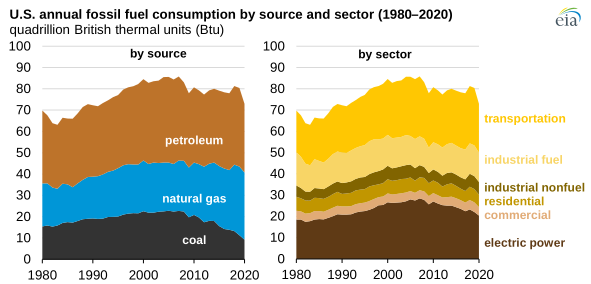
This sounds baselessly alarmist. Like yeah, we'll have to learn to live with less fossil fuels at some point, but it's not like a pandemic; there'll be years and years where we'll be able to collectively adapt. And since fossil fuel usage is already trending downward in the developed world (1), as green technologies become more efficient, it may well end up a rather gentle transition.

1 - for example, in the US: https://www.eia.gov/todayinenergy/images/2021.07.06/chart2.s...

This looks like the new normal is that fossil fuel usage drops in a recession, then stabilizes after.

Like many Americans, we have a mix of electric and natural gas appliances. Historically, natural gas prices have been significantly cheaper than electricity prices, and that's an important factor to take into consideration when trying to estimate the lifetime costs of new appliances (mainly things that need to generate heat: stoves, laundry machines, water heaters, pool heaters...). Is there any reason to suspect that natural gas prices might rise significantly in comparison to electricity prices in the next, say, ~30 years? What resources might one look for in order to try to answer a question like that?
Is there any reason to suspect that natural gas prices might rise significantly in comparison to electricity prices in the next, say, ~30 years

Isn't that what's happening now?

I don't know what the cost difference is between heating from an efficient natural gas furnace and heating from an efficient heat pump, so I'm not sure if natural gas has exceeded the price of electric heating.

https://www.cnbc.com/2021/09/09/natural-gas-prices-are-risin...

Peak oil was communicated as some kind of sudden "running out of oil". We did not run out of oil despite the old oil wells going dry as predicted. We simply made new oil wells. We will not run out of oil but rather run out of energy because getting more oil out of the ground takes more energy than we are able to extract. So this process appears like it's an economic problem. Oil from new oil wells just keeps getting more expensive while alternatives keep getting cheaper.
No, the peak is that point of the curve where production begins to decline because it no longer makes sense to continue. I always heard it described in terms of EROI. And EROI is not an economic problem. It's an energy problem. If it takes more than one barrel of oil to run the machines to produce a barrel of oil, then it makes no sense to continue extracting. The remaining oil in that well will stay in the ground. Up until that point we can throw cheap money at producers to get them to extract oil despite the costs. That part is economic. But once you pass parity in EROI (or get close enough to it, really) it's not.
You could use Nuclear energy to extract oil. If you really need oil that could make a lot of sense. For example if you need it for chemical processes or as fuel.

The EROI is only a limiting factor if you look at all your energy sources combined. For example, Saudia Arabia (or rather Canada with their oil sands) could invest in Solar and Nuclear to keep extracting and exporting oil even though the EROI of the oil wells themselves fall below unity.

How do you propose one plan to live life without a fossil-fuel based economy? Bunker in the woods with 30 years of canned food? I'm not being facetious, just cannot even imagine where one would even start.
I'll be honest with you. I haven't totally figured that out yet. Mostly because there is still too much uncertainty to know exactly what is going to change and when. In broad strokes, though, my plan is to arrange my living situation to reduce my dependency on products I need but cannot produce and cannot acquire locally. I think food/water/shelter is a good place to start. Do you own your own home? Do you have a well you can use if the power goes out, or do you collect rainwater? Do you have gardens and know how to preserve what they produce, or is there a reliable small farm nearby? Without those basics other types of preparations don't make much sense. After that what will make your life comfortable? I like reliable electric power, so I think a solar power system with battery backup is a good idea. I like to stay warm, so I have a wood stove. I think all of these types of things improve my life even if I expected the status quo to remain unchanged.

I know humanity lived without fossil fuel for thousands of years before we found coal, but there were societal systems in place then that supported that type of lifestyle. We weren't all driving cars to big grocery stores filled with 10000 mile products [1]. And a lot more of us were farmers [2]. Hopefully as fossil fuel resources dwindle we can restore some of those older systems, or figure out better ones. But that depends on how fast the oil production declines. And if it takes a while to set up new systems you might need to provide for yourself in the interim. What to provide is up to you. What do you need and what would you not want to live without?

1. https://cuesa.org/learn/how-far-does-your-food-travel-get-yo...

2. https://www.vox.com/a/explain-food-america

Brace yourself for the op-eds about "learning to live with less" and shaming people about their consumption / prosperity. Not that I am completely opposed (I try hard to reduce, reuse) but it generally rings hollow as a message from the upper class and media who we know will generally not make meaningful lifestyle concessions (but are happy to implore others to do so) and are heavily insulated from resource shortages
I don't think that's what OP was getting at...