Hacker News new | ask | show | jobs
by throwaway803453 1711 days ago
I recall that a paper published by Oxford in a journal related to gerontology claimed that blue light accelerated aging of the retina. If I understand correctly, this article doesn't counter that claim outright, it just didn't find that risk with the low intensity of blue light coming from a typical monitor.

Tangentially related, that same Oxford paper (sorry I don't have a link and no longer have access to the paper) did however claim that light generated by red LEDs with sufficient intensity to leave a significant persistence effect after 3 minutes of exposure can reverse aging and damage in subjects over 40 years old although the sample size was just a few dozen people IIRC. It does so because somehow the retina's mitochondrial function is improved by light in the 650nm to 1000nm range.

Continuing on this tangent, I am 50 and have been exposing my eyes to red light for 3 minutes a day for many months and feel like my night vision has been restored. If I wake up in the middle of the night I used to see gray noise and now I can see darker black with better contrast. But I may be kidding myself.

9 comments

https://academic.oup.com/biomedgerontology/article/75/9/e49/...

TLDR Brief 3 minute daily exposures to 670 nm (energies at the cornea were approximately 40 mW/cm2) for 2 weeks can significantly improve retinal function in those over approximately 40 years of age

Edit: 670 nm is deep red light

I wonder about presbyopia though. Would imagine that’s the holy grail of age-related vision decay? anyone knows of any promising research in this area?
I used reading glasses for years.

Then I started drinking a pint of kombucha, most days. I got my accommodation back, no more reading glasses! Other improvements too, e.g. blood pressure, skin elasticity.

I can't think of anything else to attribute the improvement to. I would never have guessed anything would help. (No guarantees, but would welcome other reports, positive or negative.) This is one of those "anecdotal" things where you might as well, because there is only potential upside, plus tasty hydration, no down. Like getting your Tdap booster (free at the drug store), because why not?

A pint of kombucha runs US$2.50-$4 at the supermarket. But I brew mine for <$0.20.

Ok, that sounds kind of whacky but very intriguing. Can I ask what age you are and if you measured your current accommodation power (like: how many diopters can you accommodate now)?
Old enough to notice skin elasticity. My reading glasses were +1.5. I still use them for extra-fine print, so there are limits.
Is your brew carbonated? The stuff at the grocery store says it's naturally carbonated but I have no idea how it all works
Kombucha includes also yeast which metabolizes sugars and releases CO2 so it has some natural carbonation like e.g. beer does.
I have a times added 1/2 tsp of dextrose ("corn sugar") before I tighten down the bottle lid, to boost fizz. (Beer brewing trick.)
how does one expose their eyes to light in that spectrum safely?
The safest way to do this is to step out in daylight when the sun is bright. Take a brief walk. You will also get a boost of Vitamin D that will cheer you up. Interestingly, in Yoga there is a pose called surya namaskar (salutation to the sun) that is supposed to be done early morning when the sun rises.
Can I assume you mean without sunglasses on? Living in FL I wear sunglasses religiously, but am out in the sun daily.
Yes, at least for sometime daily, but not in blinding sunlight that can hurt your eyes.
I do not understand the assumptions behind this question. Can you clarify what you mean?
Is a red bulb enough or do you need a 670nm laser?
I hope this was a joke. Don’t shine lasers in your eyes. https://en.wikipedia.org/wiki/Laser_safety
For the love of all that’s dear in this world, please don’t use a laser for that.

If you’re in a DIY mood, you can easily pick LEDs around that wavelength and they would generate more than enough light to even cause damage (if close enough).

what assumptions? it was an honest question.
Very interesting. Thank you.

Red light is also just fun to be in. It has a different atmospheric mood.

I have a gaming rig with two big front fans with red LEDs. I can swear my eyesight and mood improves just by staring a few minutes on them.
Where do you find this sort of light and how do you ergonomically do this?
In my bathroom I replaced the large bulb that is turned when switching on the vent with this bulb from Amazon: https://www.amazon.com/gp/product/B07TDP67LR/ref=ppx_yo_dt_b...

I use a small hand held concave vanity mirror and reflect the overhead light into my eyes. I wiggle the mirror handle to increase the spread. This is done while brushing my teeth since my electric toothbrush has a 3 minute timer.

Ergonomic ? yes. Practical ? for me yes. Safe ? maybe given the persistence effect matches what the paper said should occur. The Oxford paper used a small handheld red LED flashlight purchased for around $10 with a paper diffuser. I didn't enjoy doing it that way and stopped after a few attempts.

This bulb emits a lot of infrared light, probably its main purpose for the intended use. In Germany it is sold together with protective goggles for your eyes. So you should be carefull about the intensity of the light you put onto your unprotected eyes. With a reasonable distance it is pobably fine.
Please don’t look into IR light without proper protective glasses. Saves you from having to visit a ophthalmologist.
I'd imagine your eyelids and the sun.
https://www.piliapp.com/screen/red/ looks legit

LCD display red should be pretty close to 670nm

but just as the OP states that a monitor's blue is too weak to do harm, its red is also too weak to achieve the W/m^2 needed for therapeutic benefit
I picked up a great 670nm light from here: https://redlightman.com/
200+ for a red light? These are low power LEDs, not weaponized laser diodes. If you want a "deep" red LED then go to any hydroponic/grower supply store.

https://www.amazon.ca/HIGROW-Flowering-Fruiting-Spectrum-Enh...

Of course there’s a redlightman.com, but I am a bit surprised at the cost of these things. Is there something special about these “therapy lights” that a guy with a soldering iron and a handful of cheap 670nm LEDs wouldn’t be getting? I mean, the price of these finished products compared to my perception of the component costs is rather astounding.
This is the absurd reality anyone interested in led growing faces. And the saddest part is the uneducated fall for the many led scams out there. Many will advertise as 1000watts but then when you read the fine print they will say equivalent to 1000w. Or another good one they will name the model of the light “1000w LED Light” 1000w being the model of the light not the wattage. On top of it all many of these cheap lights are being sold for much more then they are truly worth to anyone. There are some reputable sellers who actually advertise the actual wattage used by lights but then you are really paying a premium. Like you said tho the reality is if you can solder these are easy to make. And if you live in the US you are really sitting pretty because all the parts are so cheap compared to me in Canada where I have to ship every part from the US. For about $600-$800US you can make a light that retails for closer to $2k.

Here is a very informative sight which goes over how to make several different led grow light builds ranging from 2x2 foot grow tent to an led for a 5x5. https://ledgardener.com/diy-led-strip-build-designs-samsung-...

670 nm is red light, isn't it?
I always thought that staring at monitors with blinding brightness is what causes retinal damage, not just blue light specifically.

That's one of the reasons I created Lunar (https://lunar.fyi): because having to lower the brightness of the monitor throughout the day, using its hard to find buttons, was such an annoying endeavor.

I’ve always used f.lux and now Night Shift simply because I like warm colors. I have all LED bulbs and strips in my house adapt automatically to <3000K after sunset just because it gives me a sense of warmth and coziness.

But now, thanks to your comment I stumbled onto the “intense red light” cult. I had no idea about this effect, I thought all intense light is bad for the eyes. But I hope someone tries to reproduce this study. Usually, bold claims like these can be the effect of cumulative small errors in the study process.

> I always thought that staring at monitors with blinding brightness is what causes retinal damage, not just blue light specifically.

Just curious, did it ever occur to you how much more blinding even a cloudy day outside is? Adjust cd/m2 to roughly match the ambient brightness of the room, that's general ergonomic advise.

I did some programming around light sensors calibrated to match human eye sensitivity, so I’m very much aware that outside sunlight (>50k lux) is much brighter than a monitor backlight (<1k lux measured at a distance of 30cm).

But I can stay outside in very bright sunlight for 12 hours (which I did 6 days a week before college while working in agriculture with my parents) and not have a headache or feel my eyes tired afterwards.

That’s contrary to what the monitor backlight does to me when staring at it even 6 hours at a time.

Not blinking often enough is probably the biggest cause, you are kinda forced to do that when reading/writing code and have to consciously make a decision to blink more often.

Focusing your mind very hard on the task is also probably a big cause of this and unrelated to light intensity or energy.

But having the monitor backlight adapted to the ambient light is what helps me the most to end up in a relaxed state after I finish working. I know it’s not something that will work for everyone, unlike most blue light filter ads going on nowadays about solving your sleep and vision problems.

I think using low brightness screens/bulbs/strips may have also increased my light sensitivity, because now I can’t stand a normal TV blasting its light into a dark room, or >1000lumen overhead light bulbs or staring at my phone in the dark without having the brightness all the way down (and sometimes using Reduce White Point).

It always seemed to me that these "blue light harms your eyes" proponents had never spent a day outside.
FWIW some people don't adjust the brightness on their screens at all, that's where a lot of complaints about headaches and such come from.
Have you heard of these new e-Ink PC monitors coming out of China? They seem like a promising niche use case for computing without the eye strain.

[1]: https://www.amazon.com/Dasung-Paperlike-Front-Light-Touch-Mo...

Wow. If anyone else found this intriguing and wasn’t aware of this this product category was emerging, their demo video is pretty impressive [0]. I’m balking at $1100 for 13.3”, but if they could get the price down a bit these would be great second screens for writing and email. I’d need minimal color support for coding, but that would also sell like hotcakes.

Edit: wow, they have a 25” monitor set to retail for $3k. Come on early adopters, get this price down for the rest of us!

[0] https://m.youtube.com/watch?v=vnUACe8Bsyg

My understanding is that the cost of sink is due to the patent holder keeping licensing costs high which keeps it niche. i.e e-ink is expensive so it is rare so it is expensive.

TBH at this point I have no idea why you need e-ink out side of low power situations. Quality VA panels have great contrast and viewing angles. OLED is even better.

At the prices e-ink displays are, a OLED screen would be more versatile and probably just as little eye strain (just use low brightness).

OLED screen don't seem to be happening for Computer monitors. Probably burn in issues. Dell introduced and quickly discontinued one model. Plus e-ink has no backlight whatsoever, yes OLED on a terminal screen can probably come close but i'm not so sure it is the same. e-ink is just in a class of its own. Was hoping Qualcomm Mirasol went somewhere or maybe Pixel Qi but alas nope. Still holding out hope for ClearInk. It might be the display that kills e-ink and becomes the magical display that everyone gets.

[1]:https://www.youtube.com/watch?v=51JaR7KTeKs

[2]:https://www.youtube.com/watch?v=ivauOg4FvpI

[3]: https://www.youtube.com/watch?v=zjJ2-cdhwMQ

At the moment there are several laptops with Oled panels and more are coming, so either the burn in problem is solved or not an issue in sufficiently long term. In fact car manufacturers started using OLEDs for the built in infotainment screens, and those famously sit and display the same image for hours at the time - sounds like it would be a poor choice for an OLED but clearly not.
Maybe if you are REALLY good at convincing people, you can sell this to your health/eye insurance company as a necessary health related tool that should be covered under insurance. :D
As any skilled visual astronomy observer will tell you… you can train your eyes. Part of this is acknowledging that your night vision is best off-center and learning to foveate in a way which takes advantage of that, but a degree of it is also in just patient noticing. Skilled observers will pick up details in the sky people decades younger than them would miss, with the same view.
Foveate. That's a new verb to me. From the context I take it to mean to direct the subject of one's visual attention to something else other than what one is consciously trying too. I guess it's like ethmoidating a perfume, or palatatating the mouthfeel of a fine wine, or phalangating rough textures.

Glad to see the language is still alive.

That difference between center and peripheral vision isn't a defect. It has served us well for thousands of years. Center vision is for hunting, for tracking a target you want to chase/kill. Off-center vision is for noticing stuff in the bushes trying to kill you. So off-center vision is better at night and for detecting movement. That kept us away from the lions. Our acute center vision is tuned for daylight. It helped kill those lions when it was our turn to hide in the bushes.
I've noticed I can see the Milky Way best when I observe off-center. As soon as I try to focus directly on it, it's not as clear. Bortle sky 4 probably, SQM about 21
The best way to show this to non-observers is to show them the Pleiades. Most people can clearly identify a blobby cloud, but it disappears for them when they look right at it. You have to really look at it for a minute or two for the eye to pick up on it when focusing on it.
|I recall that a paper published by Oxford in a journal related to gerontology claimed that blue light accelerated aging of the |retina. If I understand correctly, this article doesn't counter that claim outright, it just didn't find that risk with the low | |intensity of blue light coming from a typical monitor.

I don't know the paper you're referring to but I'd be curious to read it. The most commonly espoused hypothesis that I hear is that increased exposure to blue light increases the rate of progression of age-related macular degeneration. Macular degeneration is essentially an accumulation of the byproducts of photoreceptor recycling in the retina. Certain people in the business of selling glasses latched onto this idea and it's spawned a cottage industry of snake oil salesman peddling dubiously effective blue-light filtering glasses and other gizmos. As far as I am aware there is no evidence that blue light actually increases the rate of progression of AMD in humans, and there's some compelling evidence that it has no effect.

https://www.aaojournal.org/article/S0161-6420(20)30727-2/ful...

The brightness of blue light matters. Its like measuring how radioactive a banana is and worrying about it.
I just remembered the dark sunglasses that some senior people wear that look almost like goggles, where the sides are also covered. I have never asked what are those for, but I imagine it's for preventing degeneration.
They're designed to fit over regular prescription glasses and block light coming in peripherally. We give them to everyone after eye surgery. They're not specifically designed to prevent macular degeneration. Try them sometime, they work incredibly well. I wear them now when driving.
> But I may be kidding myself.

Luckily there's no requirement to justify a personal preference. I hate staring at LEDs/monitors without a warm filter even if it isn't hurting my eyes.

Most screens are too blue. Not in a personal preference sense, in an objective sense. That's why monitor profiling and color correction are important. Similar to you, I find it grating to use most screens for a long period of time, but I think the better solution to that problem is just to profile your screens.
For me it's ok to just set the color temperature to warm. But then I have to adjust all kinds of text highlighting color schemes which use pure blue for important text. These get too dim to read comfortably.
Our of curiosity, how would I do that? Or is this just something I should look up?
If you want to do it yourself, you'd get a colorimeter or spectrometer and then software that lets you use them to adjust your screen, like ArgyllCMS and DispcalGUI: https://displaycal.net/

There's a list of hardware supported by Displaycal here: https://displaycal.net/#instruments

The easiest way is to pay a professional. Hardware required to properly calibrate a display is too expensive to make any sense to buy it unless you don’t care about money.

You won’t get great results by downloading profiles from the internet because every unit is different coming out of factory.

Have you considered alternatively switching to a warmer colorscheme like Gruvbox in your main apps? That way only the UI elements are warm while your video and other important windows remain unafflicted.
It's not just displays since LED is so pervasive for all types of lighting these days. The tail lights on modern cars are the absolute worst offenders to me when I'm driving at night. Wearing my yellow-tinted glasses is the only way to make it bearable.
Same here. Can't go back, won't go back.
This is a 2018 HN thread discussing it:

https://news.ycombinator.com/item?id=17724995

>Continuing on this tangent, I am 50 and have been exposing my eyes to red light for 3 minutes a day for many months and feel like my night vision has been restored. If I wake up in the middle of the night I used to see gray noise and now I can see darker black with better contrast. But I may be kidding myself.

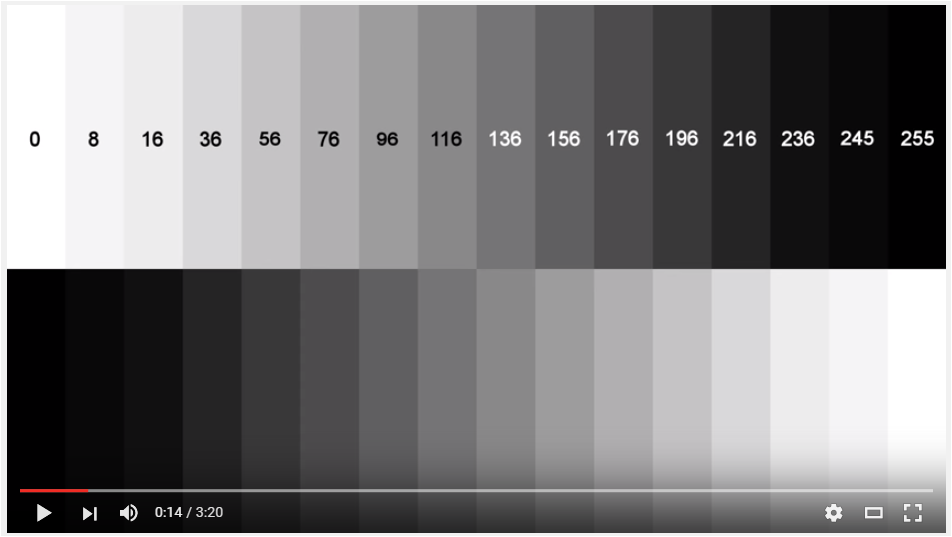
Maybe you can measure this with some placard on a wall with different shades of black strips (kinda like those old TV calibration screens) where you can see some of the black strips but not others and as time goes on measure if you can improve your visibility into it.

[1]:https://www.audioholics.com/home-theater-calibration/hdtv-ca...

Maybe some other chart like this might work better.

What kind of red light are you using for this?

Would just getting a red lamp for the office be enough for this?

What do you use for your source of light?