I don't know, McDonalds over Starbucks on food? (Or any metric!) At least the latter has sandwiches. But I don't think I really understand any scale that has either of them as well as actual restaurants?
It's ages since I've been and I rarely ate then; I agree it's not great, but I personally I never expected anything more than decent supermarket sandwich level, except I suppose that they can toast it. Overpriced/more expensive for sure - but what're you going to do, bring cheaper food in to eat? They somehow prey on that being poor etiquette, even if you've bought coffee etc., I suppose.
Err, no? We may have an unexpected (to me) dialect barrier. To the best of my knowledge, McDonalds serves primarily burgers (is a burger what you're calling a sandwich?), Starbucks serves (coffee aside) mostly sandwiches, and also salads and stuff.
(It is about ten and three years since I've been to one, respectively, but I doubt that much has changed!)
Apparently there's significant dialectal variation on whether the "hamburger" is a sandwich, including the bread, or just the meat often used to form the filling of a sandwich: https://en.wikipedia.org/wiki/Hamburger
In my usage, you can eat just a hamburger, but McDonalds won't sell you one; they'll insist on putting it between slices of bread, thus making a hamburger sandwich of it. If you want to eat just the hamburger, you'll have to peel off the bread and throw it away. They also sell fried-fish sandwiches and, in an absurd attempt to seem "healthy", chicken sandwiches.
Around here Starbucks serves mostly desserts, but that might be a regional thing.
You can definitely convince McDonald's to sell you a hamburger on a plate without bread. A hamburger isn't a sandwich, but it is commonly served on a bun in sandwich form. Like how spaghetti is common served with sauce, and if you see that dish you just call it spaghetti, but if you see a plate of just the pasta it's still spaghetti.
Ok, definitely a dialect thing. A burger (~ patty if you insist) in a bun is just a burger, I don't think anybody here (UK) would call that a sandwich.
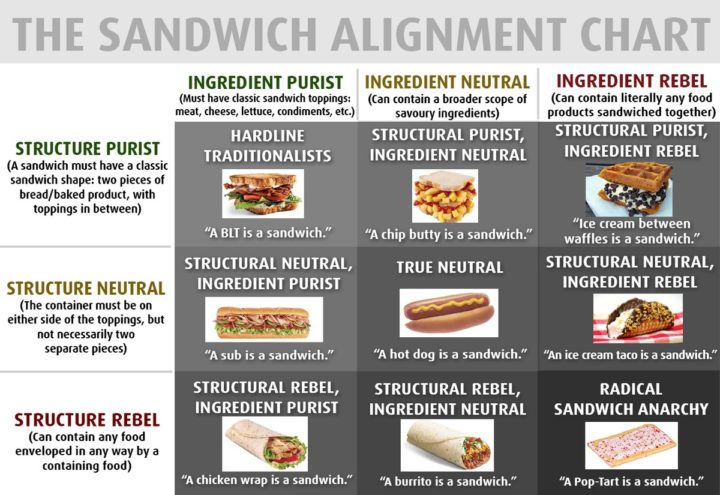
According to this graphic, all 9 groups would consider a McDonalds cheeseburger to be a sandwich, even the "hardline traditionalists": "A sandwich must have a classic sandwich shape: two pieces of bread/baked product, with toppings in between; must have classic sandwich toppings: meat, cheese, lettuce, condiments, etc."
Clearly there's an entire missing dimension to the graphic, because it totally denies the existence of the Hamburger Irredentist Youth League to which OJFord belongs!
I don't think I'm saying anything contrary or unusual for UK. The top left three (structure and ingredients pure/neutral, but not both neutral /hotdog) as pictured I would consider sandwiches.
But I think temperature is a better indicator than ingredients: 'a sandwich' is not cooked (it's ingredients might be, like meat obviously, but then cooled) or hot.
Of course you can have a 'toasted sandwich', but the qualifier's important, it's basically a different thing that happens to share a word - if you ordered a 'cheese sandwich' and it came out toasted you'd be surprised.
Which makes a hotdog trivially not a sandwich, but you could slice up some sausages the next day and have them between slices of buttered bread for a 'sausage sandwich' (which likewise is not a term anyone would use for a hotdog!)
In the US, toasted and hot "sandwiches" are commonplace. At Subway (the fast-food franchise with the largest number of franchises) the process for making many of their "sandwiches" routinely involves toasting them during the preparation process, notably the sweet onion chicken teriyaki. Similarly, a "club sandwich" has obligatorily toasted bread, although it also includes cold ingredients, and a Philly cheesesteak sandwich is always hot, as is a French dip, any other kind of roast beef sandwich, or a grilled cheese sandwich.
I'm curious if these "foods" exist in the UK, and if so, what they're called!
Not to split hairs, but I believe there is a distinct difference between a burger and sandwich -- and it's not a dialectal one. A burger always has a patty (which isn't just meat, but a piece of flattened ground up meat) whereas a sandwich does not. The burger patty is what makes a burger a burger and not a sandwich.
That's why you'll hear the term chicken sandwiches (because they don't contain patties), but you'll never hear burgers ever being called "beef" sandwiches. (Beef sandwiches exist -- like roast beef sandwiches, beef-on-weck, Italian beef, pastrami sandwiches, etc. -- these contain forms of beef that are not burger patties). Beef burgers and beef sandwiches are different things.
Similarly, chicken sandwiches ≠ chicken burgers. They're different things. The latter always has a (chicken) patty. The former almost always doesn't.
McDonald's and most other fast-food places are actually pretty consistent with their burger vs sandwich terminology and don't really mix them up.
It sounds like your concept of "sandwich" is ontologically incoherent. What kinds of generalizations apply to all or most sandwiches but not to a patty between slices of bread? We have "sandwiches don't contain patties", of course; but is there anything else? It sounds sort of like defining "Indian" to mean anyone from India who isn't from Goa, "British" to mean anyone from Great Britain who isn't from Cornwall, or "murder" to mean any event of one person killing another except when the first person is named Derek.
Such ontologically incoherent definitions are obstacles to clear reasoning (though less seriously than eargrayish definitions like defining "murder" to mean either one person killing another or stepping on the shadow of the King). Is there a reason your proposed definition of "sandwich" is not among them?
Since you mention India, would you consider curry to be a kind of soup? I believe the relationship is similar to that of burgers and sandwiches.
A curry is "just" a soup with spices. But if you walked into a restaurant and ordered "soup of the day" and got a vindaloo, you might feel deceived. If the waiter assured you that a vindaloo is ontologically a soup, I doubt that would be much consolation.
Sometimes in language, if you use a general term (A), when a more specific term exists (B subset A), then using that general term A carries the meaning A\B, because if you had meant B you would have said B instead.
I'm pretty sure that they don't here, (though as I said it's been quite a while since I've been to one) since nobody in the UK would call a burger a sandwich.