I do NOT want to go back to the times when we had to write and ship individual drivers for each graphics card, sound card and peripheral we wanted to support in our software.
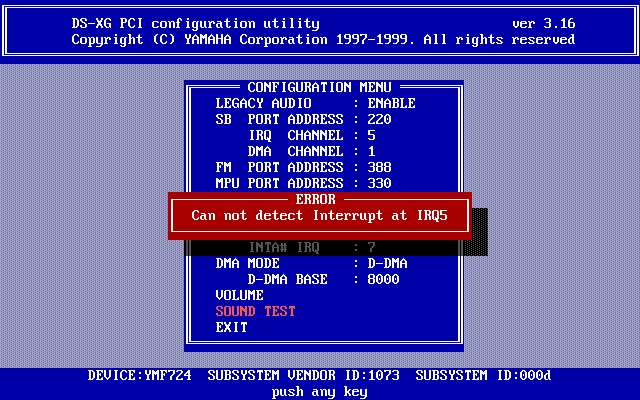
Could you imagine having to select the physical port, IRQ and DMA channel of your sound device for each app that wants to output sound? Because that's what had to be done in DOS and screens like this https://flaterco.com/kb/audio/PCI/DS-XG_IRQ_error.png
were commonplace. Good enough if you had well-defined devices like SoundBlaster(Pro) or GUS that you could auto-detect without crashing the PC, but a living nightmare with clones that didn't quite behave the same way.
So unless you only plan to support a single set of well-defined hardware, device drivers are a must.
> I do NOT want to go back to the times when we had to write and ship individual drivers for each graphics card, sound card and peripheral we wanted to support in our software.
This 1000x - I remember this time and it was quite painful
>Could you imagine having to select the physical port, IRQ and DMA channel of your sound device for each app that wants to output sound? Because that's what had to be done in DOS and screens like this https://flaterco.com/kb/audio/PCI/DS-XG_IRQ_error.png were commonplace. Good enough if you had well-defined devices like SoundBlaster(Pro) or GUS that you could auto-detect without crashing the PC, but a living nightmare with clones that didn't quite behave the same way.
I also remember the application working one second, unrelated hardware change (1), and back to the drawing board all over again
In the (post)modern world, every device should have its driver built-in (along with a CPU to run it on). The communication protocol (the command language) should be standardized for each given class of devices. The protocol should support the ability to upload custom “shaders,” whenever this makes sense, to tweak or extend the default behavior.
> In the (post)modern world, every device should have its driver built-in (along with a CPU to run it on). The communication protocol (the command language) should be standardized for each given class of devices.
We are currently in this world. NVMe, USB, etc. NVMe for example is "just" DMA'd ringbuffers of requests and responses.
One challenge is that vendors tend to want to have "special features" that go beyond the standard command set. SCSI and SMART are examples of that pain.
> The protocol should support the ability to upload custom “shaders,” whenever this makes sense, to tweak or extend the default behavior.
This part is crazy complex and not very likely to happen. "Shaders" in the context of GPUs can work because it's a very large & expensive component and very vendor-specific already. That approach won't work for a chip that costs $2, with the additional burden of needing to have the same programming interface for competing vendors.
I do NOT want to go back to the times when we had to write and ship individual drivers for each graphics card, sound card and peripheral we wanted to support in our software.
Could you imagine having to select the physical port, IRQ and DMA channel of your sound device for each app that wants to output sound? Because that's what had to be done in DOS and screens like this https://flaterco.com/kb/audio/PCI/DS-XG_IRQ_error.png
were commonplace. Good enough if you had well-defined devices like SoundBlaster(Pro) or GUS that you could auto-detect without crashing the PC, but a living nightmare with clones that didn't quite behave the same way.
So unless you only plan to support a single set of well-defined hardware, device drivers are a must.