This is quite a bit more promising than a lot of those projects. They are actually manufacturing the batteries for a battery plant. That's quite a bit further along than a lot of battery announcements are.
The announcement is suspicious. "100 hours" is not a meaningful number for a battery. The numbers you want to hear are KWH/Kg, KWH/m^3, max charge and discharge rates, number of charge/discharge cycles before storage drops off, efficiency, and cost/KWH.
"That project, announced in May last year, was originally due to be a 1MW/150MWh demonstration plant capable of outputting 1MW for 150 hours straight" hints that the discharge rate may be very low.
Previous work [2] indicates serious limits on charge/discharge cycles. Like 20-30 cycles.
> "100 hours" is not a meaningful number for a battery.
It is a meaningful number... in the grid scale energy storage market. It's a term that summarizes many of the complex properties you mentioned. For a given energy storage technology, there is a certain duration that it tends to be most effective at. For traditional lithium ion batteries, that duration is about 4 hours. If you want to use lithium ion storage for longer durations than that, then you're making substantial sacrifices in cost effectiveness, utilization rate, etc.
Obviously one of the huge areas of research is long duration energy storage, to smooth over energy availability fluctuations that last weeks or months. Some might argue that Form Energy is addressing medium duration energy storage, and there isn't really any technology suited for true long duration energy storage yet.
If Form Energy's technology works out, then they're saying they've developed a battery technology that is 10x more cost effective than lithium ion on a per kWh basis, but that the technology cannot discharge as quickly as lithium ion, which makes it better suited for medium duration energy storage. You could do the same thing with Lithium Ion, it would just be cost prohibitive... 10x as expensive, supposedly.
What I've shared above is my understanding from following lots of news about green energy tech for years now, but I'm not an expert who can answer a bunch of additional questions... but your comment about 100 hours not being a meaningful number isn't accurate. It is meaningful to the target audience.
There is several missing factors here, and it’s a useless metric. Lithium ion can do ‘100 hours’ as well - based on discharge rate. It can also do 10 minutes - based on discharge rate. 100 hours is literally useless on it’s own because it doesn’t tell you anything concrete. 100 hours….. of what?
It looks like a classic science writing article where they left all the important units off, misunderstood the whole thing the audience was looking for, and made it all super confusing and pretty useless compared to an actual paper.
I agree but that’s a highly misleading number because there’s a conflation of scenarios. Capacity is one thing, useable capacity at the requested discharge rate is another. You can’t pick and choose which numbers to use.
> > You could do the same thing with Lithium Ion, it would just be cost prohibitive... 10x as expensive, supposedly.
> Lithium ion can do ‘100 hours’ as well
Did you reply to the wrong person? I already addressed your entire comment several different ways in my original comment, and you didn't address anything I wrote in mine, as far as I can tell. Maybe I'm not the best at explaining things?
> 100 hours... of what?
Cost effective energy storage solutions that can discharge for 100 hours at maximum operating output. "Cost effective" is absolutely the key factor. Lithium ion is not currently cost effective at such durations. It is cost effective at about 4 hours, but some sources will say anywhere from 2 to 8 hours.
If you aren't familiar with a particular industry, it's perfectly logical for that industry's shorthand to sound like total nonsense. You (and most of HN) are not the target audience for a statement like "100 hour battery". Grid scale energy storage operators are the target audience, and they understand what that means. It means slow batteries, which also implies cheap, because no one would buy slower battery technology if it weren't a lot cheaper. Form Energy explicitly declares the technology to be 10x cheaper. We'll see if that holds up in reality.
Someone unfamiliar with computer science who overhears a conversation about "garbage collection" would likely be very confused. "Computers don't emit garbage! RAM is reusable, how could bytes of RAM become garbage?" But, obviously garbage collection is a real thing with computers, even if it sounds like nonsense to someone outside the industry who just knows enough to know what RAM is.
Here's an article[0] that talks about long duration energy storage, and they even mention Form Energy. Relevant quote from the article:
> Lithium-ion batteries have absolutely dominated new storage construction in recent years. But they rarely can deliver their full power capacity for more than four hours — that’s what people mean when they say “discharge duration.” Batteries technically can go for longer, but it generally costs more than it’s worth in today’s market dynamics.
One more choice quote:
> Batteries cannot yet compete with gas plants in providing prolonged power for multiple days. But a cost-effective 24-hour duration storage system could handle longer demand peaks, and a 48-hour system could do even more.
Huh, that is almost as ridiculous as using nameplate disk capacity units that sound the same, but are are different than the ones used and reported by the operating system.
In your first comment you seemed to be talking right by the person, but I guess not.
That cost-effectiveness discussion was enlightening. I find you have a knack for explaining what people don't see, by the way.
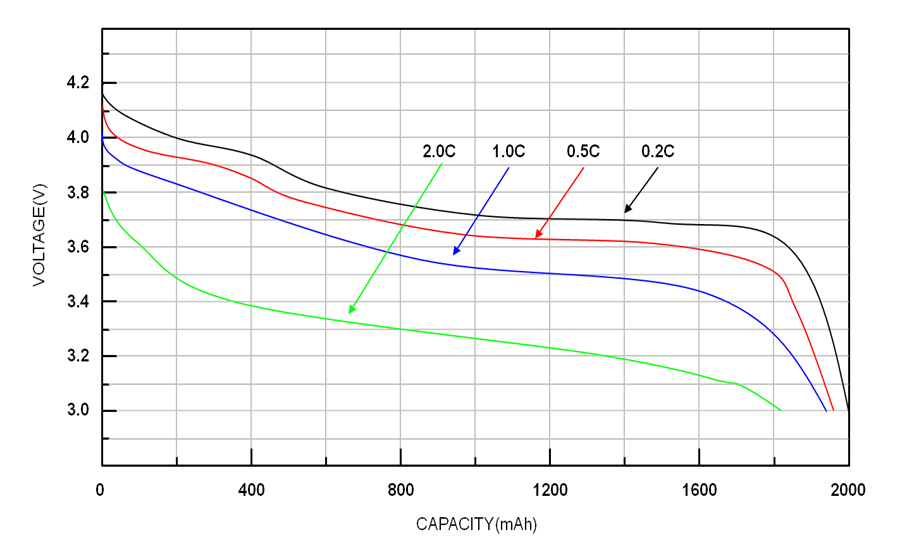
Open question, which maybe you might have info about, I'm just curious if maybe anyone crossed something on this; I wonder if that characteristic is inherent to specific energy storage tech; for example in Li-Ion IMR/INR batteries, this might be in part because of the voltage sag and discharge characteristics? In other words, a battery that sagged less under load and had a flatter discharge curve would have a wider range of acceptable durations? For example : https://www.richtek.com/battery-management/img/battery-disch...
This graph gives a general idea of how battery performance degrades the more load you put on Li-Ion batteries, the kind in flashlights, vapes, etc. The ICR18650s of the world et al.. They are not great for energy storage, long term, frankly. The harder you discharge them, the more the voltage sags, requiring even harder discharge to maintain a proper power output, leading to more heat, and power loss in spiky demand conditions. Leaving them on but at low-power for a very long time seems to be more efficient, but by the time you hit that low of a power-delivery, they become less cost-effective, because you could do the same with a hydro plant, a reservoir, and pumps. Li-Ion batteries need management circuits, balanced charge, can be overcharged, can be drained 'till they turn into a brick. They're far from idealized batteries that discharge at all rates consistently at equal voltage all along their Wh rating. A Constant-Power drain on Li-Ion heats up and degrades way worse at low charge or low battery condition, etc.
In other words, kWh is never the be-all-end-all of energy storage. If you want long, sustained power in tiny sips, I'm pretty sure nothing beats these ZnO batteries for hearing aids that use oxygen (or is it air?) as fuel. What seems to really matter is the ability to push out kWh on a consistent basis is, as far as I can tell, and we have no really good solution for this?
Am total noob. Been learning from The Limiting Factor on youtube that many different Li-ion chemistries have different use cases, ideal applications, knock-on considerations.
Why Tesla intends to use different chemistries for car, cybertruck, semi, powerwall, etc. Why others are choosing different chemistries, like Apple and lithium-titanium, for their particular needs. (Such subtlety. Total nerdgasm. What a time to be alive.)
hey battery engineer. can you help me out with this stupid solar home battery confusion i have been having?
1 battery system is 12volt X 180AH =2160WH. (lets say lead acid)
2 battery system is 48Volt x 45AH=2160WH(Lets say this is lithium)
if i am using an inverter to convert DC to AC viz 220volt where my AC appliances run, does it matter on the battery side?
if i have a load, say a pc running 1 KWH, will these two battery systems run for 2 hours both (assuming discharge rate is same, i know i know, just calculating)
i am doing this because solar batteries are being sold at 48Volt x small AH to come up with KWH but at the same time lead acid are only sold at 12Volt but high AH.
what if i buy 7AH 12Volt x 25 batteries to get same KWH?
does battery voltage or amperage matter when converting to AC? how does that work?
oh, BTW, i have a 5.2KWH solar array that is grid tied
> If they made it cheaper per kWh then they should say that
They do say that. Quote from the article:
> at less than 1/10th the cost of lithium-ion
"100 hours" isn't an advantage for this technology. The advantage is the cost effectiveness. "100 hour battery" mostly means that it will take 100 hours to discharge one of these batteries (of any capacity) at the maximum discharge rate that the technology allows. Obviously that is a huge downside compared to lithium ion, which is able to respond to grid energy needs with much higher power density!
But it doesn't really matter, if the price is right. Long duration energy storage is all about lowering the cost per kWh by developing technologies that have lower power density in exchange for also lowering cost per kWh of storage. Lithium ion isn't cost effective for long duration storage right now.
Also, people in that industry know that surely no one would proudly advertise a "100 hour battery" if it weren't significantly cheaper than lithium ion on a per kWh basis, so the term "100 hour battery" also means (to the right audience) that the batteries have to be cheaper than lithium ion.
Whether Form Energy will succeed in their claims at scale is TBD. I hope they do well, because cheaper energy storage is immensely helpful for decarbonization of the grid.
> Also, people in that industry know that surely no one would proudly advertise a "100 hour battery" if it weren't significantly cheaper than lithium ion on a per kWh basis
Or they just have a slow-discharge technology and are trying to create the illusion it's good for something.
> at less than 1/10th the cost of lithium-ion
That's just a PR statement at this point. They haven't built many batteries.
If the materials cost for a lithium-ion battery went down 90%, battery cost would only go down 50%.[1]
The number of "it's going to be really cheap" battery claims far exceeds the number of really cheap and usable batteries that actually ship.
As I said, whether they succeed or not is an open question.
Their claim is not referring to the raw battery materials. Their claim appears to be that they will be able to offer grid scale batteries for 1/10th of the cost of lithium ion, all in. Obviously, the drawback is that these batteries take over 100 hours to discharge and recharge, so they’re slow.
They are doing a pilot project for Great River Energy in 2023. That’s when we will know how real this product is.
Industry experts that I respect believe that Form Energy is very real, unlike all the vaporware that exists out there.
You can remain skeptical and dismissive if you want. It’s irrelevant to whether Form Energy succeeds or fails.
I haven’t seen anyone here saying that Form Energy has a 100% chance of success, and skepticism is warranted for any startup. Even if a battery startup has perfect battery technology, they can still fail for many reasons.
This is the key statement: with this number, more isn't better. It just clarifies which class of discharge rate you're competing with. When discussing batteries which take at least 100 hours to discharge, this battery looks to be the most cost-effective.
> Also, people in that industry know that surely no one would proudly advertise a "100 hour battery" if it weren't significantly cheaper than lithium ion on a per kWh basis, so the term "100 hour battery" also means (to the right audience) that the batteries have to be cheaper than lithium ion.
That seems like a stretch or an unwise convention. It could have some other advantage instead. Loudly proclaiming a disadvantage doesn't tell you what's good about a product, or what circumstances it's useful in.
thank you for all the great comments in this thread. I'm a former Li-Ion researcher (Yi Cui group). I'm less familiar with grid storage. Would you be open to chatting a bit more about this? My email is in my profile. Thank You!
Would you be so kind as to show how to reverse a hash? A summary is like a hash; it throws away information deemed irrelevant to the task at hand, but it is still related to the input information. So, no, I won't show how to do that, because it's impossible, and I never claimed otherwise.
I just love these "gotcha!" comments that pop up on HN so frequently. I'm having to explain what it means to summarize information.
Hashes aren't useless or meaningless, they just aren't a substitute for the full information if you need the full information. I'm sure that if you're a serious potential customer, you can contact Form Energy and get whatever detailed information from them that you need. Otherwise, you obviously only get the information they choose to disclose publicly.
Your desire for more information doesn't somehow make "100 hour battery" a meaningless statement. When you see the mpg rating of a car, that is a summary that has thrown away detailed test results that could tell you more about the fuel economy of the vehicle under various conditions. EPA testing involves multiple test "cycles" that represent different conditions, but you don't typically get to see the results of each cycle. People still like to see mpg ratings and compare them.
> I'm having to explain what it means to summarize information.
It is what it is.
FWIW, I use HN as batting practice, to refine my talking points.
A terrific recent example is Scott Galloway advocating breaking up big tech. Observing his message craft over the years is instructive, inspirational. He now says stuff like "oxygenate the market". Brilliant.
Choice of metaphor matters. "The different between the right word and almost right word is the different between lighting and a lightning bug." -- Mark Twain (from memory)
I didn't ask for exact values, and never expected them.
But if you say "summary", then I'd expect at least to get some info in the right ballpark. Otherwise it is not a summary, but just some alternative bit of (possibly relevant) information.
Also, a hash is not a right analogy for a summary because typically hashes don't hold any bits of useful information, at least within reasonable computational limits.
That isn't a gotcha comment. If it's a summary, you should be able to compare it to something else, or pick a baseline to reverse it. For example:
* What's the equivalent summary statistic for an iphone battery?
* If it has the same discharge stat as an iphone battery (just picked arbitrarily for calculation purposes), the 100-hour battery's capacity should be calculable.
The comparison has to be meaningful. This is a term used for grid scale batteries, and the capacity is irrelevant to this number. Lithium ion grid scale batteries are “4 hour batteries”, roughly. Depending on the exact chemistry and configuration, they could be anywhere from 2 hour batteries to 8 hour batteries.
You can compare Form Energy’s 100 hour batteries to traditional lithium ion and see that Form’s batteries are 25x slower. That’s a valuable datapoint, and speaks to a limitation of Form’s batteries.
The time to discharge an iPhone battery at maximum supported output of the battery is entirely irrelevant to iPhones.
Having worked in this sector I agree with everything you write, though I would add some qualifications:
For grid scale storage, kWh/kg and kwh/m3 (actually j/g and j/m^3) are, for all intents and purposes, irrelevant -- people aren't carrying power plants around, and grid scale investment is the classic Cap Ex/Op ex carry trade.
Also your $/kWh is an input to LCoS rather than a metric that can be used to make a judgement on its own; discouragingly, though LCoS is even mentioned in the article, it's only in a wavy.
The announcement is suspicious. "100 hours" is not a meaningful number for a battery. The numbers you want to hear are KWH/Kg, KWH/m^3, max charge and discharge rates, number of charge/discharge cycles before storage drops off, efficiency, and cost/KWH.
"That project, announced in May last year, was originally due to be a 1MW/150MWh demonstration plant capable of outputting 1MW for 150 hours straight" hints that the discharge rate may be very low.
Previous work [2] indicates serious limits on charge/discharge cycles. Like 20-30 cycles.
[2] https://phys.org/news/2017-11-renaissance-iron-air-battery.h...