No - since even warming areas will experience weather and climate instability which is very hard to manage. We as humans like plants are good at adapting to certain conditions, if these conditions are volatile we can't adapt. Plants and animals can't adapt.
So no, there is no possibility of anything positive in this.
It’s pretty well established by science that the effects will be overwhelmingly bad. To try to find the “silver lining” in the sixth mass extinction sounds like a pundit’s exercise in devil’s advocacy. You may as well be trying to “look on the bright side” of the holocaust.
... except that's _literally_ how science works. People _have_ looked into the "bright side" of the holocaust. Refusing to expand human's knowledge and understanding of the world because of political taboos is a mistake. Yes, we wouldn't purposely warm the planet in the interests of "increasing our knowledge," but since the experiment is already underway, there is an obligation to learn from that.
Is this science that we're doing right now? No, this is debate in the service of a particular agenda. No one is stopping you from "looking into the bright side of the holocaust", as you put it, on your own time. There are plenty of holocaust "researchers" who question its place in history. I'm sure they would welcome your company.
But if you were to pose that question in the context of a discussion about a Holocaust survivor's fund, for example, then that's definitely not historical research you're engaging in.
Likewise, when you interrupt discussion about global warming with "maybe there are good sides", without providing any actual evidence for your supposition, then your actions have the effect of redirecting the conversation away from the scientific consensus and casting a shadow of doubt, on the basis of nothing more than speculation.
Plants love carbon dioxide. That’s why it’s called “greenhouse effect” - greenhouses artificially increase the amount of carbon dioxide in order to increase plant growth. Trees and plants will grow faster and larger as CO2 ppm increases, and we have already observed this.
CO2 isn't the only metric to look at to determine if plants can grow or not in a given environment...
Rainfall pattern/acidity, humidity, average temperatures, extreme temperatures, animals living the the area (providing nutrients through body waste and decomposition), insect population, &c. are all factors, and most of these factors are interdependent
Trees, like animal, migrate, this migration isn't a matter of months, or years, but centuries, since the lifecycles of trees are very long and their locomotion speed is ... limited
Plants do not sequester enough additional co2 to offset what humans release into atmosphere. But increasing co2 will increase rate of growth of plants provided other limiting factors do not impede growth.
Flora, fauna and the whole ecology have adapted over tens of thousands of years to the current environment we're in. Sudden massive changes is more likely to lead to mass extinction, adaption due in thousands of years for entirely new species. To massively try to force adaption, will lead to lots of instability and even worse damage than letting nature take its course over a longer timespan.
It's called the "greenhouse effect" because the CO2 traps heat in the earth's atmosphere, just like the walls and roof of a greenhouse trap the heat inside the greenhouse. Greenhouses are also enriched with extra CO2 to boost yields, but that's not why it's called the "greenhouse effect"
My point was that we refer to “greenhouse gasses” and “greenhouse effect” because these are associated with what happens in greenhouses because plants grow better in them.
The greenhouse effect is due to radiation being trapped by the environment, atmospheric or otherwise - not the increased CO2. And while greenhouses may have artificially increased CO2 to improve plant growth it's accompanied with nitrogen fertilizer. The global increase in CO2 will only see a minor increase in plant growth but will be capped by limited nitrogen, and the hotter environment and associated increase in water evaporation will lead to reduced plant growth.
Not if increased water evaporation leads to increased cloud cover leads to increased rainfall. We don’t know what will happen, it’s simply too complex to model accurately.
"We don't know what will happen" is a specious reply because the models we do have are continuously improving, have been proven quite accurate so far, and backtesting continues to refine the behavior. This isn't a matter of having no idea what'll happen; there'll always be uncertainty but when the models continue to be validated and keep pointing at potentially devastating scenarios then the prudent thing is to act now instead of hoping the models are wrong.
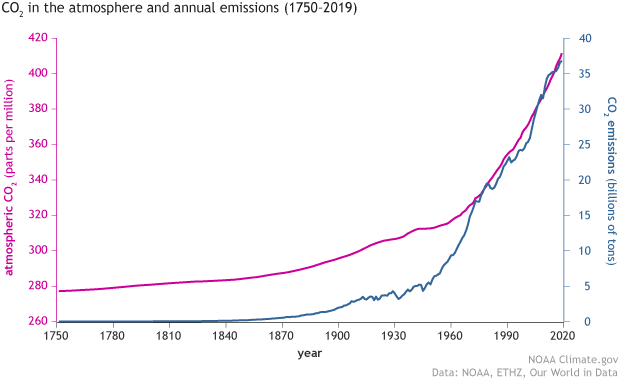
What we can definitively say is that CO2 levels have increased dramatically since the industrial revolution, and their cause is humans burning fossil fuels. On the models themselves, if you look deeply at how they are created and how they are updated, they involve a ridiculous amount of "tuning" where basically they don't line up with historical records so they have to continually modify them with fudge factors.
I think the central problem is that the way they divide the atmosphere / oceans into 100km square grids is too large for local weather, but if they shrink the grids it takes way too long to run the simulations, so they are in a bind. I am of the opinion it's better not to risk increasing the amount of CO2 because we don't know what will happen. But I wouldn't consider any of our models even low-confidence. It is impossible to solve given how chaotic nature is, the number of variables, and how slow our super computers currently are.
So no, there is no possibility of anything positive in this.