|
|
|
|
|
|
by dukwon
1832 days ago
|
|
|
> a particle has a slightly different mass from its antiparticle This is not the case, and that would violate CPT symmetry. There are two states with different masses (the mass eigenstates) but they are not antiparticles of eachother. They are linear superpositions of the flavour eigenstates: |D1> = p|D⁰> + q|D̅⁰> |D2> = p|D⁰> − q|D̅⁰> where p and q are complex coefficients. The difference in mass between D1 and D2 is directly proportional to the oscillation frequency. If p/q ≠ 1, you have CP violation in this mixing. The amount of CP violation in this measurement was found to be consistent with zero. |
|
|
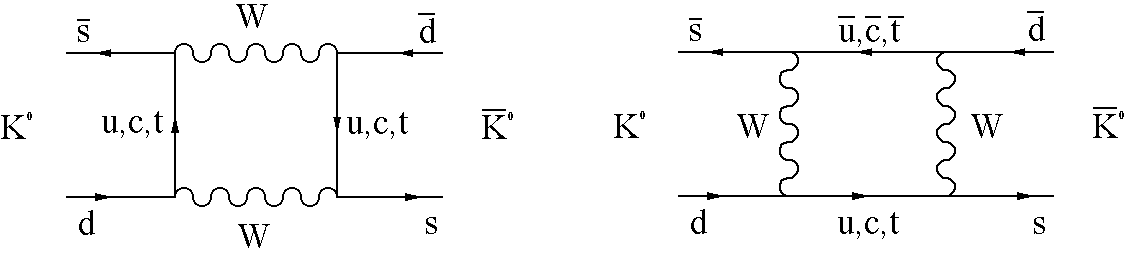
But... having flavor eigenstates not being mass eigenstates is almost as mind-blowing to me. How is that possible?
And, by "p/q ≠ 1", I presume you meant their norms?