Hacker News new | ask | show | jobs
by nsajko 1859 days ago
> Fortran for linear algebra software.

Not an expert, but it is my understanding that Julia is becoming an ever more serious competitor day by day.

> Excel for business spreadsheets.

Honest question, what does LibreOffice miss compared to Excel? In any case, (again not an expert) spreadsheets seem quite inferior to a combination of Julia, CSV and Vega (Lite); although there are certainly more people that are familiar with operating Excel.

2 comments

> Not an expert, but it is my understanding that Julia is becoming an ever more serious competitor day by day.

And Julia uses BLAS which is written in Fortan.

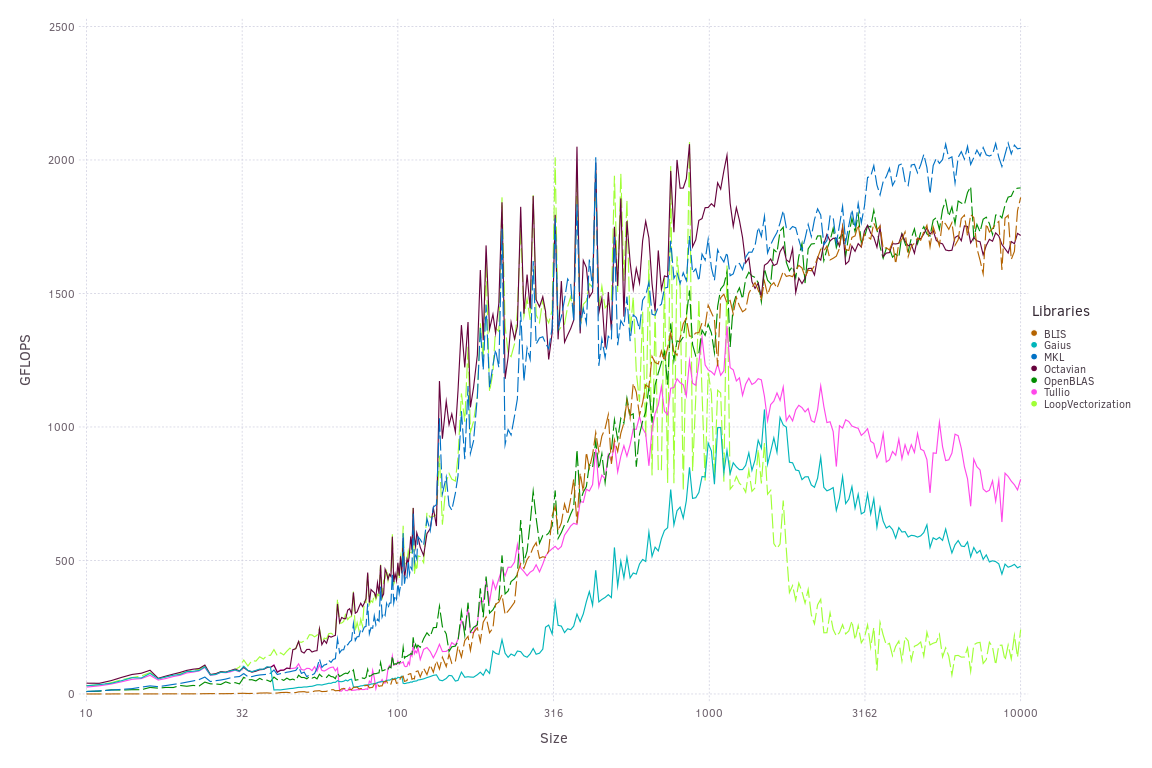
Not necessarily. All of the DifferentialEquations.jl defaults use pure Julia BLASes which outperform the Fortran BLASes. Mainly, RecursiveFactorization.jl and Octavian.jl, which tend to match or outperform MKL and OpenBLAS on our benchmarking computers, form our workhorse.

https://raw.githubusercontent.com/JuliaLinearAlgebra/Octavia...

https://github.com/JuliaLinearAlgebra/Octavian.jl

https://github.com/YingboMa/RecursiveFactorization.jl

Julia has a long way to get there, where Fortran is in terms of stability and maturity, needs approximately 60 years more.
What issue do you have with the use of RecursiveFactorization.jl in DifferentialEquations.jl? I can't think of a maturity issue so I'm curious what you have found, or whether this comment isn't grounded in specifics.
Did my original post even mention RecursiveFactorization.jl or DifferentialEquations.jl? (or is this an implicit package promotion? I do not have issues with them anyway, perhaps great work, have not used them...) Regarding your second point, let's see if the language and its various package APIs remain stable, actively maintained, and backward-compatible just ten years from now, let alone 3 quarters of a century. Such issues do not become visible right away or overnight. I am not against the language, just stating the fact that it has yet to pass the test of time.