Hacker News new | ask | show | jobs
by init 1863 days ago
Africa has 54 countries, thousands of languages and 1.2 billion people.

As an African, whenever I see this map I'm more astonished by how densely populated Europe and India are, how big and populated China is and how homogeneous the US is compared to its size.

10 comments

That really depends on where you draw the borders on Europe.

The population density of the EU is 105 people per km2. Include some or all of Russia and things look rather different. Similarly, Finland is 8% of the EU’s land area but only has 16.3 people per km2.

https://en.wikipedia.org/wiki/Demographics_of_the_European_U...

That has to be including all of Russia as part of "Eastern Europe" (indeed, if you drill down into the data, that's what's happening).

When we're talking about geography, you can't include anything east of the Urals in the European subcontinent.

The Urals as a border is purely political and historical in nature. It has no particular geographic significance.
Huh?

In Geology class they teach that the Urals formed about a quarter of a billion years ago when Europe and the Khazak land masses collided. I know this because we had to do a group paper on why such an old mountain range would be so unusually high. (Long story and not important.) Point is that though my degree wasn't in geology, and I'm only going from memory, I'm 99.999% certain that the Urals are the Urals for a critically meaningful geographic reason. At least, geologically speaking.

Of course, if this is all just political, then you can take any borders you wish to be Europe. I was only pointing out that if we're talking about landmasses in the geological sense, then the commenter was correct, Europe clearly does not extend past the Urals. Scientifically speaking.

In terms of geology it’s all just the Eurasia pate. https://en.wikipedia.org/wiki/Eurasian_Plate

Europe has always just been an political/economic entity as overland passage to Asia is difficult. Which makes the border completely arbitrary with various historic maps placing it in different areas.

That said plate technics is surprisingly recent, reaching a fairly modern form and acceptance in ~1960’s.

I'm referring to the European countries included in the visualization.
I'm always surprised to hear people say "The world is overpopulated" - I'm thinking there's plenty of room to grow in regions that live sustainably.
What would those regions be ? The Sahara isn't overpopulated if you look at the density of population, but it can't really sustain anybody. I'm sure there are some rain forests left to cut so we can grow more food for 1 or 2 billions extra people, but what's the end goal ? The world is overpopulated.
What are you measuring to determine over or underpopulation? Food production? We grow more food that is required to feed current population, much of world's farming is not efficient, done without modern equipment, etx., and then there is the subject of meat - if we stopped growing feed for animals, and instead seitch to vegetarian diet, we could feed a lot more people.

Then there is the argument that glasshouses are 10x as productive as open fields, so if we were to use them predominantly, we could return land to forests.

The modern agriculture just means automating depleting natural aquifers and using up topsoil and abusing chemicals at massive scale. Its the agricultural equivalent of optimizing for next quarter, but losing out on next decade.
Ancient equivalent is slash-and-burn agriculture, and famines from crop diseases and droughts. I dont think modern vs oldschool juxtaposition is helpfull
Agreed, but the scale makes all the difference. What few million farmers were doing manually is now being done by same number of of people (approximating, but could be wrong) using massive industrial scale machinery.

Quick google-fu is failing me with actual numbers, but I would not be surprised if we are using 3/4/5 orders of magnitude of water every year compared to 3000 years ago.

How would greenhouses use up top-soil?
Some places when seen from planes looks literally as vitrified, for example in Netherlands.
Those would be the regions that live sustainably - e.g. low insecticide use, but currently have relatively low crop yields that can be improved by adopting some non-harmful modern techniques, like mechanization. You can also compare the average amount of garbage thrown out by a family - developed nations generate a lot of of waste and a lot of greenhouses. If we're capping population growth, the most wasteful regions should be the first.
No, there isn't room to grow unless you're talking about decimating other species and habitats. I live in one of those densely populated areas, and see the environmental, social, and political challenges of overpopulation every day.
with the population density of NYC the entire World population would fit in Texas.

the environmental benefits would be enormous

Good luck living in Siberia.
As the tundra thaws that place is predicted to be a massive agricultural production area.
Biodiversity is being decimated at an ever increasing rate, oceans are being stripped of life, many minerals will be mined out and become depleted and economically inaccessible within a generation or two, fresh water is running out, antibiotic resistance is increasing, long term chemicals are accumulating in the environment.

That's all before you even talk about greenhouse gasses.

When you say the US is homogenous for it’s size, are you referring to the physical geography or the demographic make up of the population, or something else entirely?

(I think I would disagree, but good faith requires I actually try to understand what you meant before I take issue with it.)

As the other commenter responded, I'm referring to the linguistic, socioeconomic and judicial homogeneity. Even though the US is culturally diverse, it still has a single currency, a single dominant language and a single jurisdiction (with minor state specific legal requirements). I only need one US visa to travel to all 52 states. A software company taking payments in the US has access to all 52 states. A peach cobbler is called the same throughout the US even though the recipe might change a little bit from place to place.

This is not the case in Africa or Europe, where countries use different languages, scripts, legal codes, currencies, driving directions, etc...

EDIT: I'm referring the land masses included in the visualization and what they entail in practical terms.

The US can be seen as a single market, the same applies to China and India. Europe has the schengen area, the EU and the EEA. Africa needs similar initiatives.

Do you have any idea how many different kinds of sandwiches we have in this country? You're just not looking at the right things for diversity! :-)

https://www.nytimes.com/interactive/2015/04/14/dining/field-...

Good article. They rightly attribute the reuben sandwich to the Blackstone hotel.

Anyway, I'm enthralled by the idea of a lobster roll. I had clam chowder one time when we were in New England and it blew me away. I ate the pint and tried to go back and buy another, but my husband stopped me. I've had it a number of times since back here in the middle of the country and it doesn't even compare. Even in fancy restaurants, it's just not the same. I really want to try a lobster roll, but I have the feeling I'm not going to find one around here that does the sandwich justice.

The lobster roll is really delicious.

I’m sure you’re aware you had New England clam chowder, And that there’s also Manhattan clam chowder. But few folks know there’s also a Hatteras clam chowder. It’s made with a broth and the taste of clams really comes through a lot better than with the cream or tomato based variants.

https://blog.carolinadesigns.com/outer-banks-food/hatteras-i...

(And now that I’ve worked my way to the Carolinas… if you’ve never had shrimp and grits, look it up. Yum.)

p.s. as good as lobster is, stone crab is even better.

Definitely New England clam chowder. I'm not sure I'd like Manhatten style. You're just teasing me now with this Hatteras style. I don't think there's a good way to get decently fresh clams to the middle of the country.

I don't have a taste for grits. I finally came around to gravy on my rice, but I'm still iffy on grits.

I'm holding out hope that there's a decent lobster roll around here somewhere. You can get live lobsters here. There's no real reason you couldn't do a good lobster roll.

I did have fresh-caught blue crab when I was living in New Jersey. Once I figured out how to eat it, it was amazing. Fluke and striper straight from the water to the oven. I don't miss the coast, but damn do I miss the food.
I love this! As an American, I think I've had most of the sandwiches on this list at one point or another in my life :)
Everything you said is correct and makes a lot of sense with the exception of the number of states. There are 50 states in the US.

Better luck next time DC and Puerto Rico.

That was pretty clearly a deliberate choice to show solidarity with two parts of the country who lack the same rights and government support for historical reasons.
Not taking away anything from what you said, my experience has been a bit different.

I actually found US more federal in nature for doing business compared to India and to some extent Europe.

The tax laws are lot more state specific than India, California has very different rules for privacy(ccpa) or environmental regulations than other states. Europe largely following GDPR is good enough (with some exceptions for Germany), most environmental regulations seem broadly consistent across Europe.[1]

US did seem lot more regulatory diverse than India which is more culturally/linguistically diverse,it feels like US states have more significant autonomy than countries in Europe have over EU regulations!

[1] It may be that I have not done as much work with Europe as US so I have not yet come across nuances

Try running a barbershop in France, Germany and the UK. They are far from business homogeneous.

In eg Germany you need three years of government approved training to work in one. And another two years of government approved training to run one.

(And I don't think those training certificates can be used for anything in other countries?)

Barber licensing is done at the State level in the US, and also varies pretty widely between states.

https://www.barber-license.com/

Not saying regulations are lighter in the Europe compared to the US , like the other poster below mentioned I have usually found some mechanism for cross border applications.

On a fundamental level access to free market and European project has a goal of synchronizing the regulations across member countries.

US states are proudly unique, Texas doesnt even keep frequency sync to the national grid!

Even UK(Texas of Europe?) , generally need to follow similar rules if they want access to common market brexit or not.

The training is often transferable.

Here is a link to a database of regulated professions in the EU: https://europa.eu/youreurope/citizens/work/professional-qual...

A hairdresser in Czechia, with equivalent qualifications from other countries listed: https://ec.europa.eu/growth/tools-databases/regprof/index.cf...

> The US can be seen as a single market, the same applies to China and India. Europe has the schengen area, the EU and the EEA. Africa needs similar initiatives.

Yes, but you don't need much international cooperation to get a single market or visa free travel: individual countries can unilaterally declare free trade and open their borders. (And economic theory is in favour of that, too.)

You get an imbalance with free incoming trade but taxed/impaired outgoing trade. Perhaps a massively importing country can live with it if importers get better deals as a consequence. But otherwise bilateral arguments would be the long term viable approach.
What imbalance? The benefits of free imports accrue whether you’re a big country or a small one. Hong Kong did very well out of unilateral free trade.
The demerits also accrue, you lose a bargaining chip for your export fees, and it makes it more attractive to rely on imported goods than build a local alternative that could lead to an export business.
Also, FWIW, I've read that Africa has more human genetic diversity than the rest of the world put together.
I think america is diverse, and shockingly homogenous given its diversity. For example, chinatown in NYC does not seem particularly different from chinatown in SF.

Yes, the midwest calmer and the south is friendlier, the east is more uptight and the west is more chillaxed, and the cuisine is different in different parts of the country, but these are pretty much details at the edges. Everyone speaks english, the low-end labor speaks spanish, african-americans are discriminated against, etc.

To me (an outsider from Europe) the US doesn't feel homogenous at all. Compare New York to Taxas or California to South Carolina and they feel as much as different as for example Germany and Spain. With the only difference being that all US states share the English language and Europe has different languages, but even that difference is slowly reducing. For example the French, famous for not speaking English 20 years ago now actually do it very well if they're under 40 or 50 or so. And similar for Germany.
None of what you write makes any sense.

Spain and Germany have hugely different history, completely different food, different weather, they speak two non-compatible languages sets (Romantic vs Germanic), they have different laws, different stores, different banks, anything.

Texas and California speak the same language, have similar makeup of people, are similarly wealthy, they have the exact same stores, your bank account is the same, everything.

Now I am not argueing there aren't differences between CA and TX. But those are similar to differences between Hamburg and Bavaria or between Catalonia and Madrid. German<>Spain is a whole different ballgame.

Don't want to interrupt this nice discussion but the head topic was about Africa for once, and here we are talking about Europe and US again. Funny we can't switch even for a moment. I bet Africa sees a lot of this.
Probably the vast majority of HN readers/posters hail from the US and Europe, most probably haven't even been in any African country, so that hardly remarkable or unexpected.
And even in Spain itself you have three romances plus some alien language: Galician (closer to Portuguese), Catalan (French-Occitan family), Spanish (and Andalusia has it's own subdialect), plus Basque.

A Basque playing the txalaparta would look like a guy who came from a UFO for an Andalusian guy playing Flamenco with a guitar.

Ditto with a Galician with an Atlantic culture (and Celtic customs) plus a obvious bind to Portugal because 500 years ago they were the same language against a Valencian living in the sunny Mediterranean towns.

> Catalonia and Madrid

I believe those are what are literally called "fighting words"

I think you may be comparing "apples to oranges" within the US. When you say New York that includes a lot more than New York City. I'm from New York City but have never really felt out of place in Austin, San Francisco, LA, Denver, etc. But far upstate New York would be a different story.
Eh, the difference between those all will have more to do with population density than their location. Rural New York feels more like rural South Carolina than it does NYC.
>eel as much as different as for example Germany and Spain

Then you don't know Spain.

Western chillaxation is put-on.
It seems to me the commenter is referring to the number of languages and countries in a land mass.
What does it mean to be an African? Is there unifying culture of all of Africa? Like when I say I am an American, I don't mean the continent, I am talking about living in the US, but when someone calls themselves an African, what can I glean from that other than they live on a large, heterogenous continent?
As a fellow African I struggle to answer the question!

I find it interesting that your (valid to you and a commonly used use case) of "being American" excludes Canada, Mexico, etc. ... (actually all of South America).

There isn't a common culture.

I'm also acutely aware that my definition is extremely unlikely to be shared in North Africa, Central Africa, even in another province of my own country).

All that said "being African" parses with a lot more emotional and ideological content than just geography.

There's a hint of pride at the grandeur and diversity of the landscape and peoples, a dollop of hope for a brighter future given our huge potential (despite our poverty we have so much more stuff than many other countries), there's a dash of injustice of colonial history and exploitation.

When I work with someone from Nigeria or Kenia or I interact with someone who is effectively a refugee from DRC or Zimbabwe - I can honestly say we seem to have something in common with our feeling about Africa.

It's an identity. It attracts people who have it and repels people who don't have it. With efficient communication channels around it you can eventually build homogeneity. (I'm African)
I think you'll find lot's of people from North and South America would take issue with your definition of "American".
Totally but they would also know I was just speaking of the US. I don’t have any frame of reference for someone who says they are African.
Check out these latest photos taken all across various USA cities by NYTimes photographers: https://www.nytimes.com/2021/05/16/us/scenes-from-americas-r...

It's quite varied for a homogeneous country.

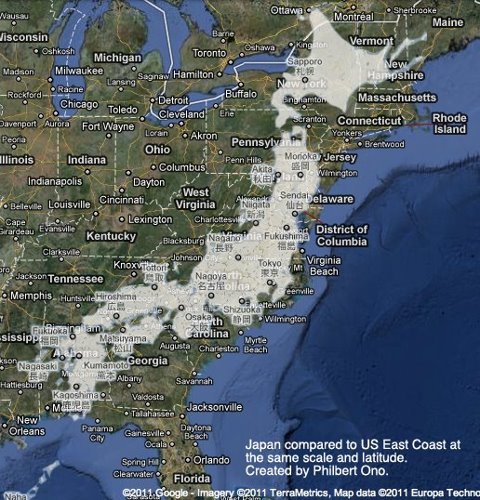
A related map comparison that blew my mind and left me feeling I understood things a little better, is East coast of USA vs Japan:

https://photoguide.jp/log/wp-content/uploads/2012/04/JapanUS...

This is especially funny when I look at my home country Germany.

It's one of EU countries with the densest population, but it doesn't feel that way. Especially the east is very empty in the countryside.

This is very much a question of reference points, I'm sure even the Belgians will insist there are sparsely populated areas in their country :)

Scrolling around on a map of Germany, I could find a forest about 10 km across in the eastern bit that only looked to have a few roads marked on the map. Go into northern Sweden and you'll be drawing completely empty circles 50 km across...

America understood very early on the power of story telling to build homogeneity. Medias are not just entertainement. They are the back bone of a nation.
The US isn’t very homogenous, it is merely depicted that way in media.
In which sense is the USA homogenous?
Language, currency, jurisdiction (to large extends), media…

An American from Idaho will be able to communicate, trade and watch the same tv as someone in Vermont, whereas a person from Malawi will not be able to do any of these things with a person in Guinea

As someone from Scandinavia I was surprised to to find out that there is even homogeneity in brand names. In Scandinavia if you from Denmark to Norway, you will likely stop shopping at Netto and instead shop at REMA 1000, if you travel to Iceland, you might find your self shopping at Nettó again, but it is a whole different chain (more likely you will shop at Bónus). In the USA you will probably shop at Safeway in New York, just as you would in California.

In comparison all of Scandinavia has a similar population size as the New York metropolitan area.

Actually, the one example you've picked there (grocery stores/supermarkets) is quite a bad one. There are very few national supermarkets in the US. Ironically, Whole Foods Market (now owned by Amazon) is as close as any to this title. Safeway may once have been widespread, but in terms of stores bearing that brand (as opposed to be owned by the company), there are not many Safeways anymore.

Instead, there are regional supermarket chains, some of which branch out a little into areas where they are not the dominant store.

Examples:

Albertsons: mostly in the western states

HEB: Texas only

Publix: southern states (all the way down to Key West)

Piggly Wiggly: hard to describe, but mostly a stripe running up through the midwest

Fairway: NYC, NJ and almost nowhere else

Now, had you written that about, say drug stores, it would be more true. Everywhere you go it will either be a CVS, Rite Aid or Walgreens. There are independents, but these 3 dominate the entire country, with some regional focus, but always a national reach.

Trader Joes has a pretty wide presence across the country (in 43 out of 50 states). And while they're not supermarkets per se, Walmart and Target have also got into groceries in recent years. There's also Costco in a similar boat.
Trader joes is the best example of homogenous because they sell mostly their own brand cross-country, so local stock doesn't dictate what is available on the shelf. The prices remain static across most of their stores as well (for most items) which is a HUGE reason why New York and Cali folks love shopping there.
And there are regional brands in many areas - just below Subway and McDonalds you’ll find things like Culver’s or Jack in the Box or In-n-Out - regional. Gas stations and restaurants are often regional, especially as cuisine varies.

Of course you can find McDonalds everywhere but you’ll find those in Europe, also.

I think the main thing that makes it feel superficially homogeneous is the shared language - which is now even more shared since the advent of Hollywood and national entertainment.

While Albertsons itself might be mostly in western states, the parent company owns plenty of other chains in other states, e.g. Safeway or Jewel-Osco. These chains all run the same promotions, carry the same generic brands, etc.
Thanks. I didn't realize that the parent company of Safeway had gobbled up Albertsons as well. Good to know.
Is Walmart not a national supermarket?
You're comparing a continent with a country. A person in Canada has very little in common with those in Mexico and/or Panama, etc. The same could be said about most continents.
I was answering the question how the USA are considered homogenous, not how the Americas are.
GP is saying that if you're comparing to the US, it would make more sense to compare to e.g. Ethiopia (a single country with several ethnical groups and languages) than compare Malawi to Guinea (two different countries, thousands of miles away from each other)
Vermont and Idaho are also thousands of miles away from each other, a distance not achievable within Ethiopia's borders. I think people are missing the point, so to make it clear, in the US, you can move from Los Angeles to New York (not even extreme ends of the country) and experience the same culture, language, TV shows, cell phone, etc. at both ends. That would be the same as moving from Madrid to Moscow, or Lagos to Khartoum.