Sure there is. I don't know which motivation you'd have to bribe someone to promite your product, though. Would also be hard to sustain if intellectual property was decommodified.
Other, more pressing concerns have to be addressed, though.
Consider firms which are wholly owned by either 1) every single employee (worker-owned firm), 2) every employee and every customer who opts in (consumer co-op), or 3) literally every citizen of a government (publicly owned).
You own it in partnership with the other people who own it.
This is, in the strictest definition, the socialism that people are so scared of.
How much control do you have over the military of your government? Or even the DMV? Are these organizations behaving directly as a response to the majority will of the people? If not, how do you solve that problem before you add more organizations?
The best answer we have today, IMO, in terms of ethics of freedom and agency, is "representative democracy," which may be extended to "liquid democracy" to bridge the gap between small, direct-democracy-capable organizations and large, unwieldy ones.
Unfortunately, no solution will be perfect, but that doesn't mean some aren't better than others. The problem is in essence unsolvable. Politics and civilization is an exercise in minimizing harm rather than eliminating it, maximizing utility rather than spiking it.
I don't know how but I do know it is much harder to make something everyone involved thinks impossible than to make something everyone thought they already had.
Perhaps the problem is as simple as setting up a forum with sub forums for every government official - then throw money at it until it works.
In the sense first and foremost that you may produce and design it, especially if production is structured in a co-op way, in the sense that you use it, especially if it's a consumer/worker co-op but also in a worker co-op, and to a lesser extent in that you are part of the society which produces it.
because there aren't luxuries in that system. that creates a need, and from it a secondary market, which without titles[1], sees the exchange of power either via favors exchange or plain tribalism. bribery then becomes the norm for the influential, even if actual money doesn't change hand, favors and contraband do.
1: a catch all to include both money, 'quota cards' and the likes
Socialism, like capitalism, also has a zero day vulnerability by the name of mundane old “human corruption” that undermines its goals. Capitalism just works better because it pits people against each other, keeping the focus off authority and top level control.
People thought of this issue since 1870 and the solution they came up with is simply non-transferable rationing devices. In traditional Marxist terms this was labour vouchers but nowadays there are much better solutions. Marx himself wrote about this, in terms of primitive accumulation in socialism.
For sure there are a lot of issues, but this isn't one of them.
You could in theory have bribery in material terms, but this is much easier to trace than in money terms.
My argument was with the idea that money will be gone as a rationing device. You can come up with alternatives but it’s the human nature that is the problem not the technology we use to ration resources. Let me know when this bug is fixed.
Well, that's not the problem we were talking about, is it? We were talking about the issue of bribery, which is made possible by the fungible nature of money.
I assume that this criticism is offered in good faith, and that you're in need of good, solid Wiki articles about the tens of millions of victims of Communist regimes--well, I'm happy to get you started!
Here's an article about the Soviet terror-famine (known as the Holodomor) which killed 4 million Ukranians. No worrisome notifications on this article, so I assume it meets your rigorous standards:
And here's one about the so-called 'Great Leap Forward', when the Chinese Communist Party's top-down modernization plans resulted in the accidental deaths of ~50 million human beings.
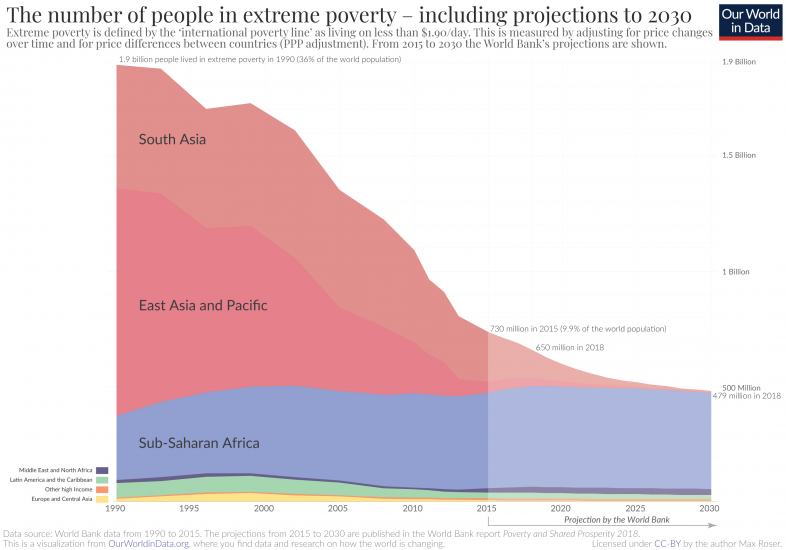
The fact that Capitalism has not (yet) solved the global issue of extreme poverty is hardly an argument against it. Particularly when it is the transition to capitalism which has done the most to solve the problem!
After all, it's a simple matter of fact that the accelerating decline of global poverty since 1990 was the result of the transition to capitalism in formerly Communist/Socialist countries in Asia, including the CCP's own particular flavor of state capitalism.[0]
I think comparing Capitalism and Socialism is a red herring. There is no "pure" Capitalism nor pure Socialism.
There are only countries with specific sets of laws governing them. The question is which system of laws is better and why and when and most importantly: Better for WHO?
Arguing that capitalism is the solution is like saying: Don't look here, we are better than socialist countries and therefore there is no need to improve anything in our country. Same for the other side too.
I'm not denying or excusing that historical atrocities occurred under socialist governments, but for perspective one should also look at the myriad atrocities that were and continue to be committed under capitalist governments. That doesn't excuse such actions, but neither side is innocent. I suggest reading The Wretched of the Earth* Chapter 1, "On Violence".
* Though I will object that it is unfair to attribute the actions of the Khmer Rouge to socialism. Like the Nazis they were socialist in name only, and in fact were supported by the United States in their war against the Socialist Republic of Vietnam.
The issue is that these atrocities were committed more specifically as a result of communism, whereas other attrocities are less closely attributable to capitalism since it has been the majority default throughout history.
EDIT:. I'm not saying what's normal is ok, I'm saying what's common is more likely to falsely correlate with anything. Whereas as the common factor for communism across the board has been a high statistical propensity for mass murder and genocide. This includes the nazi regime I might add (look it up)
I'm not really interested in having this argument anymore, but I'll leave you with this:
Just because something is the "default" option doesn't mean it is non-ideological. Ideology is a powerful tool for shaping people's actions. People will go along with insane and sometimes horrifying things just because they perceive them as "normal". Maybe expose yourself to some alternative ideology. You don't have to agree with it to learn something.
That's ahistorical considering almost all deaths attributed to communism were a result of industrialization, a process which was just as deadly under capitalism.
The only difference as a result of ideology was the timeframe. The USSR was forced to rapidly industrialize due to global pressure from foreign militaries and famines in China were exceedingly common long before communism.
History is not as simple as you're making it out to be.
That is the same thing as saying North Korea's failures are actually due to democracy. "The Democratic People's Republic of Korea"
Obviously the name of an organization doesn't mean jack compared to their actually implemented and enforced policies. The first things the Nazi's did when they gained power was kill all the socialists, communists, and unionists. They are anything but socialist.
Slavery is not a function of capitalism, though. Capitalism is being able to 1) firstly, own yourself and your body 2) thus sell your labour however you wish. It's the alternatives economic systems that prevent you from being free.