Hacker News new | ask | show | jobs
by throwawayfire 1913 days ago
> The disruption will have introduced hypotheticals

In general, temporary disruption has some long-term positive economic effects (which is directly why 'disruption' is valued in Silicon Valley).

For example, during London Tube Strikes, commuters find different and more efficient routes and 5% ended up permanently changing their route on public transport: https://www.independent.co.uk/news/business/news/tube-strike...

5 comments

This happened with the bridge collapse on I-85 in Atlanta [1]

I used to take the access road parallel to the bridge and avoid a lot of traffic that was south bound. When the bridge collapsed and I-85 was blocked off, everyone learned about the parallel access road, and it now became a cluster of a traffic hot zone too.

Prior to that, a lot of people were not aware of the alternate route.

[1] https://en.wikipedia.org/wiki/Interstate_85_bridge_collapse

I’ve seen this happen to a lot of my favorite shortcuts in the east bay since the introduction of waze.
The discovery of the alternate route by "everyone else" means that the roads are now in more usage.

Unless the bridge collapse resulted in increased traffic levels afterwards, the same traffic that used to go over I85 is now distributed over 2 routes.

While there's a net negative to you, it's likely that a lot of people ended up saving time on their routes.

> it's likely that a lot of people ended up saving time on their routes.

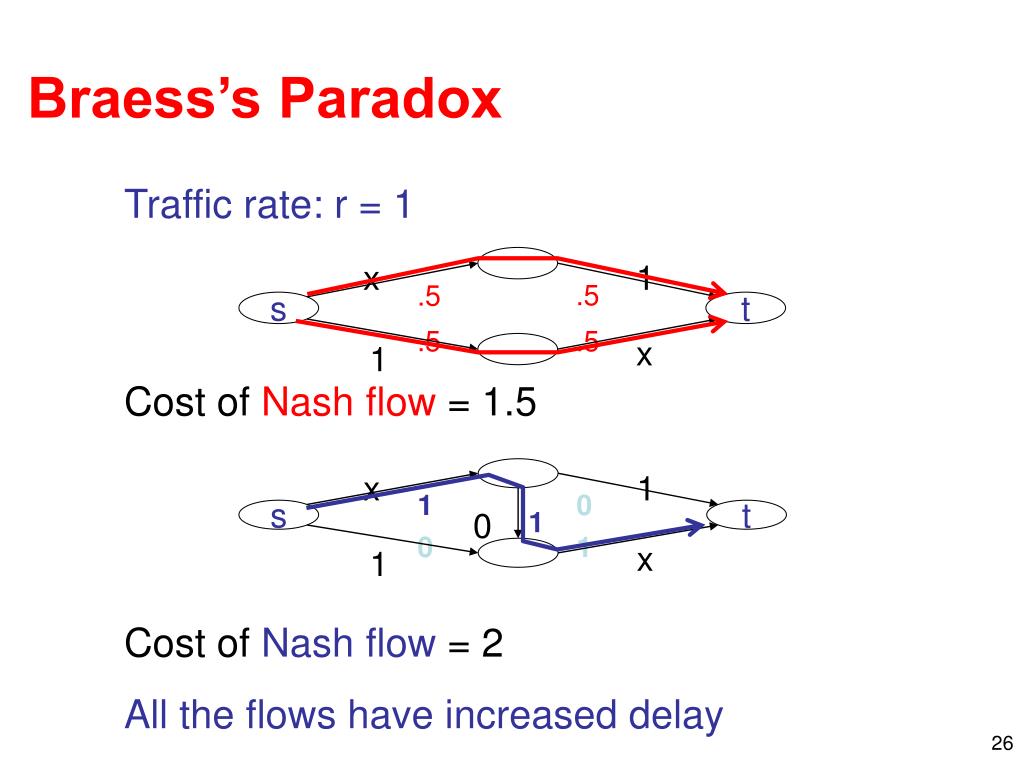
It's theoretically possible this describes a Braess paradox, whereby everybody loses: https://image.slideserve.com/280060/braess-s-paradox-l.jpg

This reminds me of annealing, and why it's implemented as a technique for finding optima.
I'm not blocking the canal, I'm testing robustness!

Also in the big picture with covid not being as deadly as it could have been, could serve as a nice dress rehearsal for a captain trips.

We theoretically may have avoided, for the next few decades, the risk of a truly dangerous infectious disease being underestimated, something halfway between Covid and extinction-level threat.
Given the sheer quantity of idiots underestimating it right now, I'm not too sure that things will have improved a few decades down the line.
I think it's hopeful humanity would prevail a more deadly pandemic, many countries closed borders very quickly and there are island nations with understandably quick responses. Civilization as we know it could definitely still get wiped out though.
That's a great tshirt slogan "I'm not blocking the canal, I'm testing robustness!"
Think of the EverGiven as global shipping's chaos monkey....
Yup, just think of covid. It has accelerated digitization of the world in an unprecedented way, amongst the many other world changes it has caused.
That article doesn't link to the study and leaves out major questions about the methodology:

1. How did they decide that the benefits would continue over the course of 4 years?

2. How did they determine what "time lost" was? I imagine it's greater than just extra time waiting at the station. People probably also got lost trying to find a new way around, and were late to things important to them. Unexpectedly being late to a job interview is a very different kind of time lost than saving 3 minutes on your regular daily commute.