|
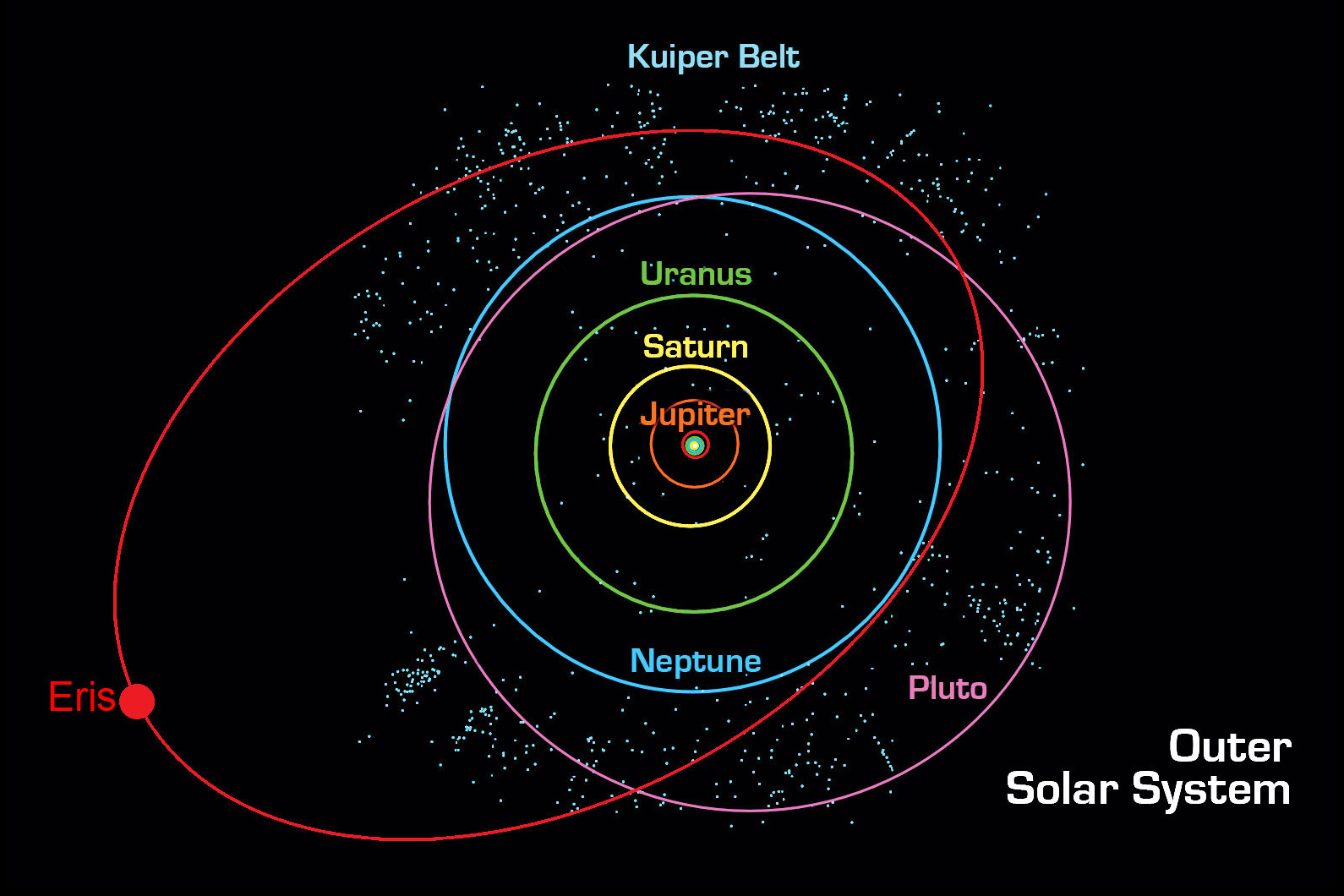
I think your counting's off: if you want to count dwarfs then Ceres would be "Planet 5", in which case "Planet 9" would be Neptune most of the time, since only a small part of Pluto's orbit crosses inside Neptune's. Pluto's number would also depend on the current location of at least Quaoar, Haumea and Makemake, since I know their orbits cross inside Pluto's. Pluto may also swap numbers over time with others, like Sedna, Eris, Gonggong, Orcus, Salacia, Varda, Ixion, 2003 AZ84, 2002 MS4, 2002 AW197, etc. since they have quite low perihelia (30 to 40 AU) so may also cross inside Pluto's orbit. Dwarf planets seem to be lucrative business for those who sell wall posters of the solar system. I would hate having to learn all of their relative locations and interactions in school! |
That seems to have been the main reason the majority in the IAU voted to make dwarf planets not considered actual planets. Can't really say I agree with the mindset - it overly simplifies our solar system, as well as making the rocky planets appear more similar to the gas giants than they actually are (a problem in a lot of images of the solar system as well).
It's funny to see the number of people who believe the definition was just following scientific facts, when the vote came down to personal preferences over nomenclature. It's one of the more common examples you run into where modern day scientism has trouble distinguishing what is and what isn't science.