Hacker News new | ask | show | jobs
by klodolph 1922 days ago
I think that this is just an attempt at explaining away toxic behavior without taking responsibility for it.

People in the OSS community can, at times, glorify toxic behavior. I know people who take it as a badge of honor to "speak the truth", "speak directly", or "have no filter". Speaking directly and speaking the truth are good ideals to have, but if you really want to PROVE that you speak the truth and don't fear social pressures, what better way to do it than to be rude or insensitive to people?

Take Mr. X, who is outraged by Microsoft's behavior and refuses to buy Microsoft's products, tells other people about his problems with Microsoft, and tells everyone to use FOSS alternatives? Now, Mr. X also thinks that it's stupid to believe in god, and is not afraid to say it to everyone he meets. He's suddenly changed from "FOSS advocate" to "toxic workplace on legs".

This is by no means exclusive to the FOSS community. Think of the product manager who styles himself a Steve Jobs type, who abuses his staff in the style of Steve Jobs. These aren't examples I'm picking out of a hat; these are real people.

5 comments

That may be but there is something to the OP's point. The big 5 personality test which is the only personality test rally taken seriously in clinical psychology, has an aspect called agreeableness.

Having high or low agreeableness has a tremendous correlation with all kinds of outcomes. It's highly tied to success in corporate, church, and government settings. It's very likely that to be set enough to go against the majority in your field and build an alternative infrastructure in the face of a great deal of obstacles is going to attract a higher amount of diaageeable people. Now if you ask me, it's possible to be quite diaageeable and remain polite but I wouldn't be surprised if these sort of outsider niches often have an abrasive personality edge.

And when the elites start telling you to tilt you moral compass a certain way, you probably start bumping into some oppositional defiant disorder which correlates with low agreeableness.

A similar thing can be seen when substances are prohibited. People who normally would not do a more serious crime begin doing them because their desire for a drug already brings them outside the law.

Obviously finding ways to build alternative communities with a welcoming and conciecous spirit would be a great problem to solve. But I believe we will always bump into this.

"The reasonable man adapts himself to the world: the unreasonable one persists in trying to adapt the world to himself. Therefore all progress depends on the unreasonable man."

--George Bernard Shaw

So expressing sincerely held beliefs in a personal forum like his own website is in and of itself "toxic"? Many of RMS's beliefs are indeed well outside the mainstream, but as far as I'm aware nobody has ever accused him actually doing anything abusive to anybody.
https://selamjie.medium.com/remove-richard-stallman-appendix...

>I recall being told early in my freshman year “If RMS hits on you, just say ‘I’m a vi user’ even if it’s not true.”

>Richard Stallman told me of his misery and that he’d kill himself if I didn’t go out with him.

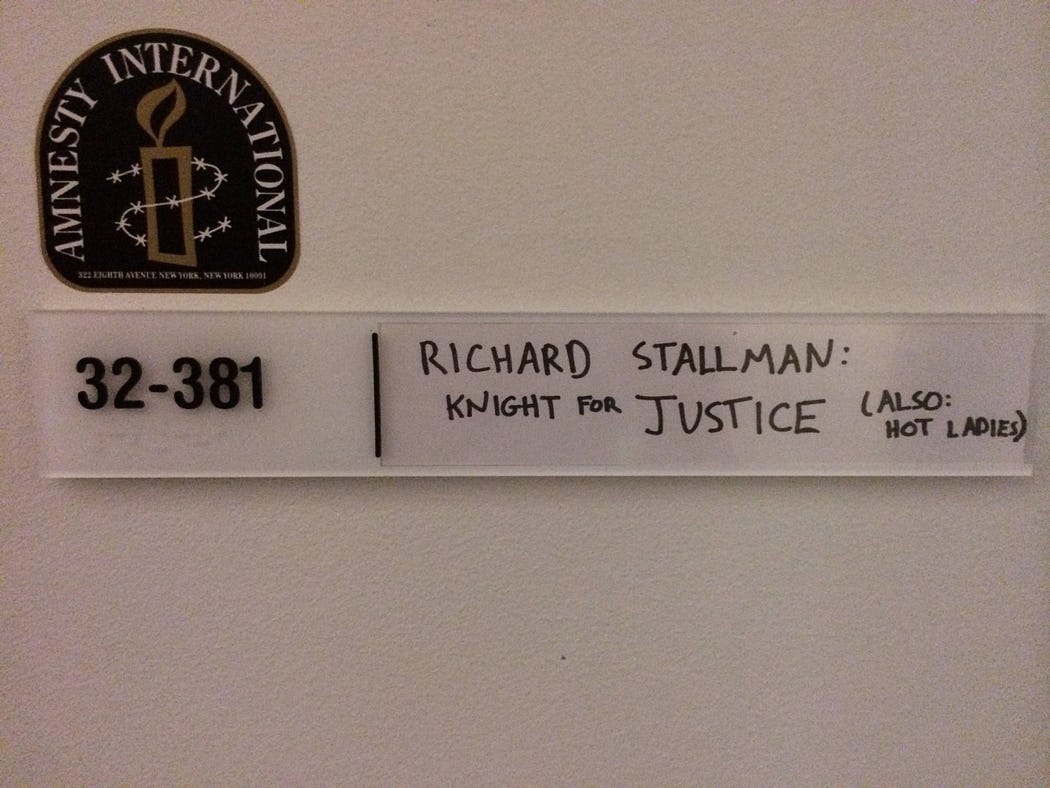
There's also his office door at one point: https://miro.medium.com/max/1050/1*lDSkAjF1958TpEafxuJsLg.jp... (source: https://selamjie.medium.com/remove-richard-stallman-fec6ec21...)

Even before his indefensible statements about Epstein, RMS was toxic and there's no denying it.

>I recall being told early in my freshman year “If RMS hits on you, just say ‘I’m a vi user’ even if it’s not true.”

The idea that Stallman would only violate women who use emacs is cartoonish levels of absurd. Personally, I'd expect he'd be thrilled they're at least using free software.

Besides that, the door thing seems to have been graffiti. And though I agree the dating anecdote makes him look bad, but also sounds like the actions of a person suffering from some mental illness.

There is a big difference between what's reasonable and acceptable in random people and what's reasonable and acceptable in people who are established or establishing themselves as Community Leaders. We expect leaders to model good behavior and take additional steps to avoid modeling harmful behaviors, because other people will emulate them.

He's been accused of things that are at the very least Somewhat Creepy. "Abusive" is a pretty high standard to reach, but I also think it's irrelevant. The way he treated people, coming from a person with power or authority, was likely to make people feel unsafe, and he was unwilling to recognize that the desire to have that position of social authority implied an obligation to mitigate such behaviors.

I think the community would be richer and better (and probably noticably more diverse in a number of ways) if either he'd changed his behavior and recognized the importance of these effects, or he'd been considered a non-leader of the community and merely an active contributor with strong opinions.

It's easy for people not familiar with these dynamics to massively underweight how much implied social pressure comes with being hit on by a person in a position of power within an organization. My usual assumption for someone with as much implied social authority as he had at MIT would be that it would basically be generally inappropriate for them to be hitting on anyone who wanted to be in or work in the lab or department they were affiliated with, because even if this specific person genuinely wouldn't abuse their power, many other people in comparable situations would and it's not really reasonable to expect people not to react to the possibility when it's such a widespread problem. (And yeah, that can sorta suck if you're lonely but in a position that makes it hard for you to hit on people without making them uncomfortable or afraid. One alternative is not to pursue or remain in such a position if it's a problem for you.)

How is there any controversy to judging people for what they believe? This seems so normal! At every level of society we judge people for what they think, for their sort of moral philosophy. That's morality on some level (or some sort of meta-morality).

Though I think the added point here is that people who believe something _and_ have some power over other people can effectively apply these beliefs. If I say "I don't think that hiring women is a good idea cuz they might go on maternity leave" and I'm also the managing director of some non-profit, well... I feel like suspicion about my capabilities in that role are judstified!

> So expressing sincerely held beliefs in a personal forum like his own website is in and of itself "toxic"?

That's a loaded question... it looks like you're making some wild assumptions about whether I think Stallman is toxic, and the reasoning for that.

> Many of RMS's beliefs are indeed well outside the mainstream, but as far as I'm aware nobody has ever accused him actually doing anything abusive to anybody.

So, I'll share a couple articles.

https://medium.com/@thomas.bushnell/a-reflection-on-the-depa...

> RMS’s loss of MIT privileges and leadership of the FSF are the appropriate responses to a pattern of decades of poor behavior.

Speaking of the FSF / GNU project leadership itself... I think it's clear that the GNU project needs a code of conduct, and if the leader is opposed to the idea as much as Stallman is, then it's correct to replace him. He has a vision for software freedom, but he's to averse to good community management (which is what the GNU project needs).

>> RMS’s loss of MIT privileges and leadership of the FSF are the appropriate responses

> I think it's clear that the GNU project needs a code of conduct

Why? It seems from your quote that people can be removed without a code and, as the FAANGs show us, a written criteria just gets gamed. A code of conduct is redundant and problematic. It victimizes the trustworthy.

> if the leader is opposed to the idea as much as Stallman is, then it's correct to replace him

The ultimate crime - even above anything in a code of conduct - is not wanting a code of conduct? Is anything else an absolute?

> Why? It seems from your quote that people can be removed without a code [...]

Just because someone can be removed from a position of power without a code of conduct does not mean that the process was correct. You can also throw people in jail without a trial, but you shouldn't.

The code of conduct provides a process for people to address grievances. I believe this makes it more likely that grievances get addressed, and reduces the amount of personal bias.

> ...as the FAANGs show us, a written criteria just gets gamed.

I don't think it's easy to game a code of conduct. Could you explain, or give an example?

> The ultimate crime - even above anything in a code of conduct - is not wanting a code of conduct? Is anything else an absolute?

You're confusing "crime" with "not doing a good job". I said that he should be replaced because he wasn't doing a satisfactory job.

His job was to run the FSF and the GNU project. He was doing that job poorly. Therefore, he should step down and let someone else run it.

Honestly, I think that some of these problems could have been avoided if he made a stronger distinction between the GNU project and the FSF. He could have handed management of the GNU project off to someone else and focused more on the FSF, which is where his strengths lie.

Not wanting a code of conduct is not a "thoughtcrime". It's just bad policy for large projects. "Bad" as in "incompetent", not as in "morally wrong".

> The code of conduct provides a process for people to address grievances.

No, that's the general procedure for handling adding and removing board members. It's the same procedure you'd follow if someone was arrested in the middle of the meeting.

A code of conduct is about the specific conduct. Picking your teeth, insulting tall people, etc.

> I don't think it's easy to game a code of conduct. Could you explain

If there is a written code it has to declare where the lack of gender recognition offense is compared to screaming at someone, for instance. If the code lists your pet offense above screaming, which they all do, then you can scream at people about your pet issue all day with zero risk.

If none of this is mentioned then it all falls back to the law. This is better because more skilled people have done more work on it, and because it's outside of the group's mandate so they can let members deal with it outside of the group. I can't follow you through a 7-11 yelling at you so you can apply the same rules to our official interactions and call the police if I act unruly in a meeting, no vote required.

Also, how does voting work when not only the level of offense, but the standard of offense itself is subjective. Does an accused director get to vote on whether the claimed offense falls into a listed class, but then have to recuse themselves for the vote on the seriousness of the specific claim? Or are they expected to recuse themselves from everything? How many directors do you need to accuse at once before quorum is you alone?

Generally nobody sees why you can't tell people about the specific anti-fraud rules until they work in a fraud-rife industry and watch the arms race. If you haven't been involved with multiple non-profits you might not have experienced this yet.

> I said that he should be replaced because he wasn't doing a satisfactory job.

But the thing he wasn't satisfying you by doing was enacting a code of conduct?

> I think that some of these problems could have been avoided if he made a stronger distinction between the GNU project and the FSF

Good point. I think everyone running things should try not to co-mingle their jobs. But this isn't a code of conduct issue, it's more appropriate as one of the basic requirements for a director. No conflicts of interest.

> Not wanting a code of conduct is [...] just bad policy for large projects

No, a code of conduct is a kiss of death. It adds nothing that honest members of the group need but gives trolls and ideologues a field day.

A group should never have rules about things outside of its core tasks, unless it wants 90% of its time to be spent arguing about things outside of its core tasks.

I'm asking you a genuine question. I note you didn't call RMS out by name, but you certainly seem to be imply it.

Re: the article you shared, I didn't really see much evidence either way there? It's clear that RMS is, to put it mildly, "difficult to like", but there's a big difference between that and being straight up abusive, particularly given that it seems quite obvious that the mens rea is missing: as far as I can tell, most of the time RMS genuinely has no idea when he is being offensive.

> I'm asking you a genuine question. I note you didn't call RMS out by name, but you certainly seem to be imply it.

I don't think the question is interesting or relevant, so I'm not answering it. I explained that I considered the question to be a loaded question. If you want me to answer a question, you will have to ask a different one.

> ...as far as I can tell, most of the time RMS genuinely has no idea when he is being offensive.

Someone who genuinely has no idea when he is being offensive should not be at the head of an organization like the FSF. "Mens rea" is a term from criminal law. It's used for figuring out the difference between murder and manslaughter, for example. It's not relevant to figuring out whether you are good or bad at your job.

The word "toxic" has been so overused as to become meaningless.
Strongly disagree. While people do misuse the word, it has meaning and can be figured out from context.
The problem is that the meaning blends together subjective offense and a desire for professional sanction in a way which makes the term very hard to actually engage with. Challenging whether some particular behavior is toxic comes across as nitpicking, while challenging whether people should get in trouble for toxicity comes across as minimizing legitimately bad behaviors.
> Challenging whether some particular behavior is toxic comes across as nitpicking, while challenging whether people should get in trouble for toxicity comes across as minimizing legitimately bad behaviors.

There are strategies to challenge accusations of "toxic behavior" without coming across as nitpicking. These strategies can be learned, and if you are worried about this scenario, I suggest you learn them. It is a great tragedy that dispute resolution and effective communication are poorly taught in school. These strategies are not difficult to learn, but it is much more effective to learn them in person. If you know someone who is effective at mediation and dispute resolution, see if you can ask them to demonstrate techniques and strategies for you.

There are also books. I personally recommend Nonviolent Communication by Marshall Rosenberg and Crucial Conversations by Patterson, Grenny, et al. Nonviolent Communication may seem a bit hokey and the book is a bit padded out but I vouch for its effectiveness.

In the context of organizations like the GNU project, one of the ways to keep discussions about behavior sane is to have some kind of formal dispute resolution process. This can be done with a code of conduct. Here is the Python project's code of conduct as an example: https://www.python.org/psf/conduct/

Asking whether people should get in trouble for "toxicity" is kind of vague, because the term "toxic" is vague and mired in opinion. That is okay. We need vague words because we need the ability to communicate vaguely. "Vague" is not the same thing as "meaningless".

I find your disagreement to be toxic.
> People in the OSS community can, at times, glorify toxic behavior.

I wouldn't go so far as to glorify toxic behaviour, but some of what is seen as toxic by some is IMO just frankness or a tactic to bring the conversation back into a realm of technical discussion.

In my experience, people who have technical discussions are often blind to their own emotions and the effect that their words have on the people around them. In good this can be solved. In bad cases, people talk about "discussing technical issues" and "directness" as a shield for their poor behavior.

An example from real life: A student, Y, was having a problem with her CS lab assignment, and talked to her professor, Prof. Z. She described what she had done and he said, "Well, that was stupid." In his mind this was just something that you say about bad code you've written. However, he was a professor, and he was saying this about a student's code, and he didn't think of the incredible negative impact that his statement made on his student.

In real life, this interaction took the "good path". They had a conversation, he apologized, and he changed how he spoke to students.

The "bad path" (which didn't happen) is where he justified/defended what he said or minimized/ignored the student's feeling.

Everyone comes to these decision points over and over again in their lives. It's inevitable. We all hurt other people. If we always defend our actions as being in the interest of "technical discussions" or state other reasons why our behavior is correct, is it likely that we are simply good people who never say bad things? Or is it likely that we are ignoring/justifying our poor behavior, and failing to learn and grow?

The "bad path" you're describing is what I and many others like about working in software. When I'm meeting with other technical people, we can have a frank discussion about problems we're facing and solutions to them, which comes much more naturally to me than constantly analyzing the feelings and relative status of everyone in the room. I completely understand why other people prefer more empathy-driven conversational norms, and I try to meet them halfway when I can, but I can't support the idea that their preference is fundamentally superior to mine.
> The "bad path" you're describing is what I and many others like about working in software.

This is not true of software in general. Software companies are diverse, and they are run in diverse ways. (Maybe not as diverse as other industries... but there is still a lot of variation.)

> When I'm meeting with other technical people, we can have a frank discussion about problems we're facing and solutions to them, which comes much more naturally to me than constantly thinking about the feelings and relative status of everyone in the room.

There are a few things I'd like you to consider.

1. Software companies face problems with people. Good managers shield engineers from people problems as much as possible, but if you are only having discussions about technical problems and not people problems, then you are probably not having frank discussions.

2. The fact that it does not come natural to you to constantly think about the feelings of others is not unusual nor is it a fundamental part of your job to constantly think about the feelings of others. If that were the case, there would not be so many good software engineers on the autism spectrum. I have worked with several.

3. It is not expected that you intuit when people are hurt, never say anything hurtful, or think about people first when you are having a technical discussion. However, it is expected that you are aware that your behavior can have a negative impact on other people in the organization and that you make reasonable attempts to correct your behavior if necessary.

> ... but I can't support the idea that their preference is fundamentally superior to mine.

This isn't a dichotomy. An organization needs a combination of strong technical skills and strong people skills in order to succeed. Those skills are, of course, not distributed equally. There is no expectation that a software engineer have the same people skills as an engineering manager.

However, consider this.

An engineering manager primarily works on people problems but would suffer greatly if they had zero technical skills. An engineering manager with zero technical skills is a liability. Likewise, a software engineer with zero people skills is a liability.

on the other hand the Prof gave to student one of the best lessons, the lesson of life

Kinda kidding, but the faster you learn how to handle critics, the better for you.

And the faster you learn how to give good criticism, the better for you. Being cavalier about other people undermines your ability to effectively communicate.
It's way harder to change other people
> Take Mr. X, who is outraged by Microsoft's behavior and refuses to buy Microsoft's products, tells other people about his problems with Microsoft, and tells everyone to use FOSS alternatives? Now, Mr. X also thinks that it's stupid to believe in god, and is not afraid to say it to everyone he meets. He's suddenly changed from "FOSS advocate" to "toxic workplace on legs".

What's toxic about this? Two perfectly sensible points of view and you think Mr. X is dangerous to be around?

> What's toxic about this? Two perfectly sensible points of view and you think Mr. X is dangerous to be around?

Not sure where the word "dangerous" comes from.

Just to explain things. If you tell people at work that it's stupid to believe in god, you are probably going to get fired, and rightly so. It's not dangerous, but it is toxic (belittling people for their religious beliefs).

Toxic means dangerous.
"Toxic" does not mean "dangerous" in this context. The lingustic phenomenon is called polysemy: https://en.wikipedia.org/wiki/Polysemy

It's like how when I "execute" a program, you understand that I am not killing the program as punishment. Even though the word "execute" has that meaning, it only applies in other contexts.

Toxicity is a serious thing. We label toxic chemicals with labels and warnings because they're dangerous. Serious business.

When we apply "toxic" to a person or his behaviour, we borrow that seriousness. That's why we choose that specific, strong words with a well-known meaning.

I oppose calling "I disagree with your world view" toxic. A serial killer might deserve the term.

> When we apply "toxic" to a person or his behaviour, we borrow that seriousness. That's why we choose that specific, strong words with a well-known meaning.

So, you knew what the meaning of "toxic" was all along, but you pretended to not know what the meaning was in order to make some kind of point? I would prefer a direct discussion.

> I oppose calling "I disagree with your world view" toxic. A serial killer might deserve the term.

Mr. X isn't toxic for his world view, it's his actions--his actions are to call people stupid over their religious beliefs.

Stallman isn't "toxic" for writing a couple essays or emails, but you could argue that he's toxic for the way he treated people over the past decades.

>When we apply "toxic" to a person or his behaviour, we borrow that seriousness.

what makes you think so?

words means in theirs contextes whatever people attributed to them, and I've never seen toxic used in other context than somebody trashtalking somebody and being called toxic, so definitely not dangerous.

This hypothetical Mr X is going to take all of a week to get the entire helpdesk & IT procurement team (and every religious coworker) to avoid him and his need to criticize some aspect of their lives.

That's "toxic" because now you have a staff member who people won't communicate effectively with.

Now you're inventing more personality for Mr X. He doesn't like Microsoft and doesn't hide it. He thinks Santa Claus is for children and doesn't hide it. He's not the problem here.
He is, though, because his opinion on Santa Claus should be completely irrelevant to his interactions with his co-workers. But if he prioritizes being hostile by correcting and insulting people over being humble and accepting that others might believe differently, he is being toxic -- he's poisonous to be around.

There are different ways to stand by one's beliefs. One is to keep them to yourself and let them guide your decisions silently, but defend them vigorously if they are actively challenged. And one is to feel the need to rub them into everyone's face constantly, because there is only Right and Wrong and you can't deal with somebody being wrong (i.e., of a different opinion than you) without feeling personally attacked and going on the offensive.

I can agree. But this means that we can never talk about anything other than specific, technical issues at work. We can never reveal any opinion or outside fact about anything. I suppose that's a solution.

In this scenario, our guy wouldn't accept that others might believe differently, because he'd never know, because they never say. Fine by me.

> being wrong (i.e., of a different opinion than you)

That's not what wrong means. Opinions are personal and subjective and can't be wrong or right. Religious ideas a not opinions, they are fact claims about the universe.

I think the agreed-upon way of handling this is revealing personal opinions on difficult subjects very carefully to gauge the reactions, and only proceeding if doing so wouldn't disturb the peace more than what the discussion would be worth. There are of course a ton of potentially difficult subjects, as the ever expanding "Culture War" Wikipedia article shows[1].

But after thinking about it for a bit, this approach of "tread carefully and don't disturb others" is still problematic. Because, where do you draw the line about things that you should or should not speak up against? My intuitive example would have been an anti-vaxxer at work, that I probably would have felt the need to criticize and correct, because their opinion might kill my grandma. But then, militant atheists might also feel like they have to criticize believers, given the huge number of people killed in the name of one god or another.

I think a fundamental factor here is the level of confidence in one's belief that is warranted. Challenging others (especially publicly) on what they believe should only be seen as a sensible thing to do when the confidence in your opinion that leads to to that criticism is warranted. For things like vaccinations, we thankfully have scientific evidence that would indicate that anyone who outright believes they are ineffectual or "give people autism" is, in all likelihood, simply wrong. On the other hand, a belief in god ultimately can't ever be shown as wrong[2], so being very confident in your belief that there is no god still doesn't justify putting down others for believing the opposite.

> That's not what wrong means.

Yes sorry, that was meant fairly tongue-in-cheek, because I assumed that for a person like our Mr. X, the distinction between "of a different opinion" and "wrong" would be very blurry.

> Religious ideas are not opinions, they are fact claims about the universe.

Isn't that just a really wide-spanning opinion though? Maybe we're using the word differently and mean the same?

1: https://en.wikipedia.org/wiki/Culture_war

2: Unless we talk about ridiculous stuff like creationism, which would at least be very hard to defend if you simultaneously want to use the scientific method for anything.