Hacker News new | ask | show | jobs
by stijlist 1934 days ago
The text says one thing, but the graph they display to support their argument does not say what I thought it said.

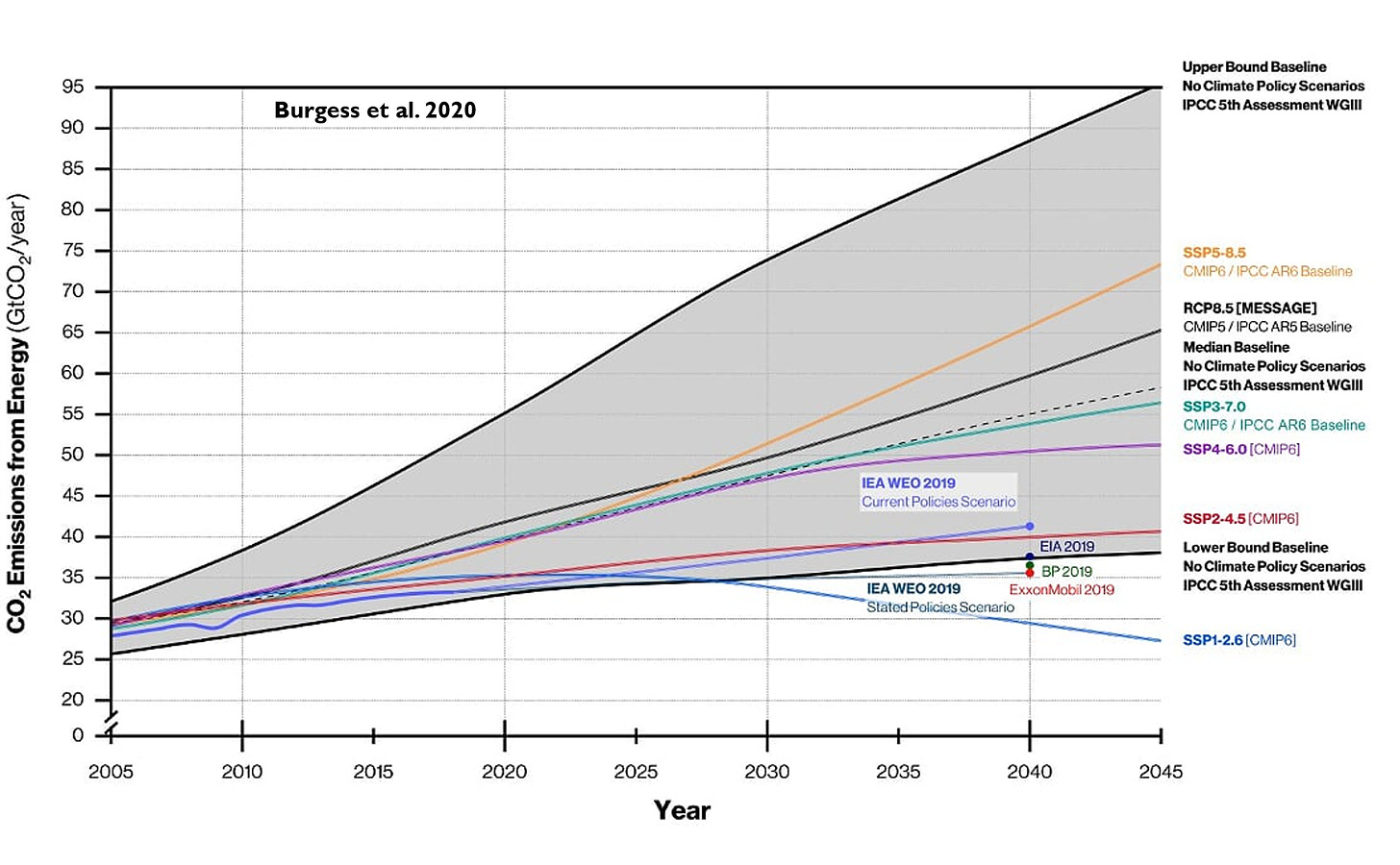
The purple line is supposed to be our "real" emissions, and the impression you get from the image and text is that our real emissions are much lower than the projected emissions.

But if you actually look at the values of the purple line vs the other lines now, in 2020/2021, the values are almost exactly the same.

I don't understand how to reconcile that with the text.

https://cdn.substack.com/image/fetch/w_1456,c_limit,f_auto,q...

4 comments

Great! So it's not just me! As I understand the paper, their main point seems to be that as you extrapolate out in time, you need to not just handle the physics of CO2 that is already in the atmosphere, but predict say how much populations will grow, as well as how much GDP will grow, and how CO2 emissions will be effected by that. So, say if there is an economic recession, then there will be less CO2 produced than if you predicted just say steady growth. This seems to be a case where I could see different assumptions (some reasonable) leading to different results--it's a far cry from say the breast cancer-vs skin-cancer mistake that he leads with
I think the point is that the actual emission are on the low side of the IPCC scenario bounds, and are tracking to exit completely the IPCC scenario bounds around 2021.

Full paper in PDF format here btw: https://iopscience.iop.org/article/10.1088/1748-9326/abcdd2/...

I don’t understand the graph at all. Which line is the purple line? Is it labeled?

It seems like real emissions should end at or before 2020 and none of them do that. They all seem to be projections of some sort?

There is a blueish wider line which is below all the others, shows the effect of the 2008 recession, and splits into multiple forecasts around 2019.
Good catch. -1 point to me for not staring hard enough at the x axis also.