Hacker News new | ask | show | jobs
by UrsaMedius 1953 days ago
What you call "most and least gifted" is in my opinion better described as "most and least privileged". And coeducation of students of different levels of privilege just seems like a good thing, nothing that needs to be dealt with.
4 comments

Of course higher intelligence is a privilege, as is higher sportive ability and other attributes given to you from birth. This includes your own personal attributes as well as the privilege that comes from your family's wealth and status. But actually, the word "privilege" muddles the waters, because those are two very different things.

I agree that schools should not differentiate based on families' status and wealth. Schools should treat poor and rich children the same.

However, schools should never treat stupid and intelligent children the same. Not everyone is cut out to be a rocket surgeon. But your argument means that we should hold back all future rocket surgeons and bring them to a lower level of privilege, i.e. dumb them down. This is neither in the interest of the children (stupid as well as intelligent ones) nor is it in the interest of society. We do need rocket surgeons...

However, schools should never treat stupid and intelligent children the same. Not everyone is cut out to be a rocket surgeon. But your argument means that we should hold back all future rocket surgeons and bring them to a lower level of privilege, i.e. dumb them down. This is neither in the interest of the children (stupid as well as intelligent ones) nor is it in the interest of society. We do need rocket surgeons...

I agree that this can be a difficult balance to strike. But I think it's also important to keep the door open for children who mature a bit later. Stamping someone as "not gifted" by excluding them from a "gifted" group sure seems like it would cause problems, especially for younger children. Of course it's a difficult practical problem to solve; to give every child challenges on their current level.

Also, while there are surely variations in intelligence that are "from birth", I do not know how that compares to all the variations caused by different educational privileges; having parents that have a lot of time to read for/with the child etc. It sort of comes down to "equality vs. equity" I suppose - and that is not a simple question.

  Schools do not treat stupid and intelligent children the same, teachers - with few exceptions - do. Not because they are evil, but because to be able to cater to the different levels of intelligence and the variation in interests that you will naturally find in a random sample of children they require the time and opportunities to do so.

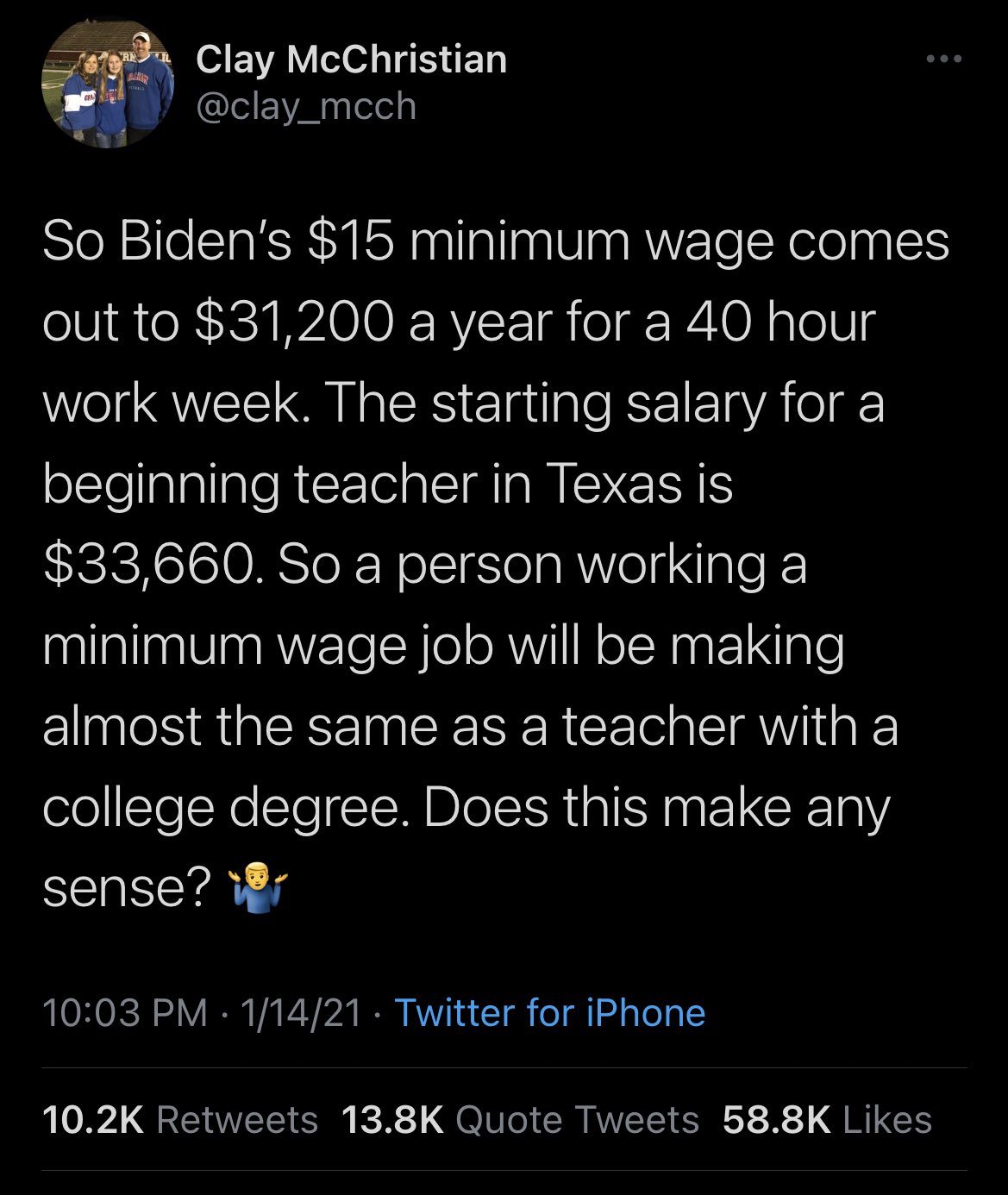
  As long as we treat teachers as the least important workers, without acknowledging the critical work they do [0], have classes that have more pupils than a teacher can follow individually in a meaningful way and consider education "an expense" that needs reduction, rather than "an investment" we will not have a proper education system.

  On the flip side: an uneducated population is easier to sway, so there is not a lot of pressure on the political establishment to change things.
[0] Lack of self awareness - https://pbs.twimg.com/media/Er2_n9pXUAMZnyq.jpg:large
Paying teachers more is beside the point. A well-paid teacher isn't suddenly a better teacher just because it earns more money.

The things we should invest in are more teachers, smaller and more separated classes and better teachers' education. Only the last one correlates (somewhat) with teachers' salaries.

How much of a difference do teachers make in the public school system? I don't mean teacher vs no teacher, but good teacher vs average teacher. The topics in the public school system are not set by the teachers themselves - they have to teach what has been decided elsewhere. A good teacher can engage students better, but how much of that is the teacher's ability as opposed to the teacher and students happening to get along? How much of it is good students self-selecting themselves into academically better schools, therefore having better peers?

Asked in a different way: if we paid (all) teachers 3x as we do right now, would we observe significant long-term improvements in students?

Please do not use code blocks just to draw attention to your comment. It is not clever or creative.

  This is odd - I am not using code blocks, I am just typing in the text box to reply. I thought it looked like code as a way of showing my comments. I really don't know why it happens, I will look and see if it's somewhere in the settings.
The issue, in my experience, is that you have to compromise somewhere. That means either leaving the higher performers to be bored, or leaving the lower performers not achieving the minimum. Neither seems like a desirable outcome.
Well, we can always f*ck up both groups. It seems this is the current approach.
No, you don't have to compromise at all.

Personal experience: I had a great math teacher in mid school; he gathered the best students from the 5 classes in that year in one class and he set the baseline quite high. For the last 2 years half of our class was taking the prizes at all the inter-school competitions in the city and a few of us from the nationals. Most of that class went to the best high schools in the city and most are today great doctors (medical) or scientists. Imagine that did not happen in mid-school and everybody would be an average Joe - that is a loss for humanity, not just for us.

Try to read Ender's Game (the book, the movie is terrible). This is very tough, but if you need great people you can help by creating the conditions to grow them. How many Einsteins wasted their lives achieving nothing and how earlier curing diseases and improving technologies was possible if that waste did not happen?

The compromise is to waste the resources that we have in the name of equality; we cannot make everyone smart, we only can make them all stupid, so let's do equality.

If I'm understanding your story correctly your math teacher did the opposite of what the person I responded to said - he separated out the high performers, creating an environment that allows them to thrive and achieve high results. This is great, but what about the ones who weren't picked into the high performing class?

There is nothing saying you can't have good classes for both high and low performers, but with schools that have limited resources it often works out to a poor medium where no one really thrives (hence the caveat of 'in my experience' in my comment).

The ones that weren't picked in the high performing class had the same teacher, but they only studied what was in the standard manual, they did not go above and beyond what they were capable of. At the same time they were not pulling back the ones more capable.
How is this a good thing? No parent would want their gifted child to be held back because there are other less gifted children in the class who will hold their child back. It is easy to understand their point of view. When you say ‘just seems like a good thing’...it begs the question.. ‘for whom’
No, you can also be underprivileged and gifted/talented (assuming you mean economic or racial privilege).
If you're underprivileged no test is going to detect your gifts. You're going to be hungry, have poor sleep, possibly abused, all sorts of things that will make you look like you're less capable than you are.
Most poor kids get fed and don't get beaten by their parents, so those factors can't be what explains the huge difference.
This was basically the exact point I was trying to make.