Hacker News new | ask | show | jobs
by rayiner 1962 days ago
I don’t understand. You think a pro-coal industry position is, what, unpopular with voters in Montana?

Your interpretation of the facts seems to be based on the preconception that voters in Montana have an antagonistic relationship toward the coal industry in the state. Such that there would be a conflict and companies would have to lobby the elected representative to do something they want at the expense of what is constituents want. That’s not what’s happening. Montana voters know where the jobs come from. And in fact, polls show higher trust in corporations than the government: https://www.wsj.com/articles/more-trust-in-business-than-in-...

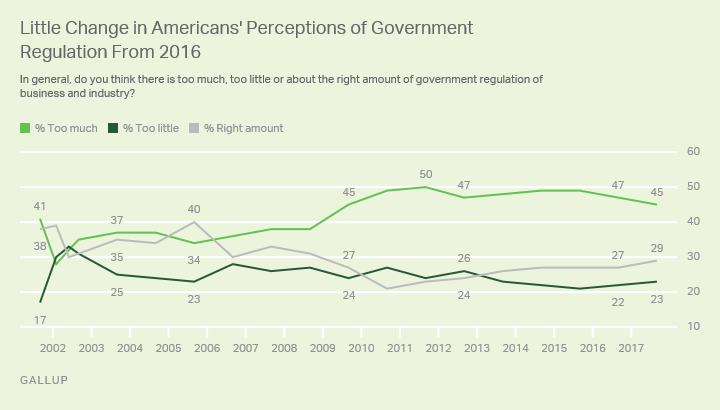
Read Gallup’s polling on the issue. Americans are incredibly suspicious of government and government regulation: https://content.gallup.com/origin/gallupinc/GallupSpaces/Pro.... Just 23% of people say there’s “too little” regulation of business. 45% say too much.

Now think about the $43,000 in lobbying, except assuming that voters in Montana want what’s best for the coal companies in their state. In that view, it makes more sense to understand that lobbying not as changing the vote, but coal companies communicating what they want to a politician that knows that his voters support giving coal companies what they want.

1 comments

I really don't like the wording on the question for the

> Just 23% of people say there’s “too little” regulation of business. 45% say too much.

poll. Most people will pretty sanely say that pointless regulation is just anti-competitive so "broadly more regulation" is easy to be against. It'd be more difficult but I think some health or environmental specific policy would be better to poll about.

Many people in the UK voted for Brexit "to get rid of EU red tape", but when questioned were unable to name a single specific regulation they wanted to get rid of. Now UK businesses are swamped in customs red tape that the EU was designed to remove within the internal market.

It's a result of years of being lied to by politicians with an anti-EU agenda. It's very similar.

This isn't all that unfamiliar in the US. There are many people against "Obamacare", but once you start actually polling on the individual pieces that it entails it turns out it is very popular.

There is a reason why despite two years of full Republican control they could not agree on the repeal they kept banging on about for the better part of eight years, and why repealing Obamacare was not really talked about in 2020 lest Democrats successfully bludgeon Republicans over taking away their constituents' health insurance.

Depends which "individual piece", especially whether it was on the side that "spent money" or correspondingly "raised taxes". The individual mandate polled as 43% "very unfavorable" and 20% "somewhat unfavorable". Perhaps that's why it was, in fact, repealed.

https://www.kff.org/health-costs/poll-finding/kaiser-health-...

See also the discussion in this thread, which mentions other unpopular provisions like the Cadillac tax (also repealed!): https://news.ycombinator.com/item?id=24410307

Parts of it have been repealed, sure, but what Republicans were calling for were a full scrapping of Obamacare (and replacement) including the parts that people liked, like the ban on denying coverage pre-existing conditions or charging those people more.

They backtracked on this after Democrats wielded this as a cudgel in the 2018 blue wave.

Hilariously in the US the ACA (Affordable Care Act) polls better than ObamaCare - there is a large portion of the population that has experienced the benefits of the ACA and support that act while also continuing to advocate for repealing ObamaCare.