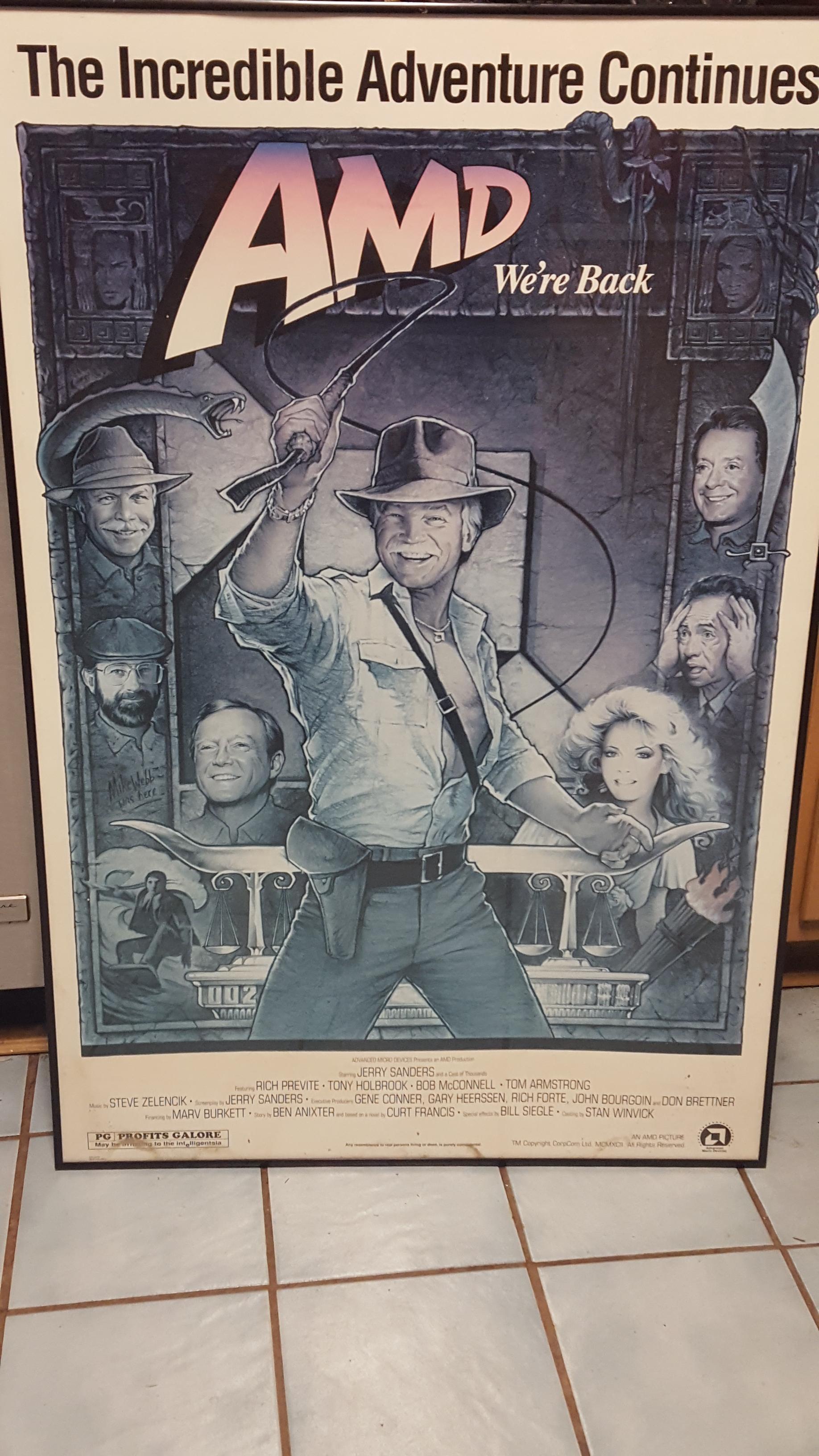
| Intel innovates in process. Everything else is ruled by backwards compatibility and frenetic management scared to stay the course. (The vast majority of projects are killed if they don't tape out in ~2 years.) Intel will shift to a TSMC model. They have the best fabs on the planet, and the best fab engineers. I believe it is something like a 3 millions dollars lost per minute if they are idle. They have already started doing that a few years ago, I suspect this will be their final form. IMHO: The only thing holding them back from the transition are the hundreds of small boondoggle-groups staffed by old-timers too scared to retire, and too scared to do something daring, yet still somehow hang on to their hidey-holes. They lost a ton of key architects to Apple a few years ago, which I also suspect was the reason why the M1 is so badass. ...and if you really want to get sentimental, here's an AMD poster we had in our cubes back in ~1991: https://linustechtips.com/uploads/monthly_2016_03/Szg2Ppo.jp... The Sanders-as-Indiana was both funny and infuriating.... (The Farrah Fawcett looking woman was Sander's bombshell wife, compared to Grove at the time, who drove a beat up old car.) |
I think that's overestimating, although you are right it is damn expensive.
Order of magnitude I would say it's more like: Fab has lifetime of 2-3(?) years, and costs $10B to build and amortize. So every minute of idled factory capital = $6,000 in pure cost of the facility.
(although, if you think of it in potential lost revenue terms, then you may be more correct.)
(Actually we can also do that arithmetic, according to https://www.forbes.com/sites/willyshih/2020/05/15/tsmcs-anno...
240,000 wafers per year * 500 chips per wafer * $100? = $12B per year revenue. Also is something like $22k per minute)