This is one of those things where it would be much, much easier to explain with images, but bear with me.
Draw a circle. Within that circle, with the same center as the first circle, draw a smaller circle. Choose a point on that circle, and draw a tangent line from that point. Now, consider the fact that the portion of the exterior circle between the two intersections the tangent line has to it is not half of the circle.
The same principle applies when expanding to three dimensions: a plain can only divide a sphere in half if it passes through the center of the sphere. When that plain must be tangent to a smaller sphere with the same center, it is only possible to divide the larger sphere in half when the radius of the smaller sphere is zero.
As such, the portion of sky visible from any point on a sphere is less than 50%.
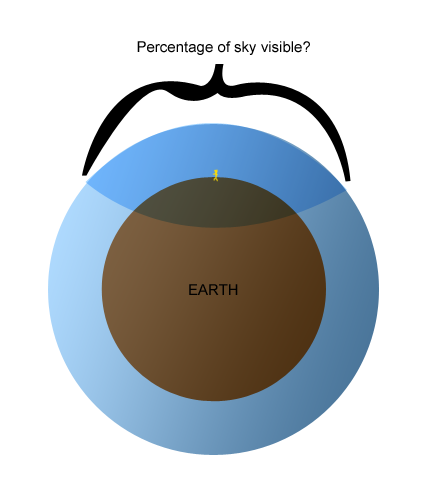
Draw a circle. Within that circle, with the same center as the first circle, draw a smaller circle. Choose a point on that circle, and draw a tangent line from that point. Now, consider the fact that the portion of the exterior circle between the two intersections the tangent line has to it is not half of the circle.
The same principle applies when expanding to three dimensions: a plain can only divide a sphere in half if it passes through the center of the sphere. When that plain must be tangent to a smaller sphere with the same center, it is only possible to divide the larger sphere in half when the radius of the smaller sphere is zero.
As such, the portion of sky visible from any point on a sphere is less than 50%.