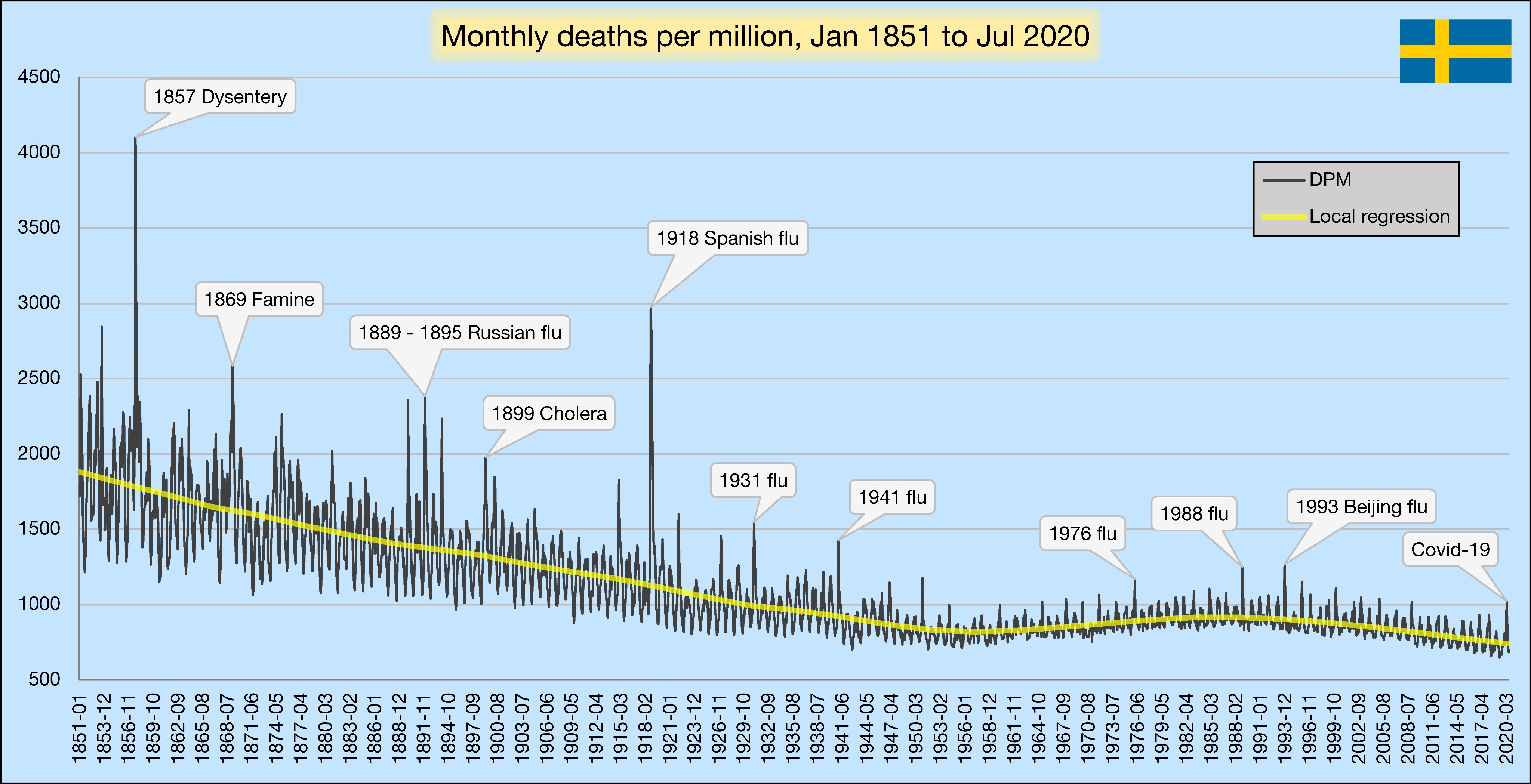
When was the last time 350,000 Americans died in a 'really bad Flu season", even without lockdowns? When was the last time deaths per day were measured in the thousands?
If you don't trust me perhaps you'll listen to Donald Trump, who told Bob Woodward in early February 2020: "And so that's a very tricky one. That's a very delicate one. It's also more deadly than even your strenuous flus.... This is more deadly,” he said. “This is five per — you know, this is 5 percent versus 1 percent and less than 1 percent, you know. So, this is deadly stuff.”
And don't forget scientists have continued to gather and evaluate data since. We now have a much clearer (albeit still imperfect) picture of the disease and its behaviour.
For example, COVID's current "death rate" estimate is ~3x worse than flu. Versus Trump's "~5x" in your quote from Feb 2020¹.
People love to argue about such overall rates but for practical purposes, they're too crude a hammer – too aggregate, too high-level to be actionable. More importantly, we now have a better understanding of the groups at risk.
> [Infection fatality rate] measuring 0.002% at age 10 and 0.01% at 25. However, the rate progressively increased with age, growing from 0.4% at 55 to around 15% at 85.
Age and certain comorbidities seem critical. This knowledge shapes the global COVID response, allowing help to be significantly more targeted and effective. For instance, when rolling out national vaccination plans.
___
¹ Whichever rate Trump was talking about – there's case fatality rate, crude fatality rate, infection fatality rate…
Oh sure, that was just a best estimate at the time, bottom line is we and he knew it was going to be bad from the start and that his public "just a flu" statements were false.
Yet still we have people to this day repeating his knowingly and now admittedly false claims as though they are true. That's how deep the hook line and sinker got swallowed. It's fascinating psychology. Even when the con artist admits and explains the con, some people prefer to stay conned.
> For example, COVID's current "death rate" estimate is ~3x worse than flu. Versus Trump's "~5x" in your quote from Feb 2020¹.
COVID-19 Infection Fatality Rate is estimated at around 0.6% whereas H1N1/09 Flu infection fatality rate was estimated to be less than 0.03%. Not sure where you get “3x”, I think the correct number would be 20x based on these numbers.
I compared Covid's estimated IFR of < 0.23% to flu's < 0.07% [1].
But that's exactly the discussion I called out as not terribly relevant: The variance within Covid (due to age, location, comorbidities…) is much greater than variance between Covid and flu.
In other words, even a Covid-vs-flu rate difference of 20x (as you say) is dwarfed by the 1000x difference between Covid age groups (which you didn't contest). Can we agree on that?
My point is that a broadly aggregated statistics like "global IFR" is too crude to be actionable. Easy to put in a headline, sure, but more potential for confusion than good.
Disagree strongly. An IFR of 0.6% when considered across the entire population is indeed cause for much more alarm than one of 0.02%. It is very relevant.
0.6% of the population in the USA, for instance, would mean about 2 million people would be killed by uncontrolled and massive COVID-19 spread.
Focusing down to small subgroups would only be relevant if you have a magic wand and could, for instance, seal off all over-60 year olds from human society for a year.
P.S. the paper you cited is by John Ioannidis. He has become notorious in 2020 attempting to prove Covid-19 isn’t very dangerous. Worth consideration as this version has managed to pass peer review, but keep in mind it’s outside the mainstream of opinion. IMO, the 0.2% estimate is pretty clearly low and I’ve read a good debunking of that specific paper in the past. https://threadreaderapp.com/thread/1316511734115385344.html
I'll put it bluntly: fixating on an average ("average IFR") of a wildly heavy-tailed distribution (e.g. exponential for IFR-vs-age) is idiotic.
Technically yes, such average exists – the population is finite. But taking a population-wide decision based on such estimate is suboptimal. We already know a population parameter (age, comorbidities) that gets us an actionable segregation!
I personally see such "hiding behind an average of an exponential" as scientific fraud. Misinformed at best; disingenuous and murderous at worst (such as with Covid).
> He has become notorious in 2020
Interesting, thanks. I wasn't aware of John Ioannidis' pedigree. For those curious – this article does a good job summarizing the controversy (April 2020):
> Focusing down to small subgroups would only be relevant if you have a magic wand and could, for instance, seal off all over-60 year olds from human society for a year.
A magic wand to seal off over-60 olds? How do you feel about sealing off everyone?
Suicides and homicides also up. Given that these deaths will occur for people with a typical age of 40, vs 80 for COVID, substantially more years of life have been lost from lockdown (which seems to have achieved little anyway), than from COVID.
And the last year with record overdose deaths was: 2019. And with the exception of 2018 every other year backwards from 2017 to 1999 was also a record drug overdose death year.
That is the opioid crisis.
Source: The CDC WONDER database, group by year, and by "UCD - Drug/Alcohol Induced Case". (Deep link doesn't work)
The US is a flaming pit of despair right now, for reasons stretching far beyond any impact COVID-19 may or may not have had. It's not reasonable to take the state of specifically that society as any sort of benchmark for how bad things are.
If you don't trust me perhaps you'll listen to Donald Trump, who told Bob Woodward in early February 2020: "And so that's a very tricky one. That's a very delicate one. It's also more deadly than even your strenuous flus.... This is more deadly,” he said. “This is five per — you know, this is 5 percent versus 1 percent and less than 1 percent, you know. So, this is deadly stuff.”