Hacker News new | ask | show | jobs
by loosetypes 1988 days ago
There really is something eerily beautiful, as the author states, about simple layouts that convey the immediate information sought as well as the intuition behind the abstraction.

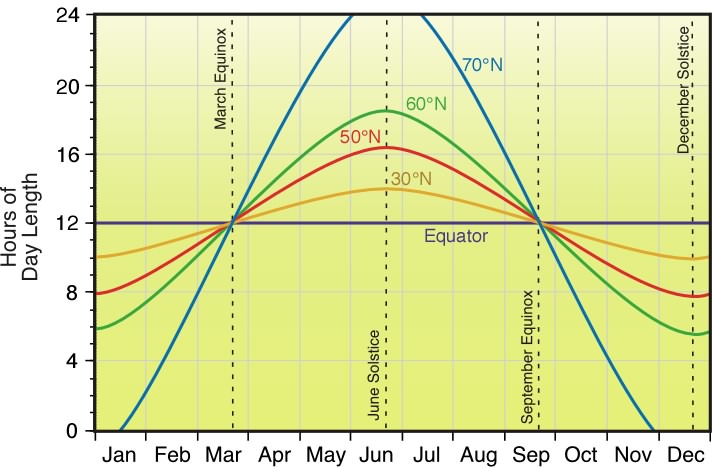
Another I'd throw out there are the charts for latitude vs. hours of sunlight per day by month[0].

I have never wanted a tattoo, but that's an icon that I'd consider - maybe overlay each city in which one's lived, and periodically update it..

[0] http://www.physicalgeography.net/fundamentals/images/dayleng...

1 comments

That's a super cool chart, thanks for sharing. Never saw that before.
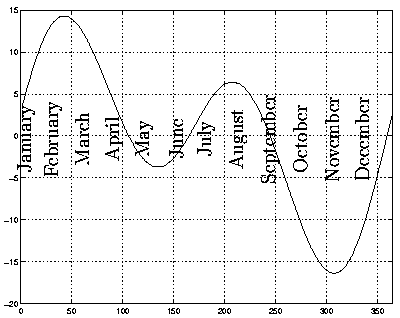
This one might be cooler: https://plus.maths.org/issue11/features/sundials/eqtime.gif

Time adjustment you need to make to a sundial by month

And then going one step further and visualizing the change over time https://cdn1.bbcode0.com/uploads/2021/1/3/dbeeb7e12e2eec7bb8...

Source: https://equation-of-time.info/work

One of these days I’m going to sit down and find the time to build an alarm clock app based on these charts. One that lets you sleep longer in the winter, and less in the summer. I’ve spent time up in Alaska and that was the first time I altered my sleep schedule based on daylight hours. I’ve always believed there was something to that.
> I’ve always believed there was something to that.

Wouldn't surprise me, Humans don't have (by the standards of many mammals we share the surface with) particularly great night vision and prior to fire we'd have had no source of illumination but the moon/stars at night.

Basically stay in your cave/shelter til you can see whatever you are stalking/been stalked by.

The connection between available sunlight and human circadian rhythm is pretty well established, or more precisely how the lack of sunlight can lead to all sort of disorders, most obviously sleep and mood disorders.

More open question is how to counteract such negative effects. Supplementing daylight with high-power artificial light seems to be one of the most promising approaches. Simply sleeping more during shorter days is fairly speculative suggestion, at least as a "silver bullet".

That being said, simply based on personal experience I would expect that slight changes of sleep length could be possible. But the effect would be more like ±30mins to sleep length, when e.g. where I live currently daylight length varies from about 6 to 18 hours. Trying to match sleep to such a big swing seems pretty unlikely to succeed.

Our YES V7 watches already have a sunrise and sunset alarm with 0-60 minute pre-alarm, set by you. https://www.yeswatch.com/wrist-watch/worldwatch/worldwatchV7...