Hacker News new | ask | show | jobs
by zipityzi 2021 days ago
What are these numbers based on? Just your "best estimate"? It's dismissive of Apple's uarch for what reason?

Arm has architecture licenses, unlike x86: anyone could've designed an Arm CPU from the ground up. NVIDIA tried, AMD tried, Intel tried, Qualcomm tried, Samsung tried, Huawei tried, etc. Everyone had a chance (and they still do). Arm is the most level playing field available in high-perf CPU design.

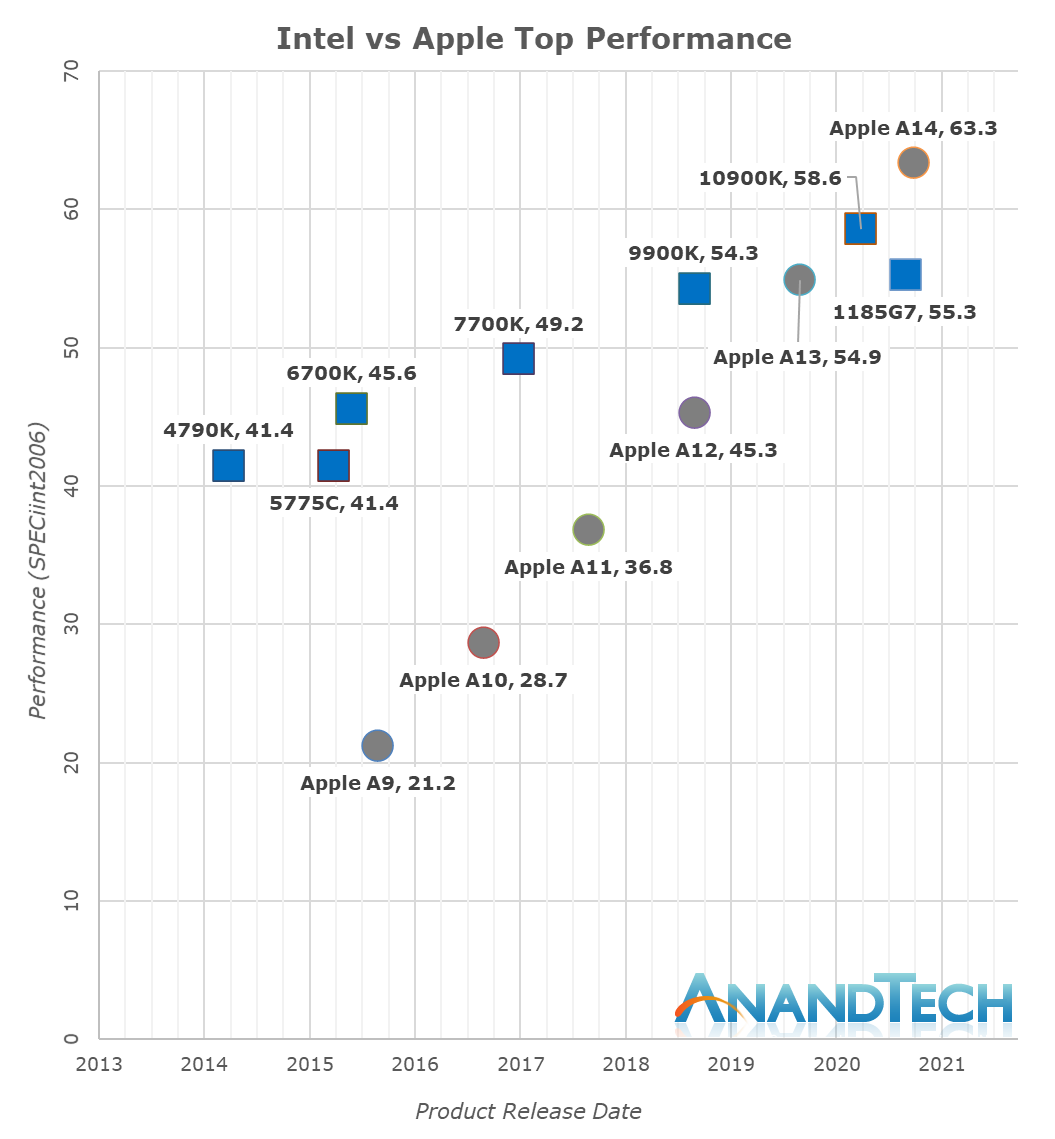
And "50% process technology" is an exaggeration even embarrassing for HN. The A13 was built on 7nm and still beat perf/watt of any x86 CPU and total 1T performance rivals Tiger Lake. A14 / M1 are a natural evolution of that same uarch.

https://images.anandtech.com/doci/16226/perf-trajectory.png

What really breaks down your argument: Samsung has had nearly every advantage as Apple, yet its Exynos line is some of the worst-perf/watt Arm uarch today: its own OS (Tizen), its own foundry, its own phones / tablets / laptops, and a massive conglomerate for funding. What happen to Samsung? What money doesn't Samsung have? Hell, Samsung is even MORE integrated than Apple, as Apple still needs to outsource its fabrication to TSMC.

There's a reason Samsung is giving up on its uarch and moving to Arm stock cores (X-1, A78, A78C, etc.), just like Qualcomm + NVIDIA.

https://news.samsung.com/global/samsung-electronics-announce...

Don't tell me "you need trillion dollar valuation to make a top-class CPU". AMD was nearly bankrupt 6 years ago and now has the fastest general compute x86 arch in the world.

This argument reeks of "well, if Apple has the fastest CPU uarch today, then I'm going to ensure everyone else has an excuse."

Apple didn't even have an Arm architectural license, much less a custom high-perf CPU, 13 years ago. 13 years from "never designed a high-perf CPU" to "dominating x86 perf / watt while at the heels of total perf" is actually notable and actually impressive.

6 comments

Well said.

It's really disappointing that as Apple comes out with some of the most exciting processor designs we've ever seen, some look to dismiss the effort and make excuses for the other players that aren't producing.

It can't possibly be that Apple is doing impressive, innovative work. No, it has to be some nebulous "other" thing that's really happening.

>13 years from "never designed a high-perf CPU" to "dominating x86 perf / watt while at the heels of total perf" is actually notable and actually impressive.

They did buy PA-Semi, a company with a lot of low power chipmaking experience. They had a plan and invested in it and continued making it better and better, but its not like they developed this exclusively from the ground up. Its impressive but more evolutionary.

A throwback to when computers doubled in performance every couple years.

https://en.wikipedia.org/wiki/P.A._Semi

P.A. Semi was partially responsible for the A4 and maybe A5? What about A6, A7, A8, A9, A10, A11, A12, A13, A14? You casually state "making it better and better", as if that's a regular occurrence for CPU architects over the past two decades. It's not, unfortunately.

Iterating a uarch is not a given. Ask Intel & AMD.

20% to 40% IPC gain / year is not a given. Ask Intel & AMD.

Iterating 20% to 40% IPC gain / year / nearly identical TDP is absolutely not a given. Ask Intel & AMD.

Likewise, P.A. Semi (in 2008) is a very recent addition in Apple's Arm journey.

// the history //

In the 1980s, Apple's ATG (Advanced Technology Group) pushed to move to on RISC and worked with Acorn in England to co-develop ARM III CPUs for Apple's "next-gen" devices

In 1990, Arm Ltd. is founded with the two largest shareholders as Apple (43%) and Acorn (43%).

Apple was reportedly responsible for Arm's current name: it's "Advanced", not "Acorn", because Apple didn't want to be associated with a former competitor.

Apple mainstreams Arm far earlier than the iPhone: in 2001, the first iPod launched with a 90 MHz ARM-derived CPU.

// P.A. Semi //

People always forget the history of the P.A. Semi acquisition, even as it's linked there.

The short version: Intel was literally gifted a major high-perf Arm uarch and screwed it up; that same CPU architect refuses to join Intel, founds P.A. Semi some years later, and Apple acquires P.A. Semi and that CPU architect joins Apple.

That "lot of low power chipmaking experience" was literally gifted to Intel and they couldn't do jack. Apple needed to acquire it after decades of trying to get Arm to work, far more effort than Intel.

Likewise, in the 2000s, Intel had significantly higher profits than Apple: https://www.macrotrends.net/stocks/stock-comparison?s=gross-...

In Q4 2005, Intel made $23b in profit. Apple made $4b in profit. Intel was a CPU IP & foundry. How did they miss Arm or other RISC designs? That's the kicker: Intel didn't miss Arm. Intel has repeatedly failed & floundered with "side technologies" that they thought inferior to x86: heterogenous dies, chiplets, Arm, XScale, etc. = Intel explicitly decried and denounced these "cheap" tactics by their competitors.

Intel in the 1990s, 2000s, and 2010s genuinely exhibited "not made here means it's crap and automatically inferior to anything we can make" philosophy.

1993: Daniel Dobberpuhl develops StrongARM, a high-performance ARM uarch.

1997: Intel is gifted StrongARM through a legal settlement and the "keys to the kingdom". Dobberpuhl doesn't agree to join Intel.

2003: Unrelenting on Arm's future, Dobberpuhl starts P.A. Semi after working at Broadcom.

2007: Intel sells off StrongARM, saying they don't know how to make money with ARM as AMD had applied unprecedented pressure with K8 & Athlon64.

2008: Apple acquires P.A. Semi.

2009: Dobberpuhl retires from Apple.

It's not like AMD, Intel, etc. were ignorant x86 had severe perf/watt limitations. They knew and they know. They tried repeatedly to overcome them and then simply lost interest as they couldn't make money.

Sources (a great read / watch, if you're bored):

https://www.theregister.com/2006/06/28/intel_mobile_failure/ https://www.youtube.com/watch?v=AADZo73yrq4&t=449s https://en.wikipedia.org/wiki/Acorn_Computers https://en.wikipedia.org/wiki/StrongARM https://en.wikipedia.org/wiki/IPod https://www.computerweekly.com/news/2240049543/Intels-Strong... https://en.wikipedia.org/wiki/Daniel_W._Dobberpuhl

>is an exaggeration even embarrassing for HN

Hardware discussion on HN has always been subpar, and Apple's M1 discussion sort of confirm that. I guess most developers dont really give a damn about hardware.

AMD's recent agreement with China and the resulting monies allowed AMD to really move ahead. We have to keep that in mind.
> 13 years from "never designed a high-perf CPU" to "dominating x86 perf / watt

The people who designed these chips are from intel, amd, samsung etc. Apple can spend way more money than amd or intel.

That's because Intel (back then, the only real high-perf CPU) rejected ARM as an inferior, slow technology.

And blatantly ahistorical on "money": where is your citation?

https://www.macrotrends.net/stocks/stock-comparison?s=gross-...

In 2005 to 2008: Intel made 2x to 6x more profit per quarter than Apple. A short example:

Q4 2005 at Intel: $24b profits Q4 2005 at Apple: $4b profits

Not revenue. Not stock price. Profit, that can be put anywhere in the business. Intel had insanely higher profits than Apple. The iPod (which ran an ARM-derived 90MHz CPU) was already out in 2008. Apple had just acquired P.A. Semi. Intel still had vastly, vastly, vastly more free cash flow and profit.

Don't tell me Intel didn't have money for Arm or hiring CPU architects or even literally acquiring entire Arm firms.

Intel had hired these very people who later joined Apple; it absorbed Arm architects, uarches, designers, portfolios, etc.

They failed. As The Register wrote in 2006,

>Intel's failure wasn't for a lack of talent or investment - or even luck - over the years. Intel threw $1.6bn on a DSP company in 1999, and followed up with a host of smaller investments. And luck blessed Intel on several occasions. When DEC's StrongARM processor fell into Intel's hands in the fall of 1997, it was as a result of a legal settlement, and an unsought and unexpected prize. Pundits at the time thought that Intel had been handed the keys to the kingdom. But billions of dollars later, Intel could only claim two significant design wins from lower tier phone OEMs RIM and Palm. Texas Instruments, by contrast, will cash $14bn in revenue from phone chip sales this year. > >So how did Intel fail to capitalize? In a nutshell, it failed to live up to its name. Intel may stand for 'INTegrated ELectronics', but it failed to integrate the electronics that mattered when it mattered. > >A series of poor management decisions ensured that StrongARM was well positioned for a market that was on the decline, and rarely competitive in a market that boomed. Early on, Intel decided against integrating dedicated digital signal processing into the StrongARM chip, later renamed XScale. While this decision was justifiable for fixed embedded markets and for PDAs, it put the chip at a huge disadvantage for lower cost devices that needed voice capabilities. In response, Intel copied the PC strategy of adding new floating point instructions, introducing MMX for Xscale. Since phone manufacturers preferred cheaper custom chips for devices that needed a multimedia flip, this was a wasted investment.

Good reading: https://www.theregister.com/2006/06/28/intel_mobile_failure/

https://en.wikipedia.org/wiki/StrongARM

https://www.computerweekly.com/news/2240049543/Intels-Strong...

Did you miss the fact that I attribute half for other than process technology.

> The A13 was built on 7nm and still beat perf/watt of any x86 CPU

We can directly compare Snapdragon 865 Plus and Apple A13 Bionic because they use the same process (N7P).

865 Plus is equal or better in most benchmarks.

https://www.anandtech.com/show/15982/the-asus-rog-phone-iii-...

What in the world are you talking about? Anandtech shows the A13 handily besting a phone equipped with an 865+.

Most of those are not CPU tests. But even in the link you provided 865+ has best performance/watt in every test in GPU Performance & Power.

Here is Nanoreview's Snapdragon 865 Plus vs A13 Bionic CPU performance tests: https://nanoreview.net/en/soc-compare/qualcomm-snapdragon-86...

(btw. My argument is not that Apple is worse)

JavaScript perf is a GPU test? I guess I'm learning new things every day.

(The link I shared is all CPU leaning performance tests.)

Nanoreview? Really dude? In the "Pro" section for the 865+ it lists two more cores (factual but largely irrelevant) and in the "Pro" section of the A13 it lists "Compatible with the latest DirectX 12.1" (laughably hilariously untrue).

I love how nano review has become the Android fan bible, despite its very obvious flaws.

Also, the Antutu developers said scores between different OSes are not comparable: https://www.antutu.com/en/doc/119646.htm but some people just love to boast how Android is better based on Antutu...