Hacker News new | ask | show | jobs
by ogre_codes 2039 days ago
> At this point the spacecraft will be subjected to a peak force 10,000 times greater than Earth's gravity, something opponents believe will seriously affect its structural integrity and the safety of its complex electronics.

These kind of forces are pretty insane compared to even the high G boost you get on a normal rocket launch. I wonder if that is going to put a crimp on their potential client list.

3 comments

The forces are going even higher than that. 10,000g is what you get from launching out of high explosive powered military cannon. The US military has managed to put guided rounds in such cannons, but they certainly aren't getting you to space with such a cannon. You need much higher than 10,000g to get up to that kind of speed.
Technically it's more the time that the acceleration is applied for, but I see what you mean. I used to work as a weapons engineer for the Dutch navy and they were quite involved at getting the Vulcano (https://www.leonardocompany.com/en/products/vulcano-155mm) rounds working at the time. IIRC the larger caliber rounds were subjected to about 40.000g at peak acceleration though you could vary the amount of powder so actual acceleration varied. The HW guys had all sorts of trouble with exotic problems like getting the chips to stay attached to the solder pads etc.

Totally agree that the SpinLaunch system does not seem sufficient to get a payload to space though, let alone if it also needs to bring propellant for circularizing their orbits.

They apparently tested spinning everyday objects up to 10,000g, which is great, but I wonder if they thought about bending moments induced when the thing is suddenly released.
And the mechanical and thermal shocks it gets when it passes from the vacuum chamber to the atmosphere.

IMHO the centrifuge part is the easiest of their challenges.

That's what seems to me to be the biggest challenge too. Going from vacuum to 1 atm at 4000 mph has got to be quite a shock. Might as well just smash the thing into a wall.
And what is the inrush airspeed when you have that large of a vacuum?

Zero to Mach 5 or 6 just seems like an instantaneous disassembly manuever, both for the craft and the centrifuge itself. Did they find a way to suppress a sonic boom at the exit point?

Do you know if that was fully custom hardware? Or what I'm specifically asking is: was the problem that the available hardware is not produced to withstand 40kG, or that they can't produce hardware able to withstand it? Because there latter sounds like a serious problem, but the former sounds like it could be solved with money spent on it.
For cost purposes they started out with mostly off-the-shelf components and then they slowly replaced those components that could not withstand the stress with custom kit. IIRC just casting some components in sturdy resin was often enough. Bad for the thermals ofc, but it only needed to run for a few minutes anyway. I left the navy a few years ago but since the product is now apparently ready I assume that they managed to solve all remaining problems. (Acquiring a GPS signal quickly enough from a high speed projectile was not trivial either)
> wonder if that is going to put a crimp on their potential client list

Solid state electronics and fuel. With respect to the former, nothing that requires stable orientation. I don't know of a propulsion system that can survive those forces.

That thing where they compress your ashes down and launch them into orbit... that may be their specialty.
So the customers who have no way to verify their payload made orbit.
Raw metal powder for 3D printing laser sintering. Or plastic pellets.

Water. Fuel. Clothes.

Maybe this is what can kick start the 3D printing in space revolution.

Maybe it can also launch radioactive waste into space? One bucket at a time. Then a space towtruck can be launched to hurl it into the sun.

But it’ll likely just part a naive investor from their money.

Not sure how serious you are with the radioactive waste thing but I'll do the HN thing and bite (nerdsnipe!), because that's not going to work. You can't launch things into the sun, you need to decelerate objects. The earth travels at 30 km / s (70K MPH) around the sun, so you need to decelerate about that much the other way. And orbiting radioactive waste is just asking for trouble.

The total amount of radioactive waste on the earth is about the size of a swimming pool (or was that the total amount of gold? I forgot, either way in terms of quantity it's not that much), burying it deep and forgetting about it for the next 100.000 years is the way to go I think.

> The total amount of radioactive waste on the earth is about the size of a swimming pool (or was that the total amount of gold? I forgot, either way in terms of quantity it's not that much)

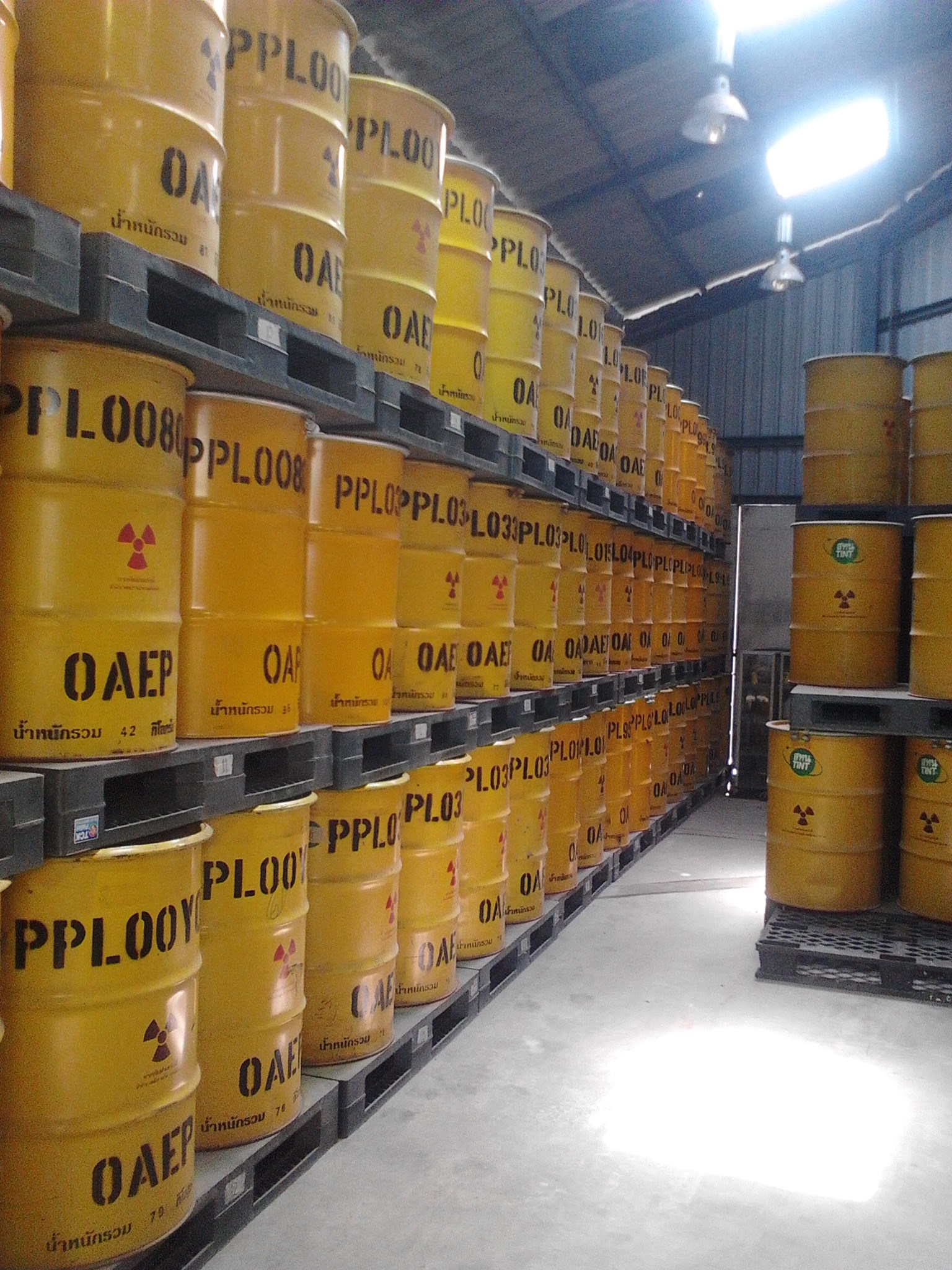
This seems wrong in both places. There are probably enough gold rings manufactured per year to fill a swimming pool. In pictures: Fort Knox itself seems to have at least a swimming pool of gold [1] and Thailand a swimming pool of waste.[2]

[1] https://external-preview.redd.it/rgD0FO1pELgkuXZzWC2NQk0vJZU... [2] https://upload.wikimedia.org/wikipedia/commons/9/93/TINT_Rad...

Those piles of bars are shallow, and those barrels are probably mostly non-spent-fuel by volume.
In the 1930s they put about 13,000 tonnes of gold in Fort Knox. (It now has about 4,500 tonnes). Density of gold is about 20g/cm^3, or 20 tonnes per cubic metre. So Fort Knox held up to 650m^3 of gold.

A normal swimming pool is about 25m x 12.5m x 2m which is 625m^3.

https://en.wikipedia.org/wiki/United_States_Bullion_Deposito...

This page indicates Sellafield has 2000m^3 of high level nuclear waste.

https://ukinventory.nda.gov.uk/site/sellafield/

> Reported volume: This is the volume actually taken up by wastes that exist at the Inventory stock date. It is the volume taken up by wastes inside the tanks, vaults, silos and drums in which they are contained.
> burying it deep and forgetting about it for the next 100.000 years is the way to go I think.

Is there a problem with burying it in a subducting plate boundary, so it is eventually pulled back into the earth's mantle? There's already fission going on down there.

>The earth travels at 30 km / s (70K MPH) around the sun, so you need to decelerate about that much the other way.

Surely you’d just need enough to end up in a decaying orbit? Then it’ll eventually reach the sun

Low-earth orbits decay because of friction between the spacecraft and the Earth's upper atmosphere. What do you imagine would guarantee the decay of a solar orbit before a perturbation (by, e.g., the gravity of the Earth's moon or a comet) sends the orbiting object into a collision course with Earth?
All you need to do is hit the Lagrange point.