Hacker News new | ask | show | jobs
by Eliezer 5529 days ago
Oh ye of little history. Do none remember Xanadu still? Inspired by Eric Drexler's call for hypertext as a way of making society more intelligent, they tried to invent the Web, a decade too early and with standards much too high (cached local copies which would still receive micropayments, two-way backlinks), and never solved the incredibly difficult programming problems they were tackling before Mosaic and HTML came along.
3 comments

Ted Nelson, not Eric Drexler. And not "inspired by" but founded by him. (K. Eric Drexler is nanotechnology, not hypertext.) Not really an Internet startup, certainly one of the longest but not the biggest tech business failures.
Ted Nelson was the founder, yes. He was inspired by Drexler, who like certain later transhumanists did human rationality on the side. Do none still remember "Engines of Creation"? It had a whole chapter on hypertext.
Nelson started what became the Xanadu project in 1960, when Drexler was only five years old.
Correction noted. I'm pretty sure though that at least some of the people on the Xanadu team were Drexler-sent.
I've worked with Ted on Zigzag and think it's a brilliant piece of software. More people should check out the Java version of Zigzag, Gzz. Basically, where the WWW was Word for the Internet, Zigzag is Excel to the Internet.
I'd like to hear more. How is Zigzag like Excel? What sort of work did you do on it? What were the principal challenges of the project?
It's hard to explain, so please allow a bit of room for error in my post.

Before I start, you can get it here: http://sourceforge.net/projects/gzigzag/files/gzigzag/0.6.3/...

You have to use it (in Gzz) to understand it.

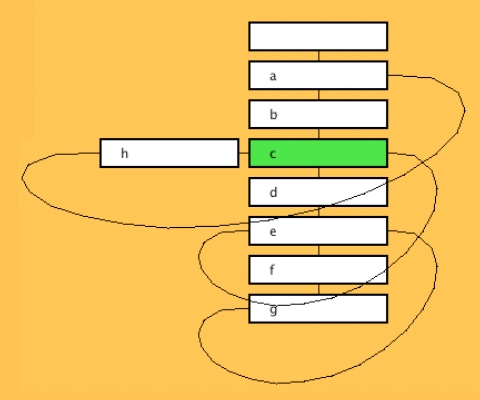
It's like Excel in that there are connected 'cells' (called that in Excel and Zigzag), but instead of being in a grid, they can be connected via a link to another cell. A link is either - or +, and the link has a dimension (eg, d.1 or d.name, or d.date). A cell has a string of text as its value.

So say we have 2 cells (which are numbered uniquely), cell 1 and 2. "1+d.1" points to 2, while "2-d.1" points to 1. Cell 1's text is "Here" and cell 2's text is "There".

The final element is that there is a cursor, which sits on a cell, and the program follows all the links from the cursor and draws them onto a canvas, and then shows it.

The user interface lets you make links, break links, edit the text in the cell, delete a cell, and show cells adjacent to the cursor cell. Another aspect is that the screen draws 3 dimensions, and you can toggle the ones shown. This is because showing every dimension is impossible, so we view a subset. It's not a static environment: rather, you make new cells, link them all together, etc.

http://xanadu.com/zigzag/ZZdnld/zzRefDef/pic24-bettersharedl...

My work was making a C version. Existing versions were a Perl version (the original prototype) and Gzz (an excellent Java version).

I should have improved Gzz instead of making my own version, but porting it from Perl to C was a good learning experience.

I then made a Lisp version which works great.

Finally, one challenge was getting Ted to accept my innovations and new features, but that isn't easy, so I had to stop working on my version of Zigzag, and maybe even stop using it.

... and who is Ted?

EDIT: I see that a sibling poster named him.

Ted Nelson's Hypercard on steroids? Oh yes. As a bright-eyed technologist of 20 at one of the big 4 accounting firms, I remember being told to 'shut up about hyperspace' In fairness, I had very little idea what I was talking about; Appletalk didn't look like a solid platform and in 1991 few people had a clear concept of the internet to begin with.

I hope I don't find myself looking back in another decade or two and and sighing over the semantic web being too far ahead of its time.