Hacker News new | ask | show | jobs
by ravenstine 2061 days ago
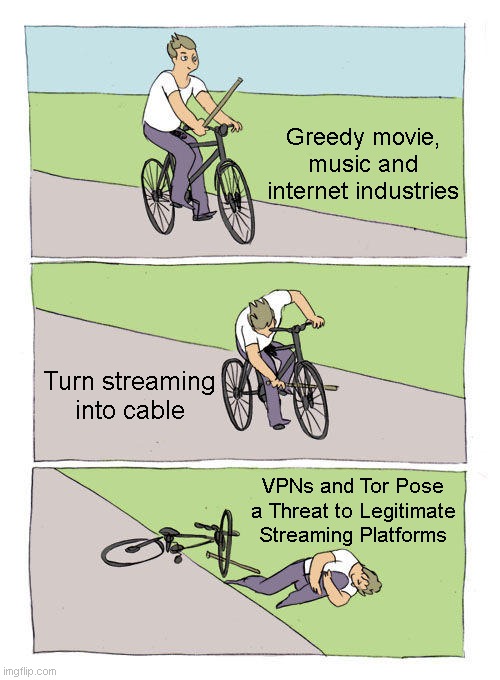
Well hey, that's what happens when you turn streaming into cable.

I had Netflix, Amazon, and Hulu subscriptions last year.

Today, I have none of those, except for one or two video purchases I made on Amazon.

Now I'm supposed to have Disney+, CBS All Access, HBO Max, Peacock, etc., and that list will probably grow. And we're at a low point in what we consider entertainment. It's bread and circuses up the wazoo. And now I'm apparently supposed to pay more(I heard the Netflix subscription increased again).

5 comments

"A la carte" was proposed for a long time as "here's what's wrong with cable" and overall it's definitely better now. I pay less for a few services, and can switch them in and out, than I did for cable.

But people got unrealistic expectations of total price from the first few years of Netflix and Hulu prices + library. That stuff was always gonna get more expensive as the market moved to streaming.

Thank you! I've been saying this for years.

I will admit that the request for a la carte assumed channel theming along the lines of cable, which isn't materializing in streaming. If I want just high quality sci-fi, which streaming service do I subscribe to? If I want feel good family movies? Etc.

But it was always going to be a dozen streaming services. Anybody who thought otherwise was either delusional or didn't understand how money worked.

It's mind boggling to hear people compare cable and satellite TV to media via the internet.

We once had to sign contracts, and have people come into your house and install things, and then pay rental for their cable boxes or whatnot and had to watch shows based on the schedule they were broadcast.

Now, we can click a few buttons and stream exactly what we want, when we want, and unless you are watching too much media, it is surely cheaper than cable/satellite in years past. And you can purchase a subscription and cancel a subscription within seconds, as opposed to calling the cable company and waiting on hold and dealing with retention departments.

Comparing it cable is unfair. At least cable worked properly with my television unlike the HDCP infested upgrade nightmare that streaming turned into.

I started just pirating the content I was subscribed to because it was easier. Then they made it harder with all the fragmentation so I stopped paying for it full stop.

Movie industry has to do the leg work to get my attention and that is very fragile. They choose not to so no cash from me.

I find a lot of pirate services don't really serve the 4k market that well. The vast majority of it is 1080p. Do you just use 1080p or 4k in your piracy adventures? Is the new thing not bittorrent?
1080p and bittorrent. That's it. I honestly don't have the eyesight or a large enough screen that 4k makes a difference for me.
> Now I'm supposed to have Disney+, CBS All Access, HBO Max, Peacock, etc., and that list will probably grow

I honestly don't see why anyone needs more than maybe two streaming services. Do you really need to see everything? Even during the pandemic, two seems to be plenty for most families.

Imagine arguing that movies are too expensive now because you have to see a movie every day. The obvious solution is to prioritize what you view and watch fewer movies.

For most people the current approach is better: spending $20 or $30 a month instead of $80 -- and with much better choices available, and often without any ads.

If you want to be frugal, it also makes a lot of sense to stop and start your subscriptions depending on what show(s) you're actively watching that season. During Game of Thrones I needed only HBO. During The Handmaid's Tale I needed only Hulu. During Stranger Things only Netflix.
The next headline would be: "Stopping and Starting Subscriptions Pose a Threat to Legitimate Streaming Platforms"

Well, more like "Dear subscriber, for your convenience and security, you can now activate your subscription in 3-month packages. Don't thanks us, at EvilCast, we're always thinking of you".

This one is easier for them to fix with loyalty-based pricing and/or activation fees.
At least we can rest for now, knowing they won't do that until one of them is convinced it won the subscription streaming war.
> Do you really need to see everything?

It's not about seeing everything, it's about seeing what's good, and how that's scattered across a dozen or more services where it's buried under mostly mediocre/bad content.

Sure, sometimes there's an option to just rent/buy digitally, but often that ends up being way more expensive than just buying a physical blu-ray version.

Case in point: If I wanted to stream Battlestar Galactica (2004) in Germany then the first option for that would be Amazon Prime Video. Even tho I pay for a prime membership, buying all 4 seasons digitally in HD quality, would cost me 92€, there is no option to just rent them.

While ordering the blu-ray set for the whole show, on Amazon with delivery tomorrow, would cost me 48€, nearly half as much and I get a physical version I can use as often and wherever I want, even if the unthinkable happens and Amazon goes out of business.

Why does the clearly inferior version of a product cost that much more?

The virtual version doesn't take up space. Physical items occupy space so after a while they want to discount them to since that's costing them money to store. Digital items won't go away even if they put them on sale, and hard drive space is cheap.
I agree it sucks, but isn't this pretty much what "everyone" was asking for? A few years ago it felt like every week there was some refrain of

> Look, I don't want to pay $120 for 900 channels I never watch. Just let me pay for them a la carte.

This reminds me of those plots where the devil grants wishes in sneaky terrible ways that are not at all what the asker intended.

Only, we're not paying $60 for 15 channels we want now. We're paying $60 for 1-2 shows each from 200 channels (most of which we don't want). Channels had themes, and what people meant by a la carte was being able to get the themes they wanted.

Personally, I'd prefer to see every service have access to (pretty much) all content and then compete on quality/price/etc... kind of like how music tends to work nowadays.

Well at the same time due to the way the industry works in the first place. Netflix was fundamentally going to die. Mainly due to how licensing fees work. Doing this alleviates that pressure in a way that cable never could.
I just couldn't resist: https://i.imgflip.com/4kyf7g.jpg