|
|
|
|
|
|
by stutonk
2059 days ago
|
|
|
The profusion of Category-theoric abstractions and some of the more recent purely functional norms in Haskell are like the PhD-level version of `AbstractVisitorContextFactoryBuilder` which, aside from all the unnecessary cognitive load, lead to enormous dependency graphs of the npm variety. Personally, I wonder if uniqueness types in languages like the sadly forgotten Clean (a close relative of Haskell) would have been better than the whole Monad/Arrow thing. All of that abstract theoretical stuff is certainly fascinating but it's never seemed worth all the bother to me. On the other hand, in SML you get all the benefits of strong HM type inference/checking, immutability by default, etc, etc.. while also still being able to just `print` something or modify arrays in place. SML's type system isn't higher-order like Haskell's so its solution to the same problem Haskell solves with type classes isn't quite as elegant but otherwise SML is the C to Haskell's C++. |
|
|
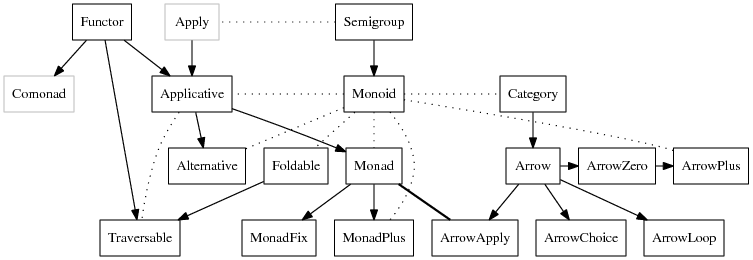
- Monad is just an interface (with nice do-notation, to be sure), but it's elevated to an almost mythic status. This (a) causes Monad to be used in places which would be better without (e.g. we could be more generic, like using Applicative; or more concrete by sticking to IO or Maybe, etc.) and (b) puts off new comers to the language, thinking they need to learn category theory or whatever. For this reason, I try to avoid phrases like "the IO monad" or "the Maybe monad" unless I'm specifically talking about their monadic join operation (just like I wouldn't talk about "the List monad" when discussing, say, string splitting)
- They don't compose. Monad on its own is a nice little abstraction, but it forces a tradeoff between narrowing down the scope of effects (e.g. with specific types like 'Stdin a', 'Stdout a', 'InEnv a', 'GenRec a', 'WithClock a', 'Random a', etc.) and avoiding the complexity of plugging all of those together. The listed advantages of SML are essentially one end of this spectrum: avoiding the complexity by ignoring the scope of effects; similar to sticking with the 'IO a' type in Haskell (although even there, it's nice that Haskell lets us distinguish between pure functions and effectful actions).
Haskell has some standard solutions to composing narrowly-scoped effects, like mtl, but I find them to be a complicated workaround to a self-imposed problem, rather than anything elegant. I still hold out some hope that algebraic effect systems can avoid this tradeoff, but retro-fitting them into a language can bring back the complexity they're supposed to avoid (e.g. I've really enjoyed using Haskell's polysemy library, but it requires a bunch of boilerplate, restrictions on variable names and TemplateHaskell shenanigans to work nicely).