Hacker News new | ask | show | jobs
by verylittlemeat 2086 days ago
You're being downvoted but you're right.

I'm starting to believe that sites like 538 feed off of the general public not understanding that a 20% chance to win is 1 in 5. Endless ink has been spilled about how the public does not understand statistics but very little effort has been made to communicate effectively.

The whole thing seems like a navelgazing sideshow where the pollsters want to have it both ways. They want to claim their predictions are infallible but then when the public says they failed they want to backpedal with holier than thou "well, actually..." excuses.

3 comments

> Endless ink has been spilled about how the public does not understand statistics but very little effort has been made to communicate effectively.

How, then, should statistics be appropriately communicated?

> They want to claim their predictions are infallible but then when the public says they failed they want to backpedal with holier than thou "well, actually..." excuses.

Do pollsters generally try to claim their numbers are infallible? If anything, the fact that margins of error are included in the results would seem to imply the opposite.

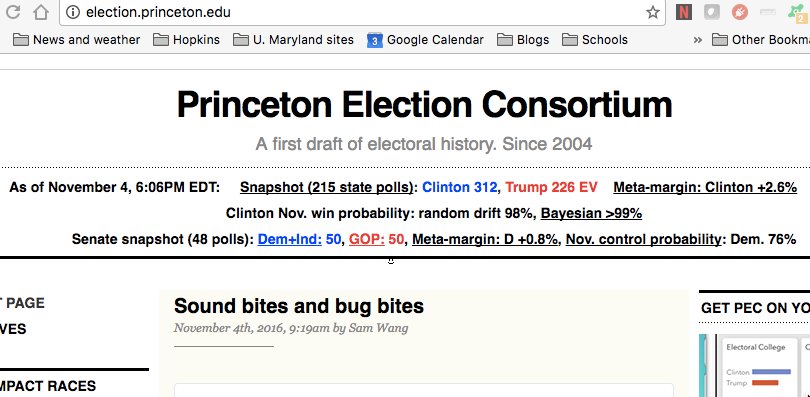
I don't buy that they're trying to communicate in good faith. I remember very clearly sources like this* in 2016. There was so much hubris and minimizing of Trump that him having a 30% chance to win was like an irrelevant footnote to Hillary's coming coronation.

*https://pbs.twimg.com/media/Cwc-j6YXUAEIMaM.jpg

The pollsters take too much credit when they're right and deflect too much blame when they're wrong. They need to do a better job of being humble and stop trying to pass themselves off as apolitical number crunchers just giving us the facts.

> The pollsters take too much credit when they're right and deflect too much blame when they're wrong.

You are confusing pollsters with "forecasters using data from pollsters". These are not the same people.

Many of the forecasters in 2016 were very bad because of naive assumptions about how polls related to election results, particularly many making the assumption that polling errors were independent between states (also, lots did a really poor job of poll aggregation before those naive models.) The reason is Nate Silver and 538 had made a name for themselves in the preceding couple of cycles, and lots of people who didn't understand the process but saw the outcome decided they could do the same thing, because, hey, how hard could it be to compile a bunch of polls and model outcomes based on them?

Read the 538 forecast on 2016 election night: https://fivethirtyeight.com/features/final-election-update-t...

In particular look at this (which is almost exactly what happened):

But if there’s a 3-point error against Clinton? That would still leave her with a narrow lead over Trump in the popular vote — by about the margin by which Gore beat Bush in 2000. But New Hampshire, which is currently the tipping-point state, would be exactly tied. Meanwhile, Clinton’s projected margin in Michigan, Pennsylvania and Colorado would shrink to about 1 percentage point, while Trump would be about 2 points ahead in Florida and North Carolina. It’s certainly not impossible that Clinton could win under those circumstances — her turnout operation might come in really handy — but she doesn’t have the Electoral College advantage that Obama did in 2012, when he led in states such as Ohio and Iowa and had larger leads than Clinton does in Michigan and Pennsylvania. In particular, Clinton could be vulnerable to a slump in African-American turnout.

> I don't buy that they're trying to communicate in good faith.

What would "good faith" communication look like, then?

> I remember very clearly sources like this* in 2016.

Can you elaborate on what exactly is wrong with that source?

(That isn't a pollster, too; that's a (meta?)analysis/aggregation, but that's a relatively minor nitpick)

> They need to do a better job of being humble and stop trying to pass themselves off as apolitical number crunchers just giving us the facts.

Are they themselves claiming that they are "giving us the facts", or is that how they are being represented by others?

And are you talking about actual polls, or about predictions based on said polls?

I disagree; I think that 538's presentation this time around is specifically geared toward avoiding these sorts of misconceptions. And I think that's really hard to do, so I imagine there will still be quite a few people who don't get it and think that a 20% chance means something that will never happen.
538 isn't a pollster. It tries to aggregate polls to make overall predictions.

It does a pretty good job - it gave Trump nearly 30% chance of winning in 2016 and given his small margin that seems reasonable.

Sites like Huffington Post which gave Clinton 99%+ chance are the ones which should be criticized.