Hacker News new | ask | show | jobs
by niho 2082 days ago
> I often think about why/how medieval artists couldn't quite grasp how to depict depth in their paintings (as a lateral thinking technique).

The explanation for that is generally agreed on to have more to do with the aesthetics of early Christianity influencing Medieval practices, more than changes to human perception (source: I have a masters degree in Art History).

1 comments

could you give more on that ? i can imagine how religious dogmas can influence a lot of things, but representation of depth ??
Not OP, though mild experience with art history and Christian history, but I suspect OP is talking about the intersection of art and the prevailing religion in Europe at the time (Christianity). Early Christian art was intentionally unrealistic in style specifically because the intent was often symbolism and representation rather than realism (this still holds true today for most Orthodox Christian art[0]). In fact, making it realistic would even border on idolatry (see Iconoclastic Controversy[1]).

That said, up until the European middle ages, nearly all art was that which was commissioned by the church. The style of the time permeated the art that wasn't commissioned by the church. As more non-religious art was commissioned, there was little need to remain working in that style and realism was embraced. I could be wrong, and probably am, but I think Catholicism is the only large Christian denomination that adopted realistic art.

I think depth was already understood by this point, though (see sculptures[2]). Again, I'm not OP, and I'm sure OP will have a more thorough explanation.

[0] https://orthodoxartsjournal.org/topics/iconography/

[1] https://www.britannica.com/event/Iconoclastic-Controversy

[2] https://en.wikipedia.org/wiki/Victorious_Youth

Good point. There’s also, to me, a perception of style and technique: there were a lot of stone-based art, made specifically to endure time. Bas-relief, a very fit approach of art for stone-based material had this specific style that got aesthetically and technically translated to paintings and stained glass, for an overall quite consistent style whatever the medium.

You can see the intent on many religious sculptures in medieval churches around e.g France: the technique is precise, so it’d be really easy for a sculptor to just compare and match to a living and breathing model, therefore they chose not to. Contemplating how churches tell stories through imagery, you can see how they used this style for emphasis on specific physical features to elicit strong emotional response instead, not entirely unlike those TVs in stores cranking up contrast to completely unrealistic levels.

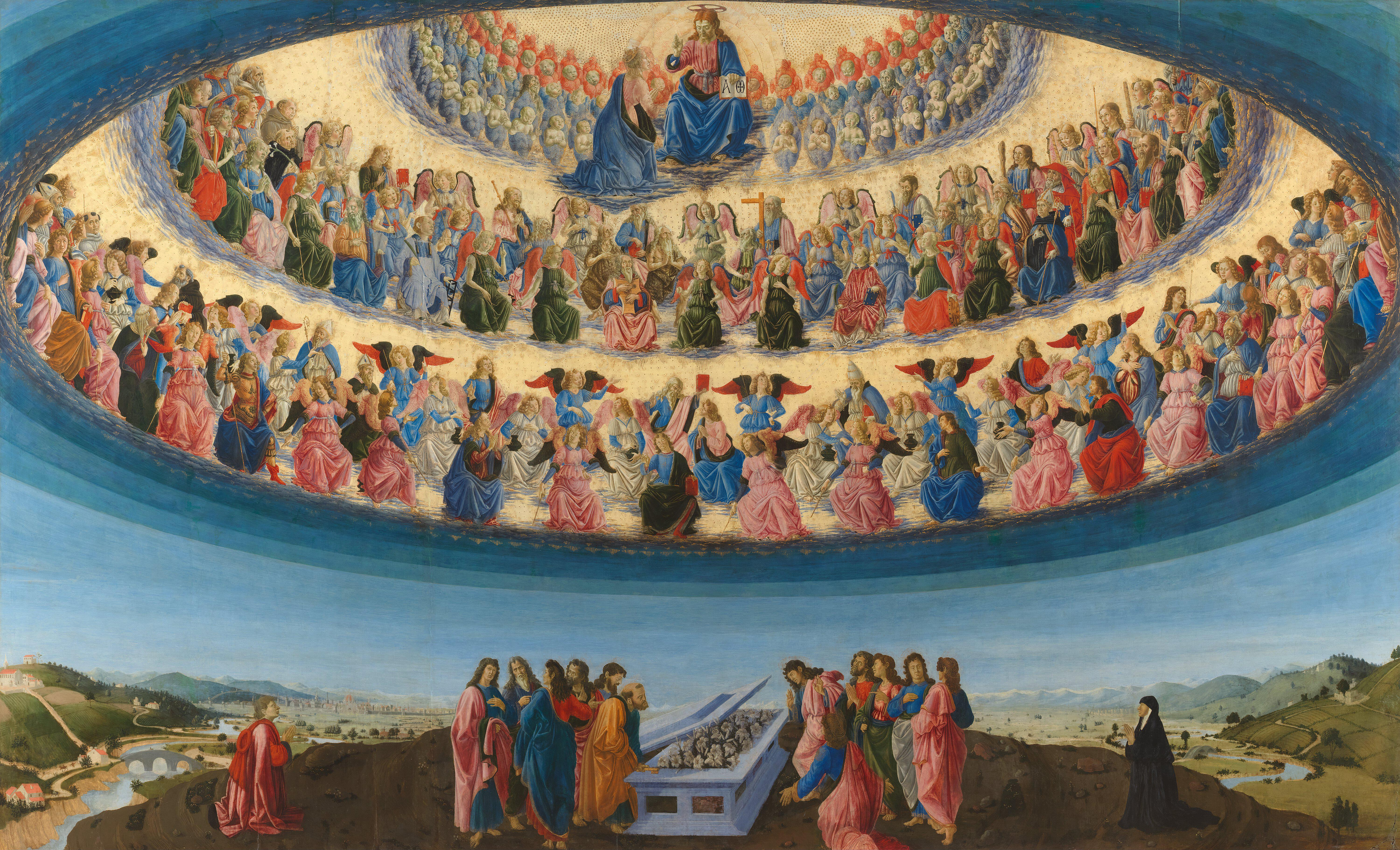
This [1] is a painting from 1476. Notice how architecture and landscape has depth, but people are all +- the same size except for Mary and God.

You wouldn't want to draw mere mortals bigger than saints just because they happen to be closer. Peasants (which couldn't read and were the main target of these paintings) could get wrong ideas.

https://upload.wikimedia.org/wikipedia/commons/f/ff/Francesc...

Not exactly what they mentioned, but check this out [1]. It talks about the perception of time in the middle ages, and how merchant time slowly substituted the impractical notions of church time. A professor of mine who was talking about medieval paintings and their ideas of space and time suggested this paper.

[1] https://journals.sagepub.com/doi/10.1177/053901847000900411 - Church Time and Merchant Time in the Middle Ages - Jacques Le Goff