| Thanks! > I vaguely recall some mention in one of the docs I read a while back that you were having difficulties with the JIT causing noticable pauses/latency in interactive environments like Morphic, comparison to the OpenSmalltalkVM. Right, have a look at the sub-discussion at https://news.ycombinator.com/item?id=24182587. > Am I recalling correctly, and if so is it still the case? GraalVM and TruffleSqueak have evolved quite a bit, but it is still the case. With libgraal, TruffleSqueak warms up much faster, and we were able to further improved the performance of TruffleSqueak. If you'd like to give it a try, it should be fairly easy to get started: https://github.com/hpi-swa/trufflesqueak#getting-started > And more generally, in comparison to the OpenSmalltalkVM, what are the TruffleSqueak downsides? The upsides seem nicely obvious! TruffleSqueak passes quite a lot of Squeak's SUnit tests (see [2]), but is of course not 100% compatible yet. Proper support for some plugins (e.g. FFI, OSProcess, ...) is still missing. Apart from that, I'd say that TruffleSqueak has to live with the design decisions made in Truffle, but we can build on and reuse all of GraalVM components (e.g. JIT, GC, ...). The OpenSmalltalkVM, on the other hand, is more flexible, but you have to implemented everything from scratch. [2] https://github.com/hpi-swa/trufflesqueak/runs/990481811?chec... |
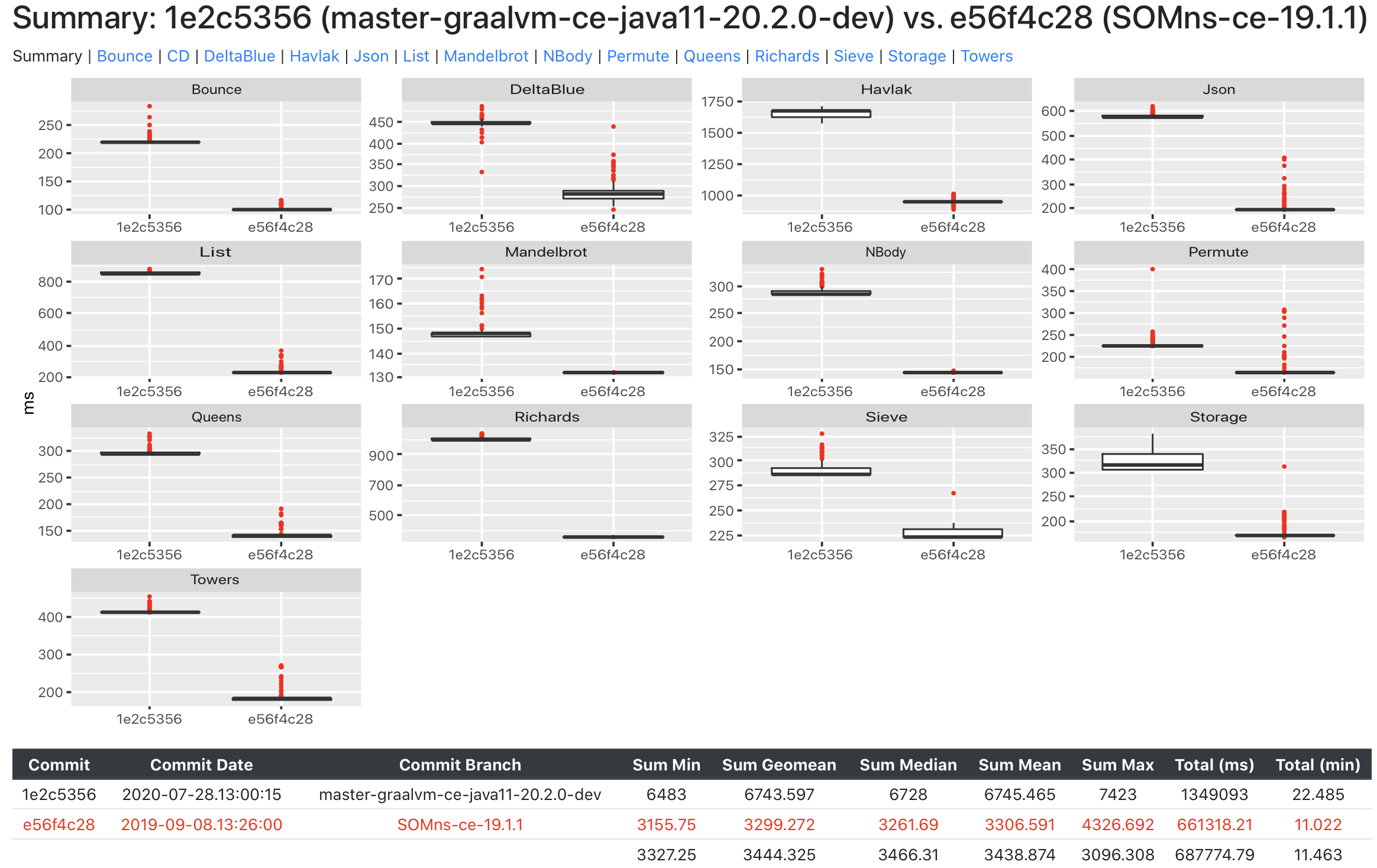
It seems like a revisiting of the experience of the Self team between the second and third generation of Self VMs[1], though the underlying hardware might be just a little faster :) Do you think this tradeoff of peak performance vs interactivity is inherent in Tuffle's approach? Or can Truffle realistically aim for the best of both worlds?
One interesting aspect of the Self VM is that it can save the JIT generated native machine code together with the Self code in the image/snapshot, so that you can load a pre-warmed set of objects. Is that possible within the Truffle framework?
[1] https://bibliography.selflanguage.org/_static/third-generati...