Hacker News new | ask | show | jobs
by ssalazar 2135 days ago
Many of the bars, restaurants, and smaller cultural institutions will be gone. The larger, well-funded museums and nature will stay of course. But much of what is interesting about a city comes from the people who live there and shape its culture.

The San Francisco of today is very different from 10 or 20 years ago, and will be very different 10 years from now. This is recoverable, sure, but its not guaranteed, and its absolutely a change of course for this city and others.

3 comments

I live in Brooklyn and have seen 2-3 business close a week around me. At this point almost every other storefront is vacant (many of which have been since before the pandemic). My hope is that this will bring down commercial real estate prices down significantly and create an opportunity for a lot more small businesses in a year or so, most of which I assume will be restaurants and other "experience" based shops.

The outdoor dining has been a great addition and it looks like it might become permanent [1], which would be a big plus for the city.

There's also a lot more people biking now and I'm hopeful that it will help shape future legislation to make the city even more bike friendly. (I went to 4 different bike shops around me and they were all sold out).

https://ny.eater.com/2020/8/3/21352532/outdoor-dining-extend...

> My hope is that this will bring down commercial real estate prices down significantly

I'm going to predict that this will not happen. More specifically, that it will be unusual in general for rents or prices anywhere to drop any more than 10%.

There's something odd going on and my best guess is that there are (a) accounting/tax practices that provide incentives for vacancy with certain nominal values and (b) real estate markets are now driven more by massive pools of capital trying to soak up opportunities than they are by demand on short-to-mid-term horizons.

But I don't know enough to say for certain and explain how, and I'm hoping that someone can tell me why/how I'm stupid.

The value of land rented is mostly based on the rent that can be charged. Loans which use the land as collateral need the value to stay high in order to roll over (refinance) the loan.

It's conceivably better for major real-estate holders to rent the land out at their preferred rate one or two months in a year, and leave it unoccupied otherwise, than accept reduced rates. The former gives a fig leaf for rental value, which props up the land value, which enables refinance. The latter admits that rental value has dropped, which would lower the land value, which would cause refinancing to fail.

That makes sense, but I'm confused how you make loan payments without tenants paying rent. Not to mention property taxes, maintenance, utilities and other overhead.

Kind of feels like the cliché "make it up in volume" when you're losing money on each transaction.

It's not sustainable indefinitely but most large landlords have significant capital reserves as well as revenue from a diverse portfolio of other properties. So they can afford to take losses on vacant properties for a few years while waiting for the market to recover.
This is to the detriment of reality, to the actual structure of the city, therefore it must be curtailed.
You don't make loan payments; you make interest-only payments and are speculating on future appreciation on the value of the land, a proxy for the local economy.

It's not sustainable indefinitely, but it can go on for some time. And if the economy picks up, then all is right again.

You are speculating with other people’s money and at very high leverage. If the market keeps going up the amount of profit can be spectacular and the losses while also potentially spectacular may not be so bad if you don’t have any collateral in the first place.
Rent in SJC is down by at least 10% if not much more. I am in an apartment now that used to cost $3500/mo for only $2600/mo now. A month or so ago, I moved out of my dilapidated, old roach infested apartment I was paying $2750 for elsewhere in San Jose. Yeah lots of businesses have closed and people moved out, but the discount units are filling up and businesses are reopening.
That does sound like a remarkable change in price. Thanks for the counterexample data point.
Money printer goes brrrr. To save your money, land and houses are your best bet. (even in or after a civil war)
I don’t think that this is always true. Land reform happens consistently in history when ownership gets out of wack. Also the value you assign to the land is going to change when the use changes, for example houses in currently popular tech hubs aren’t as important when people can work remotely. And the improvements to land like houses aren’t always going to necessarily hold their value. Labor is a huge influence on price, what happens when machines start building houses? Not saying you shouldn’t buy land or houses, I consider them part of my strategy but consider the downsides too.

Oh yeah, take a look at the Georgists and The One Tax where land is the only thing taxed since it’s the only finite resource. It’s not impossible that we end up in a situation where holding land just to hold your wealth isn’t going to exist anymore.

This has historically been true, but one major variable has changed: executives have been forced to see what their companies look like with remote workers. The land and housing markets look very different when a significant percentage of people aren’t paying for a shorter commute.
I think the massive pools of capital thing is somewhat true, but this investment strategy works because ultimately there's so much demand for property, which is what's driving the real estate prices.

A permanent drop in demand because more people are working from home could crash the market.

If everybody has access to the pool of fake money: you get inflation.

If only a handful of fools do, you will get economic devastation sooner or later, because you remove the feedbacks of capitalism and hand the reins to monkeys that just happen to have access to the money printer.

Commercial real estate prices are coming down.
That's great four months a year, but what about the rest of the year? No one can eat outdoors in 20F, or bike to work in the snow and ice. SF does have the advantage of year round biking weather.
I would beg to differ. 3 season biking is easy as pie, and 4 season with just a little effort. there was only maybe a month out of the year I couldn't bike to work in Minneapolis or Chicago, all it takes is infrastructure and the right gear.
True for you and me, insurmountable inconveniences for the average person.
As easy as pie, all it takes to bike to work is all the tarmac and smooth roads of a car world, all the parking space of a small car world, all the maintenance of a small vehicle, and a car/bus/taxi/train system for when you can’t bike, and their infrastructure, parking and maintenance.

Do bikes have the largest amount of unmentioned externalities of any form of transport?

> all it takes to bike to work is all the tarmac and smooth roads of a car world, all the parking space of a small car world, all the maintenance of a small vehicle

You are just joking, right? You’re exaggerating by an order of magnitude, you can literally fit 10 bikes in the space of a small car, on the road and when parked. You think bike maintenance is the same effort as car maintenance? I’m baffled by this claim, and I maintain several bikes and several cars. Cars are much harder, much more expensive to maintain, and require far more resources. Bike maintenance is something most riders can do on their own, while car maintenance is something people take to a shop.

> Do bikes have the largest amount of unmentioned externalities of any form of transport?

What on earth are you referring to? Are you comparing a few sidewalks and bike lanes in select metro areas to the 3 million miles of paved roads in the US? Are you suggesting the 1-2 ounces of oil I use on my bike chain per year is somehow worse than the average 2 metric tons of gas and oil used by the average car in a year? Are you including pollution in your list of externalities? Are you including accidents and fatalities in your calculation? I’m confused, I really can’t think of a single unmentioned externality where bikes don’t compare favorably to cars by a very wide margin.

So, it seems like the answer is a really clear and obvious no, there are other forms of transport with externalities so much larger than bikes that it makes the mere suggestion seem pretty absurd. Examples include but aren’t limited to: cars, airplanes, and cargo boats.

> You are just joking, right? you can literally fit 10 bikes in the space of a small car, on the road

You are just joking, right? A Fiat 500 is 3.5 meters long and 1.6 meters wide. No way can you "literally" fit 10 bikes being ridden on the road in that space - or even 3. Parked, you might be able to fit 3 if they're staggered, but if you're going to tell me you can double-decker it, you won't also fit the stairs/ramp/elevator mechanism in that space as well.

> You think bike maintenance is the same effort as car maintenance?

You take it to a shop, drop it off, and leave it there, then get it back later? Yes, that sounds about the same effort. Except a car usually needs servicing and is still drivable, a bike is probably punctured or chain snapped and unusable, making it more hassle, and if you decide that means you have to do it yourself, more effort. Everyone remember how fun it is to take a bike wheel off and run it through the bathtub to identify the location of a puncture, yes? Never spent that much effort on taking my car to a garage.

> Bike maintenance is something most riders can do on their own, while car maintenance is something people take to a shop.

You've gone from "baffled by this claim" to "most people spend more effort on bike maintenance than car maintenance" in the space of a paragraph. No comment.

> What on earth are you referring to?

I'm referring to the things I said. If you didn't have paved roads made for cars, you would need to build them for bikes. You wouldn't need to build them for walking. Bikers never ever mention this, it's a kind of parasitism on the car infrastructure - a cost that bikers don't consider. If there were no cars, but we needed to upkeep hundreds of miles of tarmac roads, bikes would need to be taxed hugely. It's an externality in the sense that bikes need it, but aren't paying (directly) for it, and are offloading the cost onto car drivers (who currently need it more and do more damage to it).

> Are you including pollution in your list of externalities?

No I'm not including the cost of container shipping enough bikes for 500,000 people from China, or the cost of digging up the iron ore and making the steel and carbon fibre to build them, or the trash heaps where hundreds of thousands of bikes rot. Good point though, neither do bike enthusiasts.

> Are you including accidents and fatalities in your calculation?

The kind where a big heavy fast moving metal lump collides with a soft squidgy easily damaged slow-moving pedestrian? I'm not including those either, but I am against bikes being allowed anywhere pedestrians are, so let's add that in as well.

> I’m confused, I really can’t think of a single unmentioned externality where bikes don’t compare favorably to cars by a very wide margin.

Neither can I. That's a totally cherry-picked comparison because it's like saying "being stabbed compares favourably to being shot by a very wide margin". There's no unmentioned externality where walking doesn't compare favourably to bikes by a very wide margin - in a place which is designed and built for humans walking -- which all places should be because humans are more important than vehicles. Walking needs less tarmac, less machinery, less maintenance, less money, is more accessible to people of more abilities, takes less parking space, less infrastructure, causes fewer accidents, places fewer restrictions on clothing, has lower environmental cost, lower pollution, less waste, doesn't need helmets and high-visibility clothing and bike-locks, doesn't need insurance and breakdown recovery and loan-cars...

> So, it seems like the answer is a really clear and obvious no, there are other forms of transport with externalities so much larger than bikes that it makes the mere suggestion seem pretty absurd.

Cars pay for roads in terms of fuel taxes and vehicle taxes. Bikes don't pay for either. Cars often pay for car parks, bikes often use sidewalk, or car parks. Cars pay for accidents with mandatory insurance, bike riders are uninsured. That other things are worse was not my point, my point was that bikers gloss over needing roads and the cost of that, car drivers don't.

Have you been in a place where lots of people ride bikes?

A small car world would be 100% -> 60% resource reduction. At reasonable scale, bikes are at least a 100% -> 10% reduction in all mentioned 'externalities' or should we say resource use, or 10x capacity for same resources, except for road size at maybe 3x, but still more than 10x on cost.

Public transit would grow (no need to fit all cyclists), but that should actually be a net benefit.

To comprehend the difference in scale, view images here [1]. Half as many cars wouldn't fit, even if they covered every cm of the image.

[1] https://biketoeverything.com/2018/12/18/bicycle-infrastructu...

> A small car world would be 100% -> 60% resource reduction.

You're missing the part I replied to which was about bikes being usable 11 months of the year. If you need all the car infrastructure for 1 month, plus the bike infrastructure, that makes it overall worse, not better.

But discard that, if biking is a 60% reduction, then a walking+train world would be way more.

Your link talks of a train station building a 12,500 bike-parking garage. For comparison the busiest train station in the UK (Waterloo) has 250,000 people using it every day. Note that the pictured bike parking in Amsterdam takes up the space of two of the large multistorey hotels next to it, just to store metal, but pushes actual walking humans two hotel distances further away from their destination just to walk past unused metal storage.

Bike parking, like car parking, is a non-place in the sense of https://newworldeconomics.com//place-and-non-place/ it's not somewhere anyone wants to go, or a place where anything happens. Scale that bike parking up to 100,000 people and it would be an enormous amount of physical city-center non-place. Now count that you have to park those bikes at both ends of every journey - bike parking at the supermarket, at the clothes shops, at the pubs, at the apartment buildings - and instead of a small, dense, walkable city center, you're now measuring the total area devoted to non-place metal storage in square kilometers, and inconveniencing everyone with kilometers more walking every week just to cross the distances taken up by mega bike park bloat.

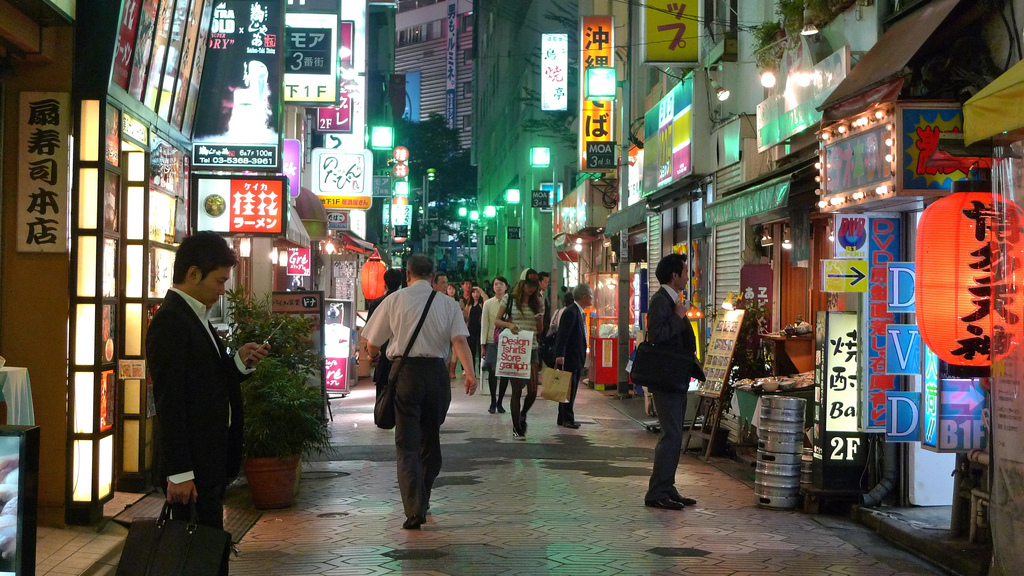
This picture is Shinjuku in Tokyo, the world's most populated city, near the world's busiest train station: https://newworldeconomics.com/wp-content/uploads/2017/01/shi... - can you imagine that street being as pleasant with 2,000 bikes barelling down it at 2x walking speed and every one of those eateries having 5-20 bike parking outside?

And there's no chance those 12,500 bikes would fit on the trains, how many bikes fit on a passenger train, maybe 15 or so? Bike+train means most people can only bike on one side of any train journey.

> Public transit would grow (no need to fit all cyclists), but that should actually be a net benefit.

If public transit is growing, more people will be able to not-need bikes.

> To comprehend the difference in scale, view images here [1].

Or you, view images here: https://newworldeconomics.com/what-a-real-train-system-looks... and comparisons here https://newworldeconomics.com/the-problem-with-bicycles/

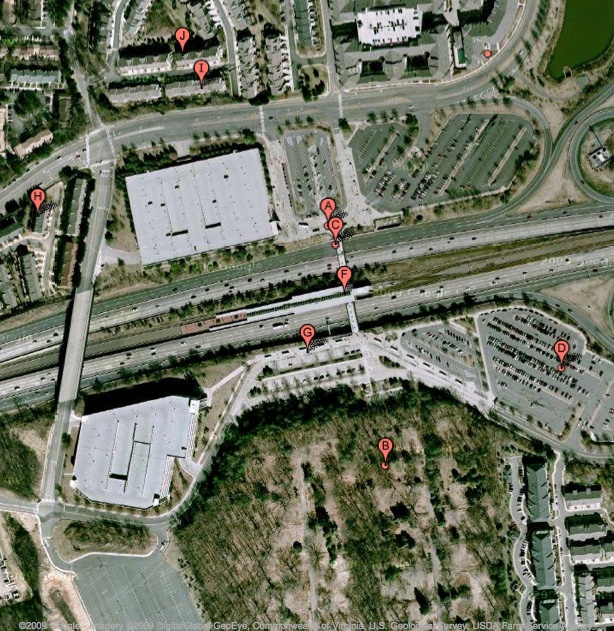
e.g. [1] "The typical U.S. solution is to surround the train station with acres and acres of free parking.[...] There are 157 acres of land in this photo. When you step off the train, you have immediate walking access to 157 acres of /nothing/"

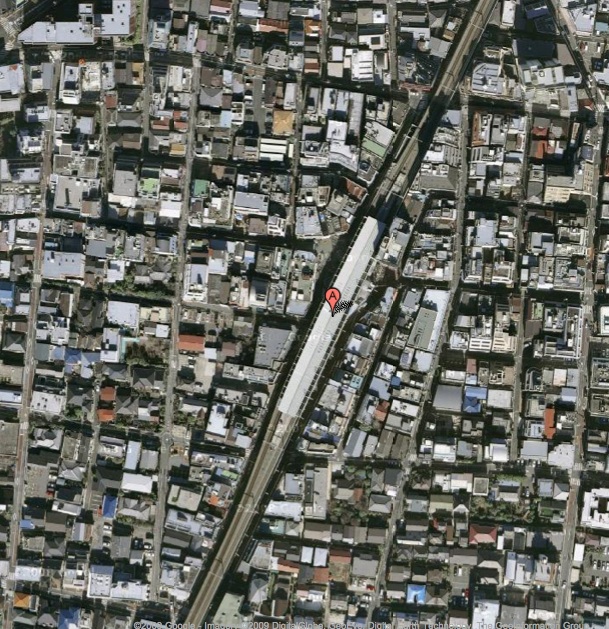
and [2] "The better solution is to surround the station with all the highest-value property. All the best offices, stores and restaurants are as close to the train station as possible, so we can walk there from the station, and where there is the most pedestrian traffic. Plus, you also try to put as many apartment buildings there as you can, so you can easily walk to the station in less than ten minutes."

"if you want people to be able to live without automobiles, you have to make it easy to get from the train station to wherever you want to go on foot. This means you put all the good stuff right up against the train station — even build it into the train station itself if possible. When you step out of the train station, you want to land right in a wonderful pedestrian Traditional City environment, not a parking lot wasteland."

When you switch a "large" surround of car parking for a "large" surround of bike parking, that doesn't fix anything. I put "large" in quotes because the measure is not abstract meters, dollars, or kilos of concrete, the measure is human size and human footsteps - walking past 12,000 bikes is 90% of people walking further for no benefit, while the bike owners also walk further for a small benefit of part of a journey, and puts desirable city space to use by metal instead of humans.

[1] https://newworldeconomics.com/wp-content/uploads/2009/12/vie...

[2] https://newworldeconomics.com/wp-content/uploads/2009/12/gak...

Don't fight it so hard. Every person on a bike reduces traffic on your car commute.

Plus, they don't dump any particulates into your childrens' lungs.

"Accept a bad solution because otherwise I'll threaten your children with a worse one" might be a convincing argument, but it's not a good argument.

Designing things around bikes, and then everyone needs a bike, is a worse option than designing everything around humans (instead of some kind of vehicle).

Since when was NYC covered in snow and ice, 20°F weather EIGHT MONTHS OF THE YEAR
Cycling year around in New York should be relatively easy.

There is winter cycling culture in much harsher climates https://www.theguardian.com/cities/2016/feb/12/ice-cycles-no...

There's a reason why Finland or Canada or Alaska are sparsely populated: The weather.

Sure, those people who can be bothered with it might pick up the cycle during the winter. Those people who can't be bothered are going to pick up their stuff and leave.

I'm from one of those northern areas. Very few people leave because of the weather even if they don't like it. It's mostly because of studying and career opportunities.

North is sparsely populated because the crops were historically poor and prone to losses due to weather conditions, not because people don't like the weather.

What sort of gear do you need for conditions like that? During one cold snap, my chain literally froze on a long ride through some light rain/sleet. (No, I don't know how that happened, but it did.)

And that was in the Seattle area, where it rarely gets all that cold.

I was a Mormon missionary in Hokkaido in some of the snowiest places in the world and got around just fine using a cheap mountain bike. The only additional "equipment" needed was a lighter, to thaw out my bike lock when it would freeze shut.
I see where this thread is going...

https://www.youtube.com/watch?v=ue7wM0QC5LE

I cycled to work through an entire winter in Trondheim, Norway.
Nobody is going to boast about not doing that, so let me just speak for a large but not very vocal part of the general population when I say:

I ain't gonna do that.

I looked up Trondheim, NO weather. It's only Rhode Island cold not Minnesota cold. Plenty of people in Providence, RI bike in the Winter. Trondheim also doesn't have the range found in either RI or MN so you don't get ridiculous heat and humidity to bike in.
I live in a place with -40-45°C (-40-50°F) winters. We've got lots of cyclists even in these conditions.
Hang on, -40 to -45 winters and people bike?
I visited Oulu in late November to early December a few years ago. Yes, they cycle.
My midwestern city is out of bikes too, but it isn't because of a surge in demand. It's because all the bikes were made in China, and supply has slowed to a trickle.
The bicycle component factories in China are now back to operating near normal capacity and the supply chain is recovering.
Me and the family bike many weekends on a city bikepath and I can report that there are a lot more bikers than normal these days.
Absolutely, I totally agree. It's going to be really sad when we're out in a year (or two or three) and all those places that we went to and remember are no longer there because of this pandemic and ensuing lockdown.

But I think about the places (bars, restaurants, clubs, galleries, small shops) I visited almost a decade ago now when I first moved to SF and a bunch of those disappeared in the good times! They were displaced by rising commercial rents or a change in their clientele because of the rapid gentrification of neighborhoods and replaced, oftentimes with more kitsch stuff but sometimes with amazing restaurants or shops, which might not survive this lockdown.

San Francisco was once destroyed by a fire and has bounced back over and over again and I don't think this time will be different. It'll be different but not in the way people are panicking about in this thread and post.

Sounds like an opportunity to create something new tbh.
Currently in S.F, rent controlled. On the fence about leaving, but I don’t see This getting better. I’m seeing this country turn totalitarian; COVID19 running rampant, and one, of many to come,Retrovirus, which is extremely disruptive to our T-cells (immune response).

Where to? Santa Cruz, too quirky? Marin, beautiful but overdone? Santa Rosa, I like this. Now, in Silicon Valley, there’s a sense of being out there; Mountain View, Los Gatos; attractive smaller enclaves.

Inner neighborhoods like the Tenderloin, SoMa, Union Square, Nob Hill, Lower Nob Hill, the Russian Hill, etc. Will probably need a lot of infusion to keep the cartels from fighting over territory. With a deficit so big, its hard to see an easy way forward.

Naw bro, they should put all the homeless people on a bus to Texas and then get rid of all forms of taxes. Make it so you don't even need a license to open a business. It'll be the greatest city in the world! /s
Small blips compared to SFs greater history.

A 8.5+ earthquake would be a city changing event. Entire neighborhoods with URMs would probably no longer exist afterwards (Chinatown, Tenderloin, Soma, etc).