Hacker News new | ask | show | jobs
by Robotbeat 2143 days ago
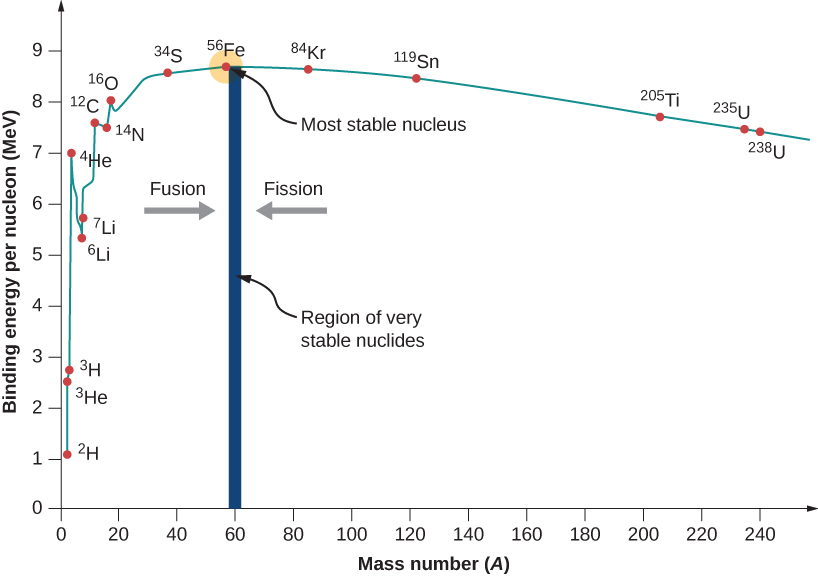
Both fission and fusion release net energy by having products with greater binding energy. The greatest binding energy is iron (and some surrounding elements). Once you get there, no more energy can be released by fusion (or fission).

See this graph: https://opentextbc.ca/universityphysicsv3openstax/wp-content...

So it’s not a perpetual motion machine. Iron is the bottom.

(Heavier stuff than iron can be created by fusion, but that absorbs energy instead of releasing it. Supernova create these heavier-than-iron elements like Uranium and gold endothermically... they’re also created by the decaying guts of neutron stars—which are essentially ginormous atomic nuclei held together by gravity instead of nuclear forces—when they collide and some of their guts are released into space.)

2 comments

The S-Process creates elements with atomic numbers higher than Iron, and it does not rely on supernovas or neutron star dissolution.

https://en.wikipedia.org/wiki/S-process

S-process is still endothermic, though, right?

I'm not sure if endothermic is the best word. IANAP. It seems to usually be used when discussing fusion-based neutron generation. But AFAICT neutron generation, especially as it relates to the s-process, is still largely a thermal process--the greater the temperature, the more neutrons are generated, the faster the s-process evolves. (If you go back to the beginning of the universe all nuclear synthesis represents an endothermic process, right? Though, maybe such semantic games aren't particularly helpful when distinguishing nuclear synthesis processes.)

Nickel-62 is the most stable isotope, if memory serves. It’s not efficiently generated in star fusion, however, so iron-56 is believed by many to be the most stable.