During my classes, I always see waves going up and down to represent sound or magenetic waves. I really cannot visualize in real life. What exactly the ups and down in real time?
I don’t know if this will help you but it is how i think about it.
Just keep in mind that the waves you see plotted aren’t a direct physical model like you might find in the chapter about forces. In those topics you can directly represent a pully or a lever and depict force vectors and distances and their relationship within the system right on the page.
Waves drawn to represent sound or AC current or RF are confusing because they look like waves in the ocean so the brain just inserts that somehow. However, those waves are really a derived value that plots the field/pressure/current intensity over time (or distance). Imagine they are being drawn by a small plotter hooked to a sensor at some point in space and the up and down movement of the ink on the page is just the change in pressure/intensity over time at that spot.
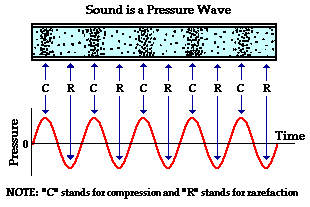
This is closer but the problem with this image is that the particles all have a laminar motion back and forth. The reality is that it's like quadrillions of superballs bouncing in random directions and these density fluctuations are only really evident in larger scale aggregations of particle motion.
For electromagnetic waves, as i understand it, there isn't actually movement up and down in space; there are oscillations in the electric and magnetic fields. Which do somehow have a spatial direction, which is why light can be polarised. I don't have an intuition for it at all!
The challenge with the longitudinal example, which is of course technically correct, is that it’s hard to map it to the spherical shells that most of these phenomena radiate into.
For sound those waves are the pressure level along the line. It only really visualizes things in 1 dimension. This picture shows the relation between the wave that's usually drawn and a view of what the wave would look like if you could see the air.
Magnetic waves are different. The height of the wave in a diagram of magnetic waves represents the strength and direction of a magnetic field at a point in space.
After working in a particularly magnetics heavy project at work an analogue that I found works better is picturing the flux lines as “fluidic” and emulating common fluid behavior. For example, having a ferromagnetic material within a magnetic field is like having a funnel in a fluid stream. Taking this analogue along with an intuitive understanding of Maxwell’s equations really gives you an intuitive understanding of magnetics for applied sciences (ie DivB = 0 means that in any bounded region the number of field lines entering = number of field lines leaving).
Of course all of this is only good up to the point you start looking at magnetics at the material science level. Then you really need to internalize it is a quantum mechanics effect and commit to learning the hard science behind it.
Veritasium has a good video on the “levels of explanation” of magnetic fields and you really need to decide how deep you want to go.
Be careful not to confuse the map with the territory. These ups and downs are a graph of something, such as the pressure in a sound wave. It’s the pressure, a number, that goes up and down as the sound wave passes by.
Just keep in mind that the waves you see plotted aren’t a direct physical model like you might find in the chapter about forces. In those topics you can directly represent a pully or a lever and depict force vectors and distances and their relationship within the system right on the page.
Waves drawn to represent sound or AC current or RF are confusing because they look like waves in the ocean so the brain just inserts that somehow. However, those waves are really a derived value that plots the field/pressure/current intensity over time (or distance). Imagine they are being drawn by a small plotter hooked to a sensor at some point in space and the up and down movement of the ink on the page is just the change in pressure/intensity over time at that spot.
There's an image on this page that depicts it as a 2D slice of reality - https://dosits.org/decision-makers/tutorials/science/what-is...
This is closer but the problem with this image is that the particles all have a laminar motion back and forth. The reality is that it's like quadrillions of superballs bouncing in random directions and these density fluctuations are only really evident in larger scale aggregations of particle motion.