| >If by qualia you mean slight differences in information processing in human brains, then sure. If you mean anything more than that I would like a) a better definition than the one I have given b) some observational evidence for its existence. Subjective experiences i.e. how I actually experience sense data. There is no real, objective observational evidence and there can't be. How would you describe taste to a species of aliens that understands the processes that happen during tasting, but don't taste themselves? It's simply impossible. I know that I have personal, subjective experiences (the 'images I see' are not directly the sense data that I perceive), but I can only appeal to you emotionally to try and make you believe that it exists operating under the assumption that you too must have these experiences. >One problem with "consciousness" is that it's such an overloaded term. I recommend decomposing it into smaller features that we care about and then we can talk about whether another system has them. This entire discussion has been about consciousness in the philosophical meaning i.e. the ability to have some form of subjective experiences. >If we twist words far enough then of course they do. They are following the laws of physics after all which is information processing, going from one state to another. But then all physical systems do that and its usually not the kind of information processing we care that much about when talking about intelligences. Technically correct given the premise but useless. This isn't about twisting words, some people genuinely believe that everything is conscious with more complex system being more conscious. >We're already making the assumption we have the technology to simulate a brain. If you have that ability you can also implement any debugging/observational tooling you need. AI research is not blind, co-developing such tooling together with the networks is happening today The point is that it's about _subjective_ experiences. |
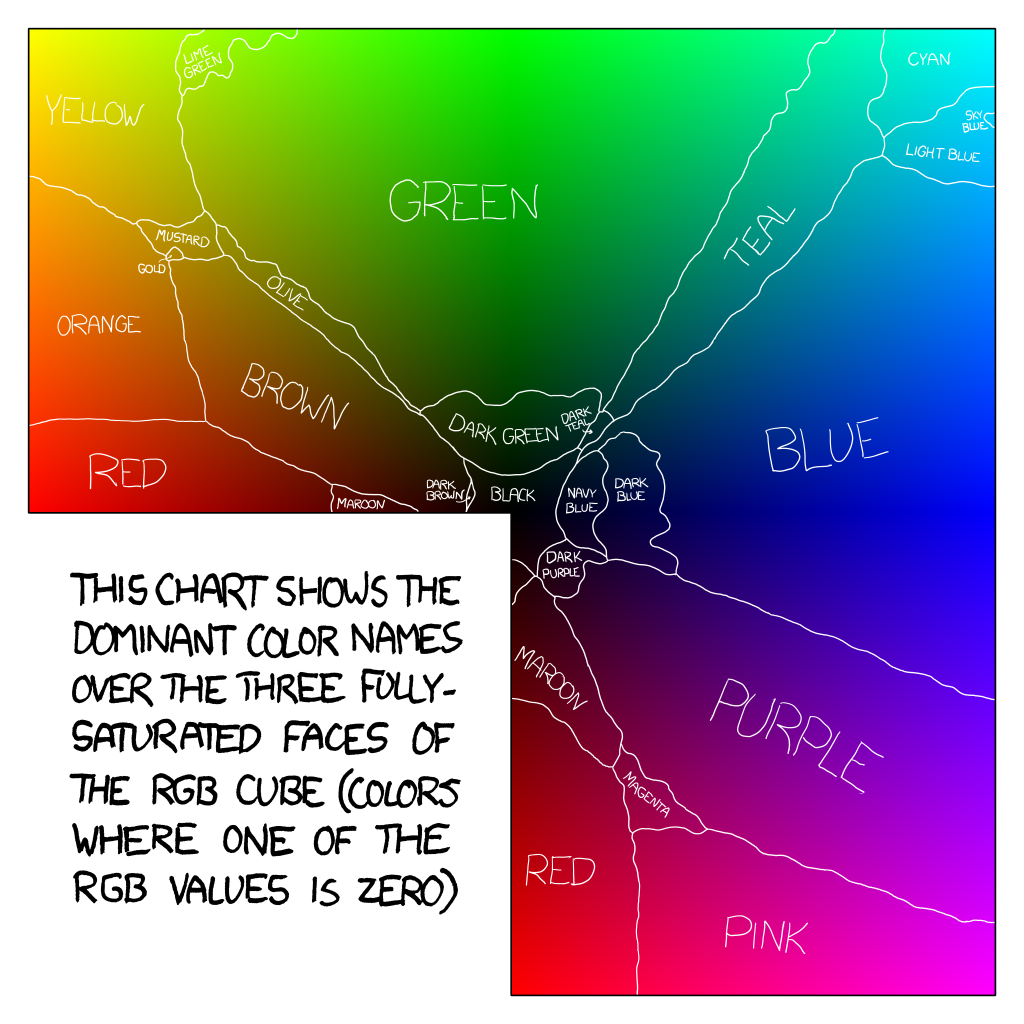
What you can do is today is start with a feature map. We can do that with colors https://imgs.xkcd.com/blag/satfaces_map_1024.png (do you perceive this color as red?) and we can do that with smells https://jameskennedymonash.files.wordpress.com/2014/01/table... That's a fairly limited representation but words are an incredibly low-bandwidth interface not suitable to exporting this kind of information in high fidelity, so we can't. That does not mean it's conceptually impossible. If you wanted to export subjective experience itself then you'd need the previously mentioned debugging interface. Our brains don't have that built-in, but software does. I.e. a program can dump its entire own state and make it available to others.
To me subjective experience seems to be an intermediate representation, deep between inputs and outputs, and due to the various limitations we're bad at communicating it. That doesn't mean there's anything special about it. It is a consequence of compressing inputs into smaller spaces in ways that are useful to that entity.
> This isn't about twisting words, some people genuinely believe that everything is conscious with more complex system being more conscious.
Anything that interacts with the world will have an internal, idiosyncratic representation of that interaction. Even a rock will have momentarily vibrations traveling through it that carry some information about the world. One of today's NNs will have a feature layers that roughly correspond to concepts that are of human interest. They're often crude approximations, but it's good enough for some use-cases. Animal brains just have more of that.
So in that sense, sure, it's a continuum. But there's nothing mysterious about it.