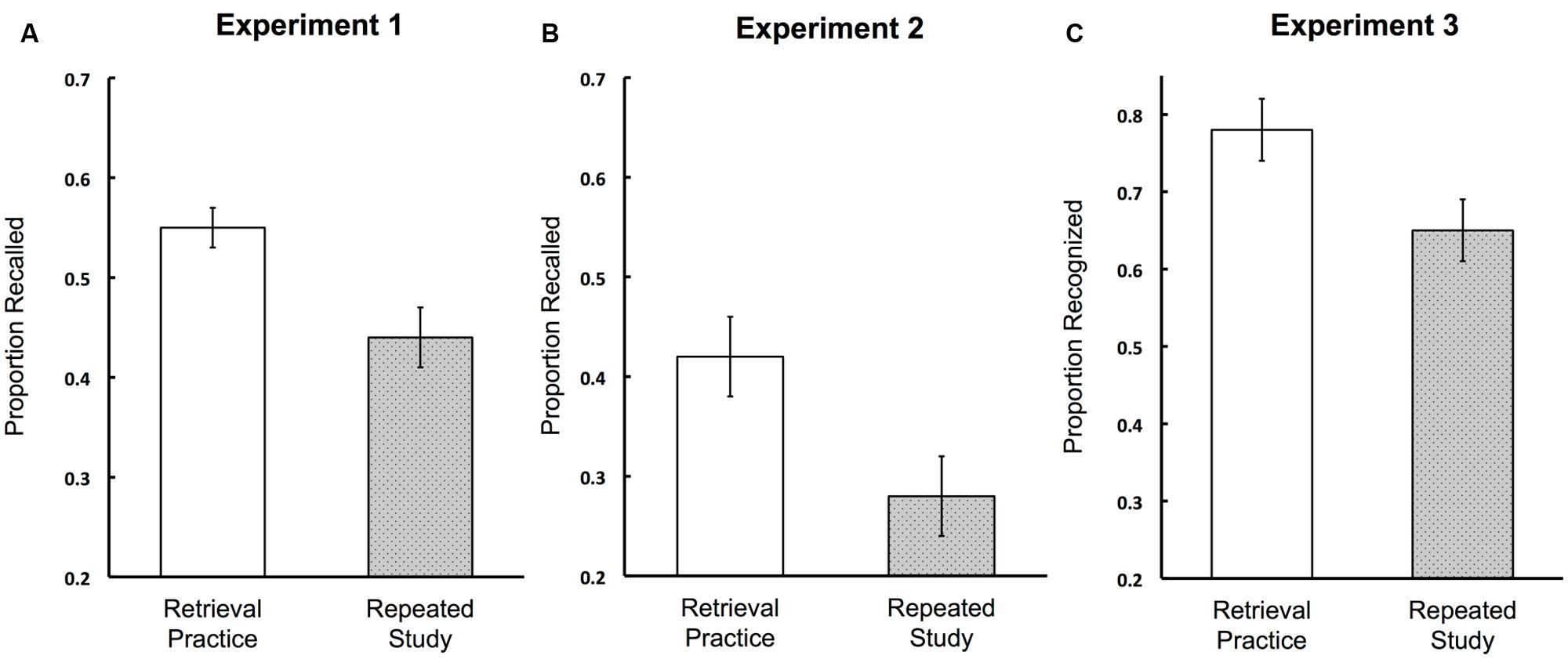
| It's not necessarily a question of "will this work at all?" but rather a question of effectiveness. Numerous studies have shown that retrieval practice is generally more effective. I'm not sure I've seen a study yet which shows any other result. For example, results in a study done on children: (image) https://www.frontiersin.org/files/Articles/175657/fpsyg-07-0...
(from https://www.frontiersin.org/articles/10.3389/fpsyg.2016.0035...) Experiment 2 is free recall (blank piece of paper trying to recall as many words as they studied in the prior phase). Experiment 3 is recognition (given a randomly sorted list of all the studied words and a bunch of other words that weren't in the list). I'd also suggest it limits the usefulness of your memory. By only learning by comparing coins, you might successfully get everything correct on a quiz that entirely consists of comparing coins. But if you're ever faced with a different situation, say you don't have a coin at all but you have to reproduce it in some way, it's likely your knowledge won't transfer. I've been in plenty of situations, and I'm sure others have too, where I've "learned something" and I'm able to answer a multiple choice, but faced with an open-ended question with a free-form answer, I'm screwed because I can't actually recall the information. I've only trained recognition when possible candidates are placed before me. |