Hacker News new | ask | show | jobs
by vixen99 2206 days ago
That does not seem to be the case. The US spends more on education than any other country. $16,268 a year per student vs global average of $10,759". It's evident that money does not translate into better results.

"According to the Washington thinktank the National Center on Education and the Economy (NCEE), the average student in Singapore is 3.5 years ahead of her US counterpart in maths, 1.5 years ahead in reading and 2.5 in science. Children in countries as diverse as Canada, China, Estonia, Germany, Finland, Netherland, New Zealand and Singapore consistently outrank their US counterparts on the basics of education."

https://www.theguardian.com/us-news/2018/sep/07/us-education...

4 comments

What's the money actually spent on? I'd argue that massive American football stadiums for grades 9-12 are perhaps incorrectly prioritized as compared to e.g. teachers.
A decade ago, I was a high school teacher in inner-city San Bernardino. At the time, the district had more administrative personnel than teachers. I’d wager that kind of spending surpasses stadiums.
The problem with these sorts of averages is that it doesn't paint an accurate picture. There are schools with buildings in disrepair and schools without the same resources as other schools. And some have waaay more resources and spending per student than most schools. This is, in part, because a lot of states don't fund their schools by redistributing money across all schools. Instead, they rely on the school district's tax base - which means if you are in a poor neighborhood, you probably won't have as much funding. The same goes for being in an area that doesn't utilize the public schools as much as other areas (using private schools) - this decreases federal funding that is reliant on the number of children going to your school.

All this means that it isn't really evident that money doesn't translate into better results. It isn't strictly funding, that is true - poverty seriously affects how well students can perform, for example - but it should be quite obvious that a school that cannot afford maintenance, proper computers for students to learn on, or enough staff so that classes are a manageable size can't really teach as well as a moderately funded school.

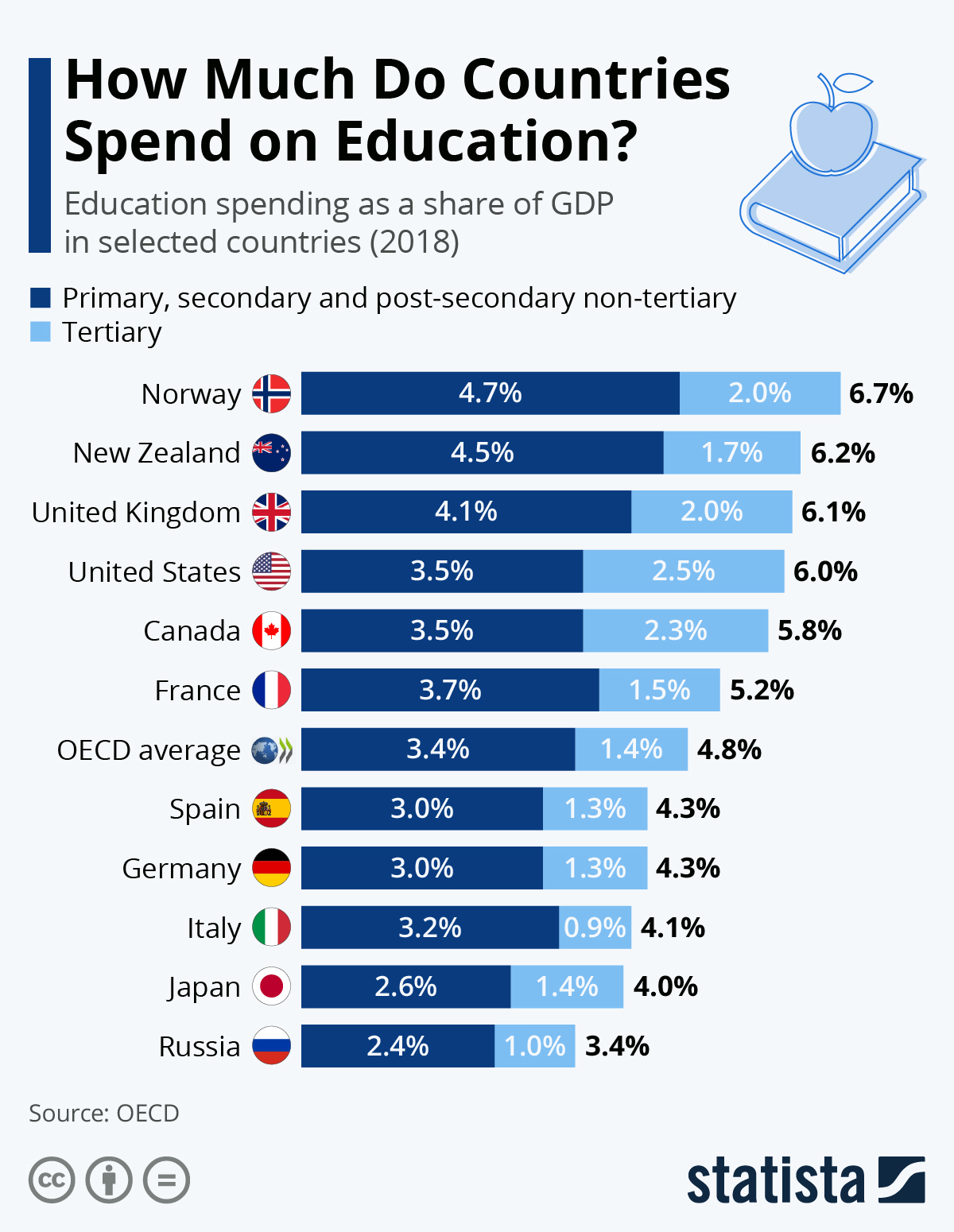
This is false. State and federal funding makes up the discrepancy between more well funded and less well funded school districts in nearly every state. There is obviously differences between states, but states have vastly different costs of living. But even then: Mississippi spends as much on education as France. Overall, the US spends more not just in dollar terms, but as a percentage of GDP than most big European countries: https://cdn.statcdn.com/Infographic/images/normal/15434.jpeg

Some of the worst cities have the beat funded schools. Minneapolis spends as much per student as Switzerland. Baltimore spends more, and spends as much of more than the rich suburban schools around it. The US also has relatively low rates or private K-12 compared to the Scandinavian countries, the Netherlands, Belgium, etc.

Your banks writing $10,000 on a piece of paper, followed by some saying "this basic service costs $10,000" has no relation to value transactions in real countries.
Agreed. I can’t reply to the child comment, but school infrastructure is usually funded with bonds (at least around here).