Hacker News new | ask | show | jobs
by IAmEveryone 2213 days ago
People have been voting by mail for decades, in the US and many other democracies. There haven't been any incidents. And, yes, I am convinced wide-scale fraud would be almost impossible to hide: you can't pull off any fraud without, for example, many voters turning up at polling places even though they have been mailed a ballot. Or people noticing the voter rolls show them having voted when they didn't. Or whatever scheme you are using to intercept thousands of individual letters addressed to individual residences being noticed. Or sudden, unexplained changes in participation being noticed. Or many dead people somehow voting because you can't possibly stay up-to-date with all recent deaths in the community.

And, of course, the discussion isn't actually about voting-by-mail, yes-or-now? Because that has been possible for a long time and isn't going to change. The discussion is about making it easier and/or the default to protect people from communicable diseases.

The issue, then, isn't even if voting by mail allows fraud. It's if the likelihood of fraud is significantly higher when, say, 50% instead of 30% choose that option.

This is yet another blatantly obvious attempt to stack the deck in Republican's favour. It's sickening to see people pretend to care about the integrity of democracy by engaging with all these phantom debates about voter fraud, in the complete absence of any actual fraud happening (except that Republican in South Caroline, of course).

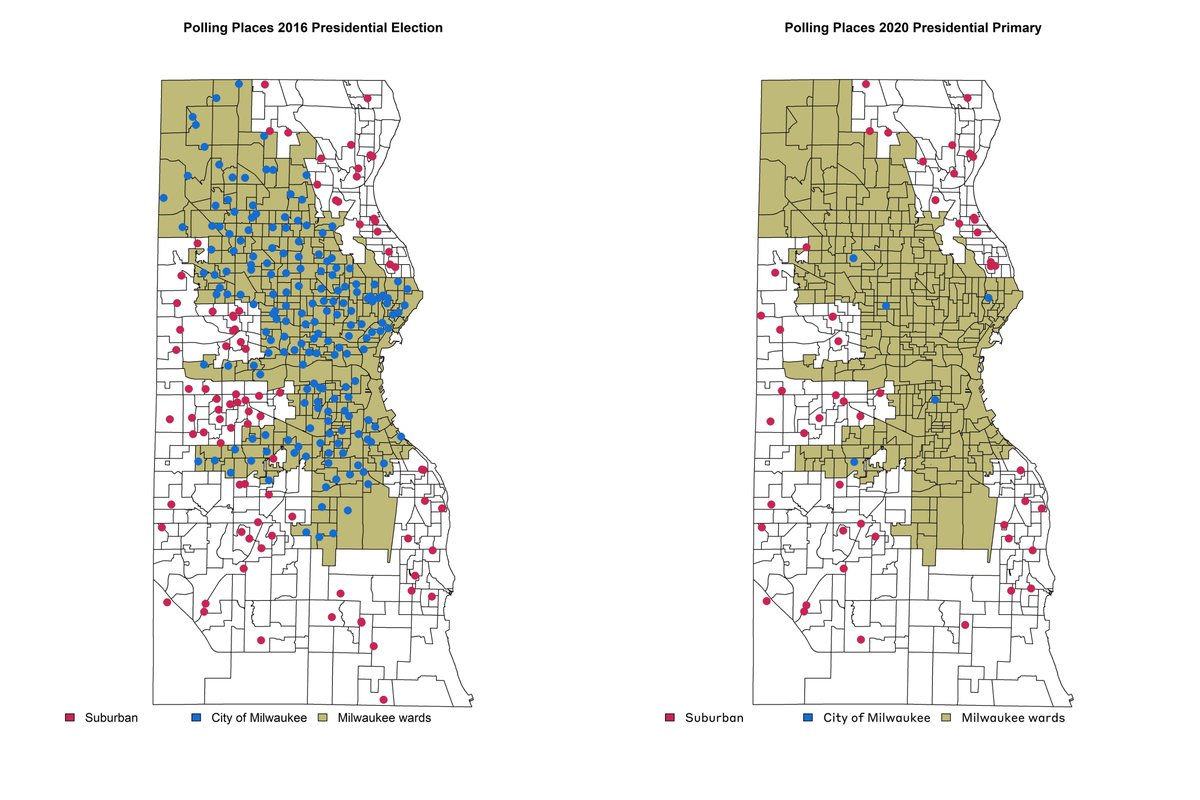
Meanwhile, real damage is done to democracy by the unrelenting attempts to selectively make it harder for people to vote. Take a look at these changes in polling locations in Milwaukee for a blatant example (the red, suburban spots are predominantly Republican locations, while the urban core leans democratic) : https://pbs.twimg.com/media/EYoIrdZXQAILKlB.jpg

2 comments

>>in the complete absence of any actual fraud happening

Which of these examples of election fraud are...not examples of voter fraud?

https://www.heritage.org/election-integrity/commentary/datab...

So 0.000001% of votes were fraudulent if you take the Heritage Foundation's analysis as fact (1,285 votes fraudulent out of 119,000,000 who voted in 2016).

Does 0.000001% fraud qualify as a problem in any reasonable sense?

Republicans' electoral strategy is basically "the less people vote, the better". Is that good for democracy? Is that just?

>>>f you take the Heritage Foundation's analysis as fact (1,285 votes fraudulent out of 119,000,000 who voted in 2016)

That's not how I interpreted the data. Not 1 incident = 1 vote, but 1 incident = 1 criminal case affecting 1 election. So election fraud at Timbuktu County could have impacted 2 voters, or 500 voters, but either way is recorded as 1 incident. I'm not seeing a link to their actual database so we can't dig into the records to confirm either way, which is disappointing. But the narrative text seems to support this.

>Not 1 incident = 1 vote, but 1 incident = 1 criminal case affecting 1 election.

This doesn't reason out.

The question is "What impact does voter/election fraud have on elections?"

You determine this by calculating the impact that these fraudulent votes had on the election. It doesn't make sense to say "because there was 1 fraudulent vote in one county in one state, we have to count all 500-100,000 (?) votes in that county as fraudulent too."

This Heritage Foundation report is literally an analysis detailing how voter fraud is a non-issue in American elections.

I found their webpage for their database! It's not 1 database record = 1 voter, they are listing cases of election abusers, often multiple criminal defendants in a single record, with multiple felonies and multiple votes per record.

https://www.heritage.org/voterfraud

Here's one entry for the state of Pennsylvania: "According to Wild Acres Property Manager Robert Depaolis, Cowher approached him and asked him to provide Cowher with ballots that were due to be mailed to property owners in the community who seldom voted, for the express purpose of filling out those ballots and guaranteeing victory for Cowher's preferred Board of Directors candidates. Depaolis went to the state police, who surveilled a meeting where Depaolis handed over the ballots, catching Cowher in the act of filling out the mail-in ballots. He was arrested and subsequently convicted on 217 counts, including forgery, identity theft, and criminal conspiracy. His accomplice, Kupershmidt, was found guilty on 190 counts."

Wait a minute. That 1,285 total includes every case they could find since 1979? LOL

This proves the point even more in the extreme that voter fraud is a non-issue. An extremely motivated source like the Heritage Foundation was able to find 1,285 instances over 41 years? About how many billions of votes cast in that time period are we talking about?

Maybe my 0.000001% voter fraud estimate was too generous. It's looking more like 0.000000000001%.

Edit: Did you even click through more than one of these? The first 20 that appear for my state show that no votes were actually cast fraudulently, meaning some portion of that 1,285 instances accounts for zero fraudulent votes. This gets more hilarious the deeper we go.

>Donald Dewsnup, a housing development activist in San Francisco, registered to vote using a false address.

>State Sen. Roderick Wright (D_Inglewood) was convicted of eight felony counts of perjury and voter fraud. He deliberately misled voters as to his residency in order to run for office in a neighboring district.

>Immigrant-Rights activist Nativo Lopez pleaded guilty to one count of voter registration fraud when it was discovered that he registered to vote in Los Angeles while living in Santa Ana.

>Jose Fragozo, a trustee on the Escondido Union School District Board, pleaded guilty to a felony charge that he voted in the 2014 general election while registered at an address where he did not live.

>Alexander Bronson, former Trustee for Manteca Unified School District, California, pleaded guilty to charges of voter fraud. He listed a false address in order to qualify for candidacy in the November 2014 Manteca Unified School District Board of Education election.

etc.

> https://pbs.twimg.com/media/EYoIrdZXQAILKlB.jpg*

Am I misunderstanding something? Are you saying they completely closed down all those polling stations? It seems like the less populated areas have more* polling stations than denser ones, what is the justification for this?