Giving you the benefit of the doubt, and assuming this isn't just pedantry, especially since you're getting downvotes (because I assume everyone thinks this is just pedantic correction) I looked it up.
In the context of "trying to do research on coronaviruses" your comment appears to be not only correct but an important distinction, rather than the pedantry it appears to be.
From Wikipedia: "...more lethal varieties [of coronaviruses] can cause SARS, MERS, and COVID-19."
And...
"Severe acute respiratory syndrome coronavirus 2 [SARS-CoV-2] is the strain of coronavirus..."
Which can be further abbreviated as C19. I have seen this in personal chats and wonder how long it will be before it gets into newspaper headlines where space is at a premium in print editions.
I know you are relaying the public information accurately, but I wish authorities pushed better names. Like calling the virus "the virus that we know has a corona and causes these symptoms" and the disease "the disease caused by this virus that has a corona and that causes these symptoms" is circular. Also, it is not true that it is entirely a respiratory syndrome. There are serious non-respiratory symptoms, extent of which we are to discover. Finally, if it is a syndrome causing virus, by definition we wouldn't have the crisp boundaries of a disease around it, which indeed we don't.
If these were names for services and classes that came in a code review, how many would really approve?
[retracted] and I hope this is just a misunderstanding. As the director of the World Health Organization (WHO) said, 2019-nCoV is a novel (new) coronavirus.[0] The CDC defines coronavirus as a virus that was not previously known — check the FAQ, “what is a novel coronavirus?”[0.5]
They changed the name of this coronavirus to reflect the disease more accurately to COVID-19.[1]
The CDC has a list of other coronavirus’ that have existed.[2]
Edit: Since there seems to be a misunderstanding from everybody’s part on this as it’s referred to as both and often interchangeably in a mainstream setting, take a look at John Hopkins guide: https://www.hopkinsguides.com/hopkins/view/Johns_Hopkins_ABX...
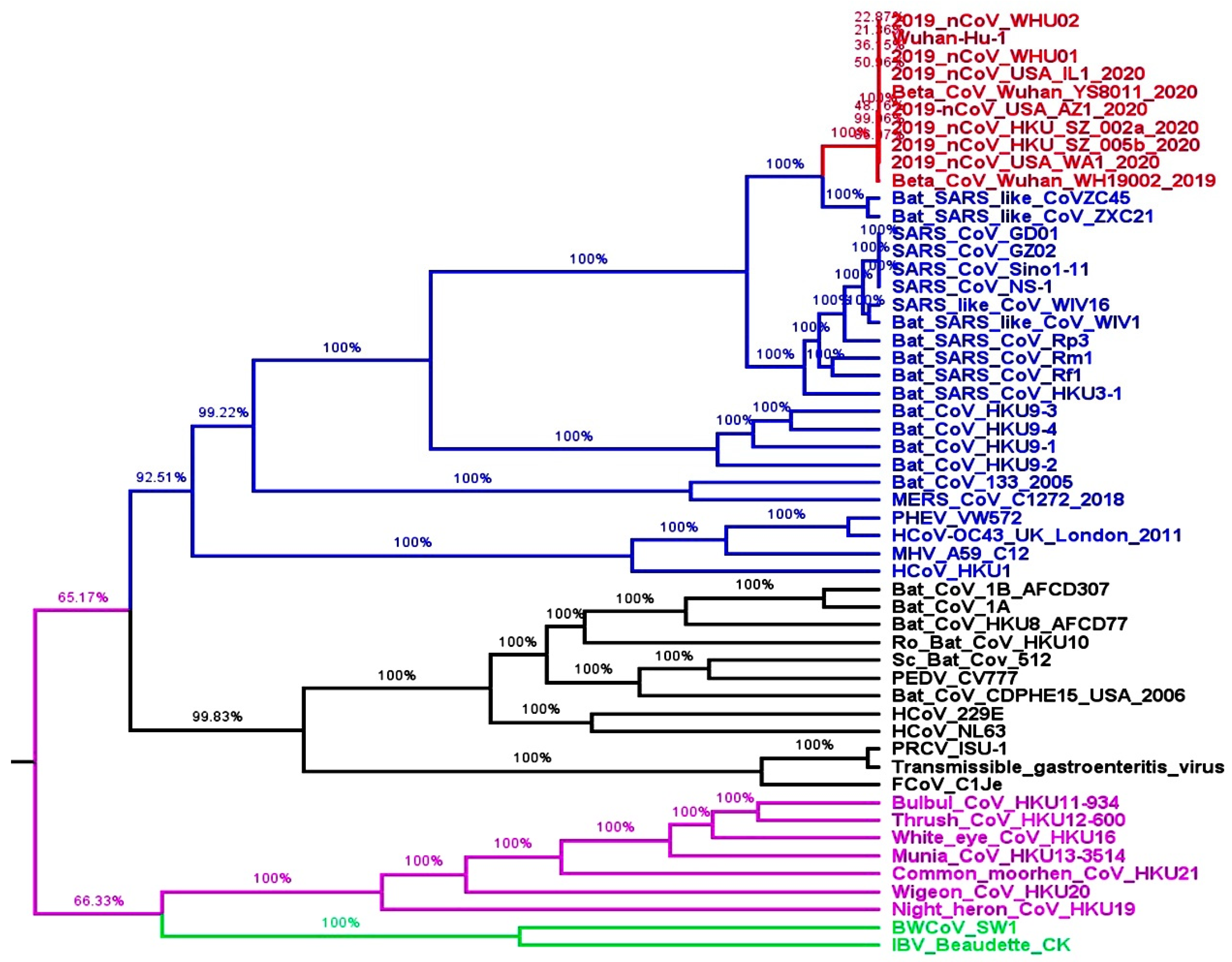
Excuse the incivility, but no. SARS-CoV-2 is not a strain or type of SARS-CoV. The viruses share ancestors, but SARS-CoV-2 did not come directly from SARS-CoV. SARS-CoV and SARS-CoV-2 are in the category of beta coronaviruses[0].
"The whole genome-based phylogenetic analysis presented that two Bat SARS-like CoVs (ZXC21 and ZC45) were the closest relatives of SARS-CoV-2."[1]
While we're on the topic of linguistic pedantary, strain isn't exclusive to direct mutations from a parent genome. Strains, like much of biological taxonomy, are a human abstraction to make communication of the idea of -- in this case -- "a virus sharing similar properties to coronaviruses that cause severe acute respiratory syndrome" -- albeit this is a very simplified definition for the sake of brevity.
SARS is caused by SARS-CoV-1 and COVID-19 is caused by SARS-CoV-2.
Rather, if we would like to be absolutely correct about these classifications, we would say SARS-CoV-1 and SARS-CoV-2 are both strains of SARSr-CoV (Severe accute respiratory syndrome related coronavirus), which in itself is a species, an abstract concept used to group related organisms into a convenient umbrella term.
There is no "eukaryote" organism the same way there is no "SARSr-CoV" organism. The added "r" was a recent addition when COVID-19 was discovered.
I will cede that I didn't specify this last point, and you were correct to point it out.
In the context of "trying to do research on coronaviruses" your comment appears to be not only correct but an important distinction, rather than the pedantry it appears to be.
From Wikipedia: "...more lethal varieties [of coronaviruses] can cause SARS, MERS, and COVID-19."
And...
"Severe acute respiratory syndrome coronavirus 2 [SARS-CoV-2] is the strain of coronavirus..."
I learned something today!