Hacker News new | ask | show | jobs
by ergothus 2232 days ago
1) I'd argue that you arent paying much attention to those other industries. I certainly see issue commonly raised in a few you mention that are in my circles. Things that still make me double-take.

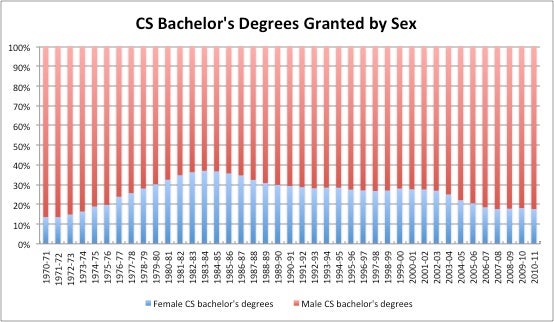
2) tech is just the latest in a series. Comp sci degree enrollment for women DROPPED for recent decades - that's not a biological lack of interest. This has occurred in many professions - when the profession becomes high profile, the women are driven out.

3) you are proving the problem in the original memo. Instead of looking into any of the research on the topic, you are repeating what feels true. You speak with such confidence on the different interests of different genders, without considering how you know what the actual interests might be. (You're assuming what you see must be the result of interests, and use that to prove a difference of interests is the cause. That's a tautology) You assert that "no one seems to have a problem" with imbalances in other professions, when it is trivial to find people definitely have problems.

1 comments

What other professions? What series? Computer science degrees and jobs are seeing a rise in women, but they're already the majority in biological sciences and other disciplines. Would you claim men are conditioned to not going into those fields?

The research on the topic covers what I state about different countries and societies showing how different interests affect professions. Here are some links:

https://stanmed.stanford.edu/2017spring/how-mens-and-womens-...

https://www.thejournal.ie/gender-equality-countries-stem-gir...

https://www.researchgate.net/publication/38061313_Men_and_Th...

https://www.nber.org/papers/w22173

Nah, in the late 50s and until the 90s, there was around 25% on women in computer science in the US, and close to 50% in some countries like France an UK (i think a book was written on why in 2017).

I've talked to Pr. Emeritus Mallard a lot three year ago, who was a biology researcher studying genotype and phenotype in animal/vegetal populations (for context, he got his degree around the time we discovered ADN). From what he remember, there was a lot more than 50% women when he started, at least as "programmers", although they were barely viewed as clever seamstress at the time.

Each time he wanted to do a computer-assisted statistical study in the early days, the programmer was a woman (again, from what he remembers) and he always thought the field was dominated by them, at least for grunts work.

There was a time when it was "systems analysts" who gathered requirements and made decisions and wrote flowcharts, and "programmer" was a glorified data entry position translating a flowchart into assembly/FORTRAN/COBOL on punch cards that the system could run. As computers became more powerful, "programmer/analysts" began writing their own source code in "higher-level" compiled languages (this meant reentrant functions and loops and "if" blocks rather than globals and computed "goto") as the full-time "programmer" job became obsolete with automation.
That's a red herring, and also the 60s - I started my career in the late 70s, 1/3 of my CS class was female, my first job in the US (as a kernel hack) was almost 50% female, still some of the best engineers I've ever worked with, all doing the same job I was.

I don't know what happened, by the time my daughter was doing CS the number of woman was < 10% and she and her compatriots were literally hounded out of the course by the bro-culture - personally I blame gamer culture, there's something terribly dysfunctional with kids these days

> kids these days

Computer science predates gaming, particularly online gaming with a social component, by a lot. You're committing the "all things with 4 legs are elephants" fallacy.

Reread their comment - they are pointing out that CS classes had a DROP in women attending them, and that decline does line up with the rise of computer gaming. They weren't saying women have never had an interest as a result of gaming, but rather as gaming rose there is a corresponding decline. Hardly proof, but as the poster above was stating their personal opinion, they aren't wrong (and they aren't alone in that belief - I've seen it many places).

Here's once quote: "Starting when computer technology first emerged during World War II and continuing into the 1960s, women made up most of the computing workforce. By 1970, however, women only accounted for 13.6% of bachelor's in computer science graduates. In 1984 that number rose to 37%, but it has since declined to 18% -- around the same time personal computers started showing up in homes. According to NPR, personal computers were marketed almost exclusively to men and families were more likely to buy computers for boys than girls." ( from https://www.computerscience.org/resources/women-in-computer-... )

Here's a graph of the data: https://images.techhive.com/images/idge/imported/article/ctw.... ( found via https://www.computerworld.com/article/2474991/women-computer... )

Those are only talking about successful degrees, there are plenty of more datapoints to look at when you consider entry vs completion, and similar stats from post-graduation careers. This doesn't prove causality, but their statement stands as viable.

> personally I blame gamer culture, there's something terribly dysfunctional with kids these days

Could you elaborate? - interested in hearing more about this.

So women have a biological interest in the technical part of transforming flowcharts into code, but not in the social parts of software development, like gathering requirements?
I think it's more that they were hired on as typists and secretaries, basically the only office professions that women could have at that time.
This is rather demeaning considering it's objectively false and downplaying the huge influence women had on early software development.

If you're going to claim that women were only hired as secretaries for software dev work I hope you have actual data behind your assertion.

I have no idea whether they weren't interested or weren't accepted.