Hacker News new | ask | show | jobs
by shlant 2243 days ago
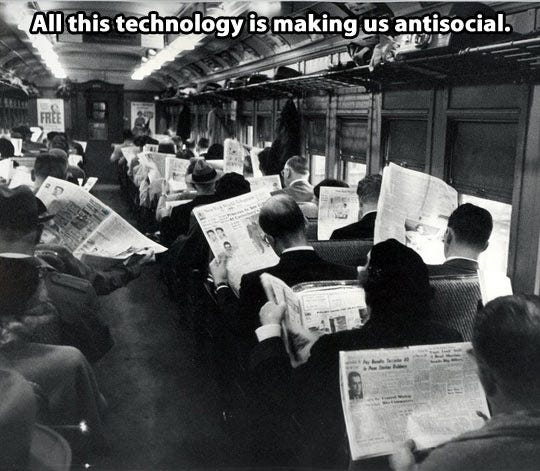
> I don't remember my parents having this problem with their newspaper. They did look at the newspaper before the sky every morning.

This seems to be a pretty common comparison, especially as a reply to older generations remarking on everyone always being on their phones. Kind of a meme at this point[1][2].

It really makes me think that not a lot of thought/concern is given to the major difference between print media and modern technology/social media: print media is a one-way relationship. There is no interaction between the reader and the newspaper - it's a passive information source.

Social media on the other hand is a two-way, highly interactive, highly curated information source/communication tool and that is where the comparison falls flat on it's face. To compare the two in the context of mental health/anti-social behavior/distraction etc. is missing the point.

And for anyone interested in some research on the subjects of technology and social media as it related to kids, I will always plug the non-profit I work for:

https://www.commonsensemedia.org/research

1. https://memeworld.funnyjunk.com/pictures/Kids+these+days+alw...

2. https://miro.medium.com/max/1080/1*U36hBj8i-C7JJJxS4MP2HQ.jp...

5 comments

Especially considering, that the printed old-fashioned Newspaper (at least if you select the right one!!!) has a professional writers and a more calm perspective on the world than social media and everything what we consume as media nowadays.
Historically old-fashioned newspapers haven't had a calm perspective. Their headlines were the original clickbait.

https://en.wikipedia.org/wiki/Yellow_journalism

In a number of countries, yellow journalism was a feature of the evening newspapers, not the morning ones which represented more reasoned, respectable journalism. So, people at least didn’t start their day with yellow journalism.
I should replace calm with slowier.
the bar has certainly been lowered about as far as it can be in terms of who can share their ideas/beliefs. It's a double-edged sword of previously unheard of freedom of speech and an unending supply of lies/bullshit/deception/ignorance. It makes cultivating a strong level of discernment one of the most necessary skills for surviving (sometimes literally) in todays world.
Yet the national inquirer, the daily star etc. Have been purchasable in front of nearly every checkout stand for at least my entire life. Lies/bullshit/deception and ignorance are nothing new.
It’s just packaged differently. Instead of easily knowing it’s trash, it’s someone you trust on Facebook spouting crazy. I think that’s what gets people the most.
> Lies/bullshit/deception and ignorance are nothing new

You are definitely right there, but my point was the barrier for entry has been lowered. No need to have a printing press and to be accepted for sale at storefronts - if you have an internet connection, you have a voice.

You're not wrong, but it seems to me the "addiction problem" of social media is not so much about the interactivity, but has more to do with the near infinite supply of entertainment.
I was about to say much the same. I deleted my Twitter accounts years ago now, but I still find myself reading the tweets of Charlie Stross, amongst others, multiple times per day.

I have no mouth, yet I must stream.

it's a complicated issue and you're right that the the unending source of dopamine hits from entertainment would certainly play a role - although that's not really unique to social media. I personally think that a bigger factor may be the instant gratification and validation that comes from followers/likes/comments/whatever. I think young kids especially (but certainly not exclusively) crave validation from their peers and social media is a perfect place to turn to for that.
> It really makes me think that not a lot of thought/concern is given to the major difference between print media and modern technology/social media: print media is a one-way relationship. There is no interaction between the reader and the newspaper - it's a passive information source.

Yeah, newspapers don't scream at you.

> There is no interaction between the reader and the newspaper - it's a passive information source.

On the other hand, people are using smartphones primarily to talk to other people. With IMs, not voice calls, but they talk with each other nonetheless. That's about as opposite of antisocial as you can have.

> On the other hand, people are using smartphones primarily to talk to other people.

I don't believe that's true. I thinnk most smartphone time for most users is spent passively consuming broadcast social media: scrolling through Instagram photos and Facebook posts.

This is a great point; I've noticed the lack of regard for the qualitative difference between print media and social media for a while now - whenever somebody will raise a point about social media, it is almost immediately pointed out in a reply that before social media there was print media, as if the difference between them is abolished by the mere comparison. XKCD has unfortunately done this too[0]. There are several differences between new media and old media which have very real effects:

* The quantity

* Ease of access to more marginal opinions

* "Dark patterns" such as infinite scrolling

* Internet "debates" traded in 140 or 280-character blows, to be endlessly liked and retweeted

* Anybody, anywhere can make a good-sounding point which is still logically flawed

* Centralization, not of opinions but of specific publishing platforms that have the final say in the control of content, despite being practically public spaces[1]

[0] https://xkcd.com/1601/

[1] While it's true that newspapers and publishers had a lot of control over public opinion, Twitter has more control over public opinion than any newspaper in history.