Hacker News new | ask | show | jobs
by leggomylibro 2266 days ago
It's incredible how far we've fallen; the border exception is particularly terrible.

I was once driving along I-10, which is an 8-lane / 80mph interstate. CBP had blockaded the entire road, and were pulling every single car and truck off to be questioned and searched.

My truck had a canopy with heavily-tinted windows that could have easily fit a few people, but I don't "look foreign", so they waved me through without even glancing at my ID or vehicle. From the people who had been pulled off, it looked like their job was to hassle people with brown skin.

I can't fathom how it isn't a violation of the Constitution to (ostensibly) search every individual driving along a major highway. What ever happened to 'probabale cause'? Is living in the US considered evidence of committing a crime in the US nowadays?

2 comments

"I can't fathom how it isn't a violation of the Constitution to (ostensibly) search every individual driving along a major highway. What ever happened to 'probabale cause'?"

How can someone possibly not 'fathom' a scenario?

There's someone shooting at people/cops, car chase, prison break out, or some kind of major violent criminal moving down the highway - they may roughly what he looks like, i.e. race and gender, hence, people who fit this profile get flagged, those that don't move on.

How hard is that to imagine?

Surely it's pretty rare, but surely such situations happen.

I've literally never seen anything like that in my entire life so it's probably not like the police are likely to be acting outrageously disproportionately. But I don't know, maybe you can look it up. But it's certainly easy to see scenarios in which many might want this to be public policy given certain scenarios.

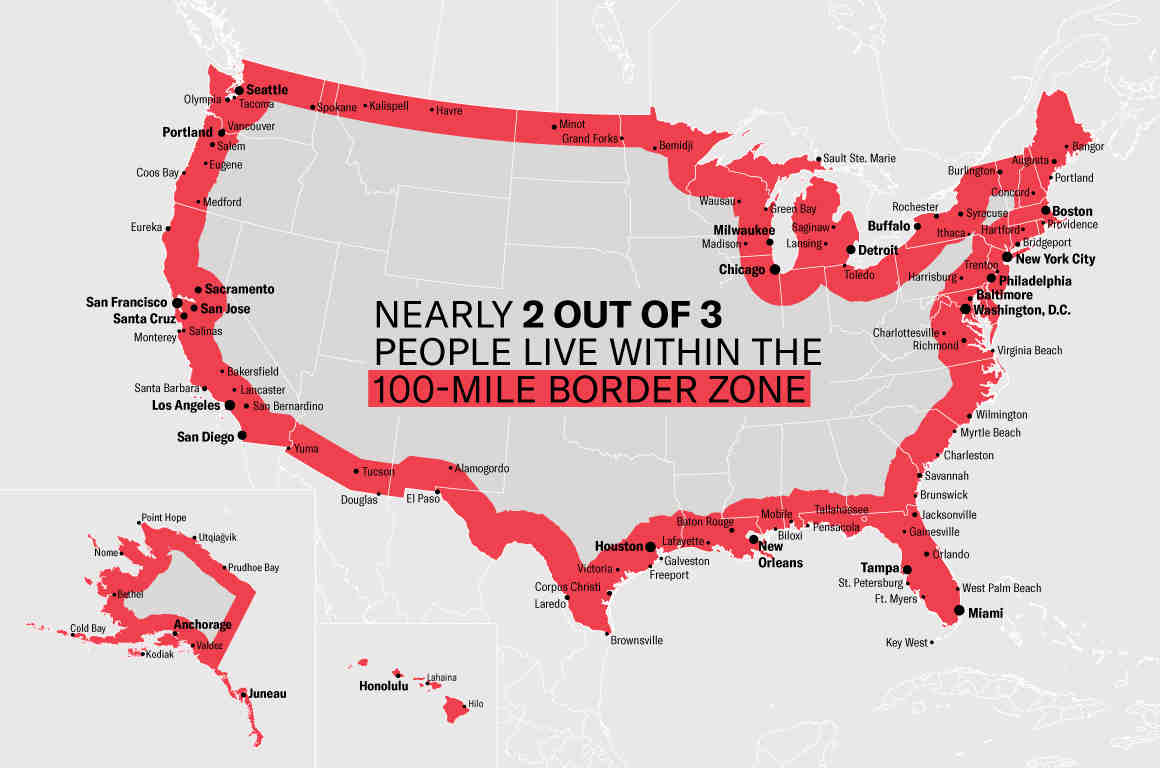
Within 100 mi of a border it doesn’t apply
I don't live near a border, I had never heard of this before, and I found a nice description on the ACLU website.

https://www.aclu.org/know-your-rights/border-zone/

It appears the 4th amendment certainly still applies in the 100 mile zone, and if it did not that would be insane. According to that page, 2/3 of the population lives inside the 100 mile zone.

The CBP officers do apparently have more leeway as far as detaining a person roadside (see 'reasonable suspicion'), or boarding a bus/ train and the like, but probable cause is still required to search a vehicle, or arrest a suspect.

"An immigration officer also cannot search you or your belongings without either “probable cause” or your consent. If an agent asks you if they can search your belongings, you have the right to say no."

In the past, I have successfully denied an officers request to search my vehicle at a routine traffic stop. He backed off immediately. It is easier said than done, being stopped by law enforcement is always stressful. But simply saying in a polite manner, 'No, sir. I prefer you didn't search the vehicle', is one of our greatest tools the 4th amendments provides us.

Officers WILL ask and try to gain consent if at all possible. I suspect that most of the vehicles the other commenter saw being searched by the roaming patrol, either did not know they could say no, or did not have the nerve to say no in a tense stressful situation.

I know that's what the courts say, I just think it's insane and indefensible. And that erodes my trust in our judicial system and my respect for our institutions.

Or it would, if I had any left. If the law doesn't apply equally to everyone, it's not a legal system so much as a way to selectively keep people down.

https://wp.api.aclu.org/wp-content/uploads/2019/03/100mile.p...

Nice constitutional rights you got there, it would be a shame if they didn't apply to two thirds of citizens.

Funny how the document itself doesn't provide for that limitation explicitly.